
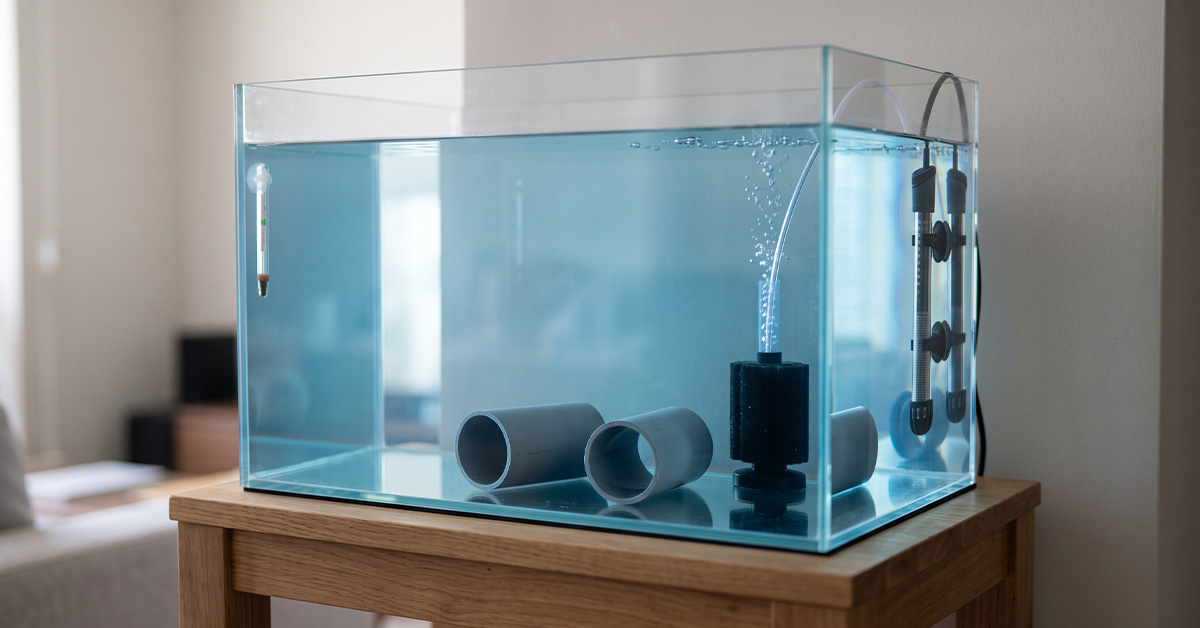

A quarantine aquarium is a second aquarium where you watch a newly bought fish on its own for several weeks before it joins your main aquarium, and it shares neither water nor equipment with the main system. The signs of the external parasites common in saltwater fish may not be visible on the day you buy the fish. Quarantine makes those signs appear in a small, bare aquarium where treatment is easier, instead of in your main aquarium with dozens of animals in it. In this guide we explain what a quarantine aquarium should look like, how to set it up, and why the commonly recommended 2-3 weeks is not long enough.
Why Do You Need a Quarantine Aquarium?
Even a fish that looks spotless at your aquarium store can be carrying the free-living stage of a parasite. Yanong (2010a) states that the white spot parasite (Cryptocaryon irritans) feeds in the fish’s skin for 3-7 days, then leaves the fish and forms a cyst. In the measurements the same source cites, the infective cells emerged from most cysts after 4-8 days, but from some only after up to 72 days. Seeing no spots on your fish today does not mean the parasite has not entered the aquarium.
Once an outbreak starts in the main aquarium, your options narrow. Yanong (2010b) states that carbonate substrates such as coral sand and dolomite bind copper and lower the free copper in the water, and that most invertebrates do not survive copper treatment. You cannot use copper in an aquarium with corals, sand and rock; you end up moving the fish to a separate aquarium anyway. A quarantine aquarium lets you do that before an outbreak, with a single fish.
Cleaner fish are no exception. No study shows that a cleaner such as the Neon Goby stops a white spot outbreak in an aquarium; stopping an outbreak takes white spot diagnosis and treatment. A cleaner fish therefore goes through quarantine like any other. Coral and frag quarantine follows a different method, because copper cannot be used.
What Should a Quarantine Aquarium Look Like?
A quarantine aquarium is not a small copy of your main aquarium. It holds only the equipment the fish needs to stay healthy and that you need to see the fish clearly.
Volume: for a single small fish, 40 l (10.6 gallons) is enough; for fish over 10 cm (3.9 in), or several fish bought at once, 80-150 l (21.1-39.6 gallons) is safer. In small volumes such as 20 l (5.3 gallons), ammonia rises within hours and the temperature swings more during the day. Bioload decides how many fish you can bring in at once; we covered the calculation in how many fish can fit in an aquarium.
Substrate and rock: the bottom of a quarantine aquarium is bare glass. Sand and rock bind copper, give parasite cysts a surface to settle on and make siphoning harder. Live rock stays out of quarantine too, because rock that has been in contact with copper cannot go back to the main aquarium.
Filter: a sponge filter or a hang-on-back filter is enough. What matters is the bacteria inside the filter. A sponge kept for a few weeks in the sump or filter chamber of your main aquarium moves to quarantine as a mature biological filter.
Heater and thermometer: Yanong (2010a) recommends running quarantine at 24-27 °C (75.2-80.6 °F). An adjustable heater and a thermometer placed at the opposite end of the aquarium are enough to hold that range.
Hiding places and lid: in a bare aquarium a fish looks for a place to hide. A few pieces of grey PVC pipe do the job, are easy to clean and do not absorb copper. For a fish such as the Citron Goby, which shelters among coral branches in the wild, a pipe stands in for the branch during quarantine. Startled fish jump, so a tight-fitting lid belongs on your list as well.
Separate equipment: the quarantine aquarium has its own fish net, siphon hose and bucket. A net used in the main aquarium that goes into quarantine and back means the two aquariums have shared the same water. The volumes in this section and keeping the sponge in the main aquarium come from established aquarium practice rather than research.
Step by Step Quarantine Aquarium Setup
The logic is the same as a saltwater aquarium setup, but the sequence is much shorter. Put the filter sponge in the sump or filter chamber of your main aquarium at least 2-4 weeks before you buy the fish. As the purchase day approaches, fill the quarantine aquarium with freshly mixed saltwater and match its salinity and temperature to your main aquarium.
It is worth writing down how many litres of water you put in while filling. When medication is needed, you dose by that number, and an estimated volume means an overdose or an underdose with a medication that works in a narrow range, such as copper. After fitting the sponge to the filter, wait a day and test ammonia and nitrite. If both read zero, the aquarium is ready for the fish.
If you have no mature sponge, the quarantine aquarium has to complete the nitrogen cycle from scratch, and that takes several weeks. If you keep a fish in an uncycled aquarium, you test ammonia every day and change water on the day it rises. It can be done, but it makes the quarantine period far more tiring for the fish and for you. Preparing the sponge in advance therefore comes from established aquarium practice rather than research.
Why Is the Quarantine Period at Least 30 Days, Not 2-3 Weeks?
Hobby sources circulate 15 days, 2-3 weeks and 4-6 weeks for fish quarantine all at once. The answer to that spread lies in the parasite’s timetable. Hadfield and Clayton (2011) sent a survey to 60 public aquariums and zoos, mostly in North America. They state that 95% of the 42 responding institutions had a minimum quarantine period of 30 days or longer. In the same survey, 64% of institutions ran quarantine in a partly or fully separate area, and 25% with staff who looked after quarantine only.
Yanong (2010a) recommends running quarantine at 24-27 °C (75.2-80.6 °F) for at least 3-6 weeks, notes that 7-11 weeks may be needed, and mentions a 30-90 day quarantine for new fish. The reason is that the infective cells of the white spot parasite can be delayed for up to 72 days and that their development depends on temperature. According to the same source, one strain of the parasite stayed dormant for 4-5 months in water at 12 °C (53.6 °F), then developed and infected fish once the water was warmed to 27 °C (80.6 °F). A cold quarantine aquarium delays the parasite, and when the period ends you carry the sign into your main aquarium.
Our recommendation is at least 30 days, with the count starting on the day the fish’s last sign disappears. If you see a white spot on day 20 of quarantine, you start treatment; once treatment ends and the sign is gone, you start counting 30 days again. Starting the count from the last sign comes from established aquarium practice rather than research. The schedule below outlines a quarantine that passes without any signs.
| Period | What you do |
|---|---|
| 2-4 weeks before purchase | Put the sponge in the main aquarium’s sump |
| Purchase day | Fill the aquarium, test ammonia and nitrite, bring in the fish |
| Week 1 | Watch feeding response, breathing and skin daily, test ammonia and nitrite |
| Weeks 2-4 | Testing 2-3 times a week, a weekly water change, daily observation |
| Day 30 and after | Move to the main aquarium if 30 days have passed since the last sign |
What Should You Check Every Day in Quarantine?
The first measure of daily observation is food. A fish may refuse food for the first two or three days, but if it still does not eat at the end of a week, that is a sign. Next, watch the gill movement. A fish breathing fast and shallow at rest may be carrying parasites on its gills even when nothing shows on its skin yet. White dots the size of salt grains on the body and fins are a sign of white spot, and a fine, dusty, velvety coating a sign of velvet (Amyloodinium ocellatum). Rubbing against the glass and pipes, clamped fins and cloudy eyes are noted as well.
In fish that arrive as a group, such as the Green Chromis, a sign in one individual concerns the whole group. You watch the group together in the same aquarium, treat it together and move it out together; taking one fish out of the group early means carrying a fish whose count has been reset into the main aquarium.
Test the water every day in the first week, then 2-3 times a week. When ammonia or nitrite rises above zero, change 20-25% of the water the same day. Siphoning out leftover food every day is the greatest convenience of a bare bottom. The descriptions of signs, the testing frequency and the water change ratio in this section come from established aquarium practice rather than research.
We recommend starting medication when you see a sign; you do not need to give every new fish preventive medication. Hadfield and Clayton (2011) state that the surveyed institutions often used prophylactic treatment in closed systems, with freshwater dips, copper sulfate and praziquantel for marine fish. Copper is also a burden on the fish, however, and Yanong (2010b) states that an excess causes lethargy, loss of balance and darkened colour.
Copper treatment is therefore never done without testing; the dose comes from the medication label and the litres you wrote down, and you need a test kit labelled “copper test” for the measurement. Invertebrates never go into an aquarium that has held copper either, because Yanong (2010b) states that they can return to the same water only once free copper falls to 0.01 mg/l (ppm) or below.
Moving From Quarantine to the Main Aquarium
If 30 days have passed since the last sign disappeared, the fish can move to the main aquarium. Catch it with the quarantine aquarium’s own net and release it into the main aquarium after a short acclimation. Because salinity and temperature were matched from the start, acclimation does not take long. Quarantine water never goes into the main aquarium, because it may contain medication residue or the free-living stage of a parasite.
The order of introduction matters too. Shy, burrow-bound fish such as the Yasha Goby go in earlier, and territorial fish such as the Azure Damselfish go in last. A territorial fish that arrives first treats the aquarium as its territory and attacks the fish that come after it. Quarantine helps you set that order as well; you can keep a territorial fish in quarantine for a few more weeks before it moves to the main aquarium. This order also comes from established aquarium practice rather than research.
Once the fish is out, emptying the aquarium and letting it dry is enough cleaning. Yanong (2010a) states that 24 hours of drying kills the parasite’s cyst and infective stages. If you put the sponge back in the main aquarium’s sump, your quarantine aquarium will be ready again within a few weeks for the next fish.
Five Common Quarantine Aquarium Mistakes
Cutting the period short: moving a fish to the main aquarium after two weeks because it shows no signs is the most common quarantine mistake. If the parasite’s infective cells can be delayed for up to 72 days, two weeks is more of a waiting room than a quarantine.
Pouring the bag water into the aquarium: the water from the aquarium store is the water the fish travelled in, and parasites may be in it too. Catching the fish with a net and discarding the water starts day one of quarantine clean.
Sharing equipment: when a net, a siphon hose or a bucket goes back and forth between the two aquariums, the quarantine exists only on paper. Hadfield and Clayton (2011) state that institutions stepped up system and equipment cleaning when a known parasite appeared.
Starting with an immature filter: in a quarantine started with a filter that carries no bacteria, ammonia rises within a few days. This time the fish gets sick from the water rather than the parasite, and the signs get mixed up.
Dosing copper without testing: if free copper stays below the range on the medication label, the parasite survives; if it rises above it, the fish is harmed. Copper treatment without a test kit is guesswork.
Setting up a quarantine aquarium does not take a big budget or a lot of space; a few pieces of equipment, a sponge prepared in advance and 30 days of patience are enough. We hope this guide helps you set up your first quarantine aquarium and wait out the full period.
Do you have a question or an experience to share about setting up a quarantine aquarium or moving your first fish out of quarantine? Leave it in the comments below. Someone about to set up their first quarantine will be far less tempted to cut the period short after reading how many days you waited and what you ran into.
Frequently Asked Questions (FAQ)
How big should a quarantine aquarium be?
For a single small fish, 40 l (10.6 gallons) is a good start, and for larger fish or several fish bought at once, 80-150 l (21.1-39.6 gallons). A small volume looks practical at first, but ammonia rises quickly and the temperature swings more. We recommend choosing the volume by the fish’s size and the number of fish you will bring in at once.
How many days should saltwater fish stay in quarantine?
At least 30 days, counted from the day the fish’s last sign disappears. Most public aquariums run quarantine for at least 30 days. Because the white spot parasite can take up to 72 days to reach its infective stage in some cases, a two or three week quarantine can carry the sign into the main aquarium.
Does a quarantine aquarium need to be cycled?
Yes, starting with a mature filter makes quarantine much easier. The most practical way is to put the filter sponge in your main aquarium’s sump 2-4 weeks before you buy the fish. A fish can be kept in an uncycled aquarium too, but then you need to test ammonia every day and change water on the day it rises.
Is medication required in quarantine?
No, it is not required. We recommend starting medication when you see a sign. Some public aquariums give marine fish copper, freshwater dips and praziquantel as a preventive measure, but copper is also a burden on the fish. If you use it, you need to test free copper every day and keep it within the range on the medication label.
Should shrimp and other invertebrates be quarantined too?
Yes, but not in the same aquarium as the fish. Most invertebrates do not survive copper treatment, and they can return to an aquarium that has held copper only once free copper falls to 0.01 mg/l (ppm) or below. That is why we recommend a separate quarantine container for shrimp, snails and corals.
Can a quarantine aquarium also be used for a sick fish?
Yes, and most aquarists use the same aquarium for that job. A bare-bottom quarantine aquarium is ideal for watching and, if needed, treating a fish that has fallen ill or been injured in a fight in the main aquarium. The only condition is that the aquarium is not holding another new fish in quarantine at the time.
References:
- Hadfield, C. A. & Clayton, L. A. (2011). Fish quarantine: current practices in public zoos and aquaria. Journal of Zoo and Wildlife Medicine, 42(4), 641-650.
- Yanong, R. P. E. (2010a). Cryptocaryon irritans infections (marine white spot disease) in fish. EDIS, 2010(2). FA164.
- Yanong, R. P. E. (2010b). Use of copper in marine aquaculture and aquarium systems. EDIS, 2010(2). FA165.