


Live rock is both the skeleton and the largest biological filter of your saltwater aquarium. A badly chosen batch can leave you with an algae bloom that follows you around for months, hitchhikers you never invited, and an aquascape you end up tearing down and rebuilding. In this guide we start with what live rock actually is, move on to how much of it you need, and finish with exactly what to look at in the store.
What Is Live Rock and What Does It Do?
Live rock is coral-derived calcium carbonate that storms and wave action break off the main reef structure, wash into shallow water, and leave to be colonised by nitrifying bacteria, sponges, crustaceans, coralline algae and countless microorganisms. What you are holding is not a mineral, then, but an old coral skeleton with a small ecosystem still living on it.
That structure gives you two things. The first is surface area: aerobic bacteria settle in the oxygenated outer layers of the pores and convert ammonia to nitrite, then nitrite to nitrate. The second is that anaerobic bacteria can live in the deeper pockets where oxygen struggles to reach, reducing nitrate to nitrogen gas. When both work together, the rock becomes the quiet filter of your aquarium. Its third job is visual: you build the rockscape your corals sit on and your fish hide in out of these pieces.
Do not treat everything sold under the word “rock” as the same product either. Wet rock shipped in seawater, damp rock whose bacteria are dormant, dry rock with nothing living on it, and man-made rock cast from cement and aggregate are four separate things. This guide focuses on the buying decision; we will cover the types in detail in a separate article.
How Much Rock Do You Need?
We would suggest setting aside the rule that still circulates on forums: “1 kg (2.2 lb) of rock for every 10 litres (2.6 gallons)”. That ratio dates from the Berlin method era, when nearly all filtration was handed to the rock and the protein skimmer, and refugiums, carbon dosing and controlled flow were not on the table. Today’s aquariums ask far less of their rock.
In current practice, 3-7 kg (6.6-15.4 lb) for every 100 litres (26.4 gallons) of water volume is a reasonable starting point for most reef aquariums. The old rule would put 12-24 kg (26.5-52.9 lb) in that same volume, which in most aquariums built today means a wall with no room left for your corals. When you settle on a figure, let your bioload, your skimmer’s capacity and above all the rockscape you want to build decide it.
One more thing worth factoring in: most of the corals you buy already arrive on their own base rock. Fill your aquarium to the brim and six months from now you may find yourself carrying that expensive live rock down to the sump to make space for your corals.
Weight Misleads: Measure Porosity Yourself
Rock is sold by the kilogram, but in your aquarium it occupies volume and holds bacteria in its pores. That is why 10 kg (22.0 lb) of dense rock fills roughly two thirds of the space that the same weight of porous rock would. The gap is not small: between rock manufactured at 50% void space (CaribSea, 2025) and dense rock at around 20%, the volume you get per kilogram changes by a factor of about 1.6.
There is a simple way to measure this at home. Weigh a dry piece, soak it for 24 hours, lift it out, wait until the surface water stops running off, and weigh it again. The difference in grams is the volume, in millilitres, of water that entered the rock’s open pores.
Here is a worked example. If 1000 g (2.2 lb) of dry rock comes back at 1400 g (3.1 lb), it has taken on 400 ml (13.5 fl oz) of water. Because live rock comes from coral skeleton, its principal mineral is aragonite, with a density of about 2.9 g/cm³ (181.0 lb/ft³) (Anthony et al., 2003a). In older rock that has converted to calcite over geological time the figure drops to 2.71 g/cm³ (169.2 lb/ft³) (Anthony et al., 2003b), though not by enough to upset the arithmetic.
The solid skeleton therefore occupies 1000 / 2.9 = 345 ml (11.7 fl oz), total volume comes to 745 ml (25.2 fl oz), and porosity works out at 400 / 745 = 54%.
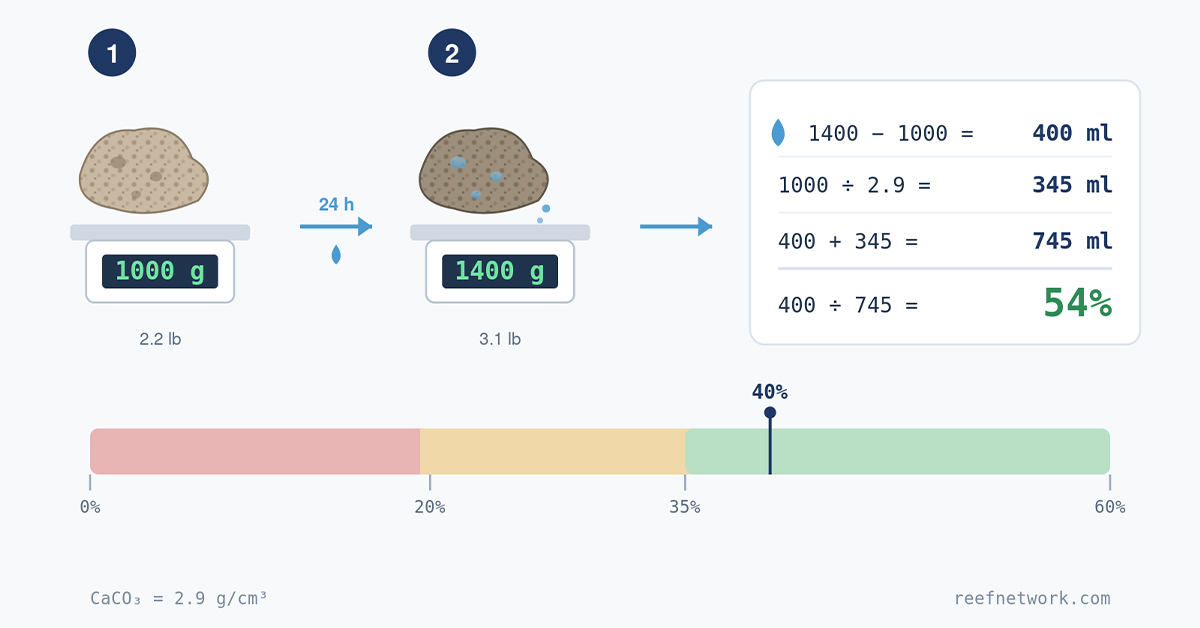
As a practical benchmark, rock that takes on more than 35% of its dry weight in water can be considered porous, while anything under 20% is dense as a paving stone and gives you far less bacterial surface. Running two candidate rocks through the same test and comparing them is a good deal more reliable than weighing them by hand at the counter.
How to Choose Live Rock in the Store
Buying rock you can see in person will almost always serve you better. Photographs and videos carry none of the true colour, weight or pore structure.
In the store you can work through it in this order. The rock should be porous and light; if it feels lighter than you expected when you pick it up, that is a good sign. Patches of pink, purple or deep red coralline algae on the surface tell you the rock has been held under suitable light and chemistry. Broad bleached areas, a film of slime and soft tissue that crumbles when you touch it point the other way: the life on that rock has died.
Then there is the smell test. Unscientific, but it works. Hold the rock up to your nose, and if you get a clean sea smell, everything is still on track. If you get rotten egg or sewage, the rock is still shedding dead tissue, and that is a bad sign.
The scientific version is to test the water the rock is sitting in. If ammonia and nitrite are measurable, the rock is not cured and must not go straight into an aquarium holding livestock. You can ask the store for those readings or take your own kit along and check yourself; we have a separate guide on choosing test kits. Buying an uncured batch is perfectly reasonable too, as long as you have the time to cure it in a separate container, and we will walk through that process in its own article.
Finally, piece size. If you are setting up a small aquarium, buying many medium and small pieces instead of a few large blocks will make your life easier when you build the rockscape. Large blocks make more sense in aquariums of 200 litres (52.8 gallons) and up.
One warning about sourcing. Fiji rock, the industry standard for many years, stopped reaching the market when Fiji suspended exports on 28 December 2017 (FBC News, 2018). Coral exports reopened in early 2024 (CORAL Magazine, 2024), though whether live rock is being supplied consistently is still not clear. Guides that tell you to buy Fiji rock are therefore repeating advice you may struggle to act on. If you come across such a recommendation, it pays to check when it was written and to ask the seller where the rock actually comes from.
Live Rock or Dry Rock?
This is the decisive question in rock selection, and the answer depends largely on your patience.
Live rock shortens the cycle considerably, because the bacterial colony is already established. In exchange, you cannot know exactly what you are introducing, and the price is noticeably higher. Dry rock is cheap, easy to find, and its biggest advantage is this: you can build the rockscape on a table before a drop of water goes into the aquarium. Its drawback is that it holds no bacteria.
| Approach | Expected cycle time | Hitchhiker risk |
|---|---|---|
| All live rock | 2-3 weeks | High |
| Dry rock + bottled bacteria + ammonia source | 4-8 weeks | Very low |
| Hybrid (dry rock + one live piece) | 4-6 weeks | Low |
The third row is the most common choice today: build the whole structure from dry rock, then seed it with a single live piece or a quality bottled bacteria product. It gives you design freedom and a sensible timeline at once.
Hitchhikers: What Are You Letting In?
The cost of live rock is not only the price on the label. The hitchhikers that come in with it can turn into an uninvited guest you spend years trying to evict from your aquarium.
The usual suspects are aiptasia anemones, vermetid snails, oversized bristle worms and mantis shrimp. Aiptasia multiplies fast and burns your corals. Vermetid snails do not attack coral directly, but their presence can reduce coral skeletal growth by up to 81% and survival by up to 52% (Shima et al., 2010). Most bristle worms are useful detritivores, though specimens over 15 cm (5.9 in) and fireworms are a genuine risk. The first sign of a mantis shrimp is usually a clicking sound at night.
This is why holding the rock in a separate container for a few weeks before it goes into the main aquarium is worth doing for observation as much as for ammonia. Seeing what emerges is far easier than dismantling your rockscape to hunt for it later.
Are There Other Options?
Rock collected from local waters or from land gets tried in aquariums often enough, but unless you happen to live in Fiji, very few of those attempts succeed in the long run. The usual problems are unwanted minerals leaching into your aquarium water and a pore structure too tight to host a bacterial colony.
A more dependable alternative is making your own rock. Pieces cast from calcium carbonate aggregate and cement let you build exactly the rockscape you have in mind and remove the hitchhiker risk in practice; we will cover that process step by step in a separate article.
Whichever route you take, it helps to make the rock decision early in your saltwater aquarium setup, alongside your stocking list. How much livestock you plan to keep feeds directly into how much rock you need, and what we have written about how many fish fit in an aquarium may help there.
A well-made live rock decision quietly makes the next two years of your aquarium easier. Take your time, pick the rock up, smell it, weigh it; we hope this guide makes that decision a little more comfortable to reach.
Do you have a question about choosing live rock, or an experience of your own to share? Leave it in the comments below. That way the next person reading this guide reaches what you learned by trial and error by a much shorter route, and that is exactly the gap no article ever manages to close.
Frequently Asked Questions (FAQ)
Do I have to use live rock in a saltwater aquarium?
No, it is not compulsory. You can build a healthy system with dry rock, man-made rock or biological media in the sump. What live rock gives you is speed and biodiversity: it shortens the cycle and delivers microfauna ready-made. If you are willing to give those up and wait instead, an aquarium built from dry rock arrives at the same place.
How do I tell whether live rock has been cured?
You tell by testing the water the rock is being held in. If ammonia and nitrite both read zero and nitrate has stopped climbing, the rock is cured. If you cannot test, smell gives you a clue: a clean sea smell is reassuring, while rotten egg means dead tissue is still breaking down. When you are unsure, hold that batch in a separate container.
Can I use rock I collected from the sea myself?
You can, but you will be buying blind. There is no way to predict which minerals the rock contains, which organisms it is carrying, or how either will behave in your aquarium. Collecting rock and livestock in protected areas can also create legal trouble. Sourcing from a controlled supplier causes far less grief in the long run.
Can ceramic and man-made rock replace live rock?
Largely yes, and the deciding factor is pore volume rather than material. Man-made rock manufactured at around 50% void space (CaribSea, 2025) offers a strong bacterial surface, while dense, heavy castings that look much the same do far less work. Before you buy, checking the product’s void ratio or running the piece in your hand through the water absorption test should be enough.
Will my rock dissolve away over time?
No, do not expect that outcome in your main aquarium. Calcium carbonate dissolution depends on the water’s aragonite saturation rather than a single pH threshold, and at normal reef values the water is saturated with respect to aragonite (SOEST, n.d.). The place where you take pH down to 6.2-6.5 is your calcium reactor, where aragonite media is dissolved deliberately with CO2 (Seachem, n.d.). Slow dissolution does occur in micro-zones within the pores, but you will see no visible loss.
Can I mix live rock and dry rock?
Yes, and this is the most widely recommended route today. Build the whole structure from dry rock, place one or two pieces of live rock inside it, and the bacterial colony spreads across every surface within a few weeks. You get design freedom from the dry rock and seeding from the live piece, and the hitchhiker risk stays limited to that one piece.
References:
- Anthony, J. W., Bideaux, R. A., Bladh, K. W. & Nichols, M. C. (2003a). Aragonite. Handbook of Mineralogy, Vol. V: Borates, Carbonates, Sulfates. Mineral Data Publishing, Tucson, AZ.
- Anthony, J. W., Bideaux, R. A., Bladh, K. W. & Nichols, M. C. (2003b). Calcite. Handbook of Mineralogy, Vol. V: Borates, Carbonates, Sulfates. Mineral Data Publishing, Tucson, AZ.
- CaribSea, Inc. (2025). LifeRock. 2025 Master Catalog. Fort Pierce, FL. Manufacturer data.
- CORAL Magazine (2024). Fiji’s Coral Exports To Restart. CORAL Magazine. Reef to Rainforest Media, Shelburne, VT. Not peer reviewed. Accessed 11 August 2026.
- Fiji Broadcasting Corporation (2018). Ministry bans harvesting and exporting of coral. FBC News. Suva, Fiji. Not peer reviewed. Accessed 13 August 2026
- Seachem Laboratories (n.d.). Reef Reactor Md. Seachem Laboratories. Madison, GA. Manufacturer data. Accessed 11 August 2026.
- Shima, J. S., Osenberg, C. W. & Stier, A. C. (2010). The vermetid gastropod Dendropoma maximum reduces coral growth and survival. Biology Letters, 6(6), 815-818.
- SOEST (n.d.). Aragonite Saturation State of Seawater. School of Ocean and Earth Science and Technology, University of Hawaii. Honolulu, HI.