
Cover Photo: Rickard Zerpe, licensed under CC BY 2.0; cropped.
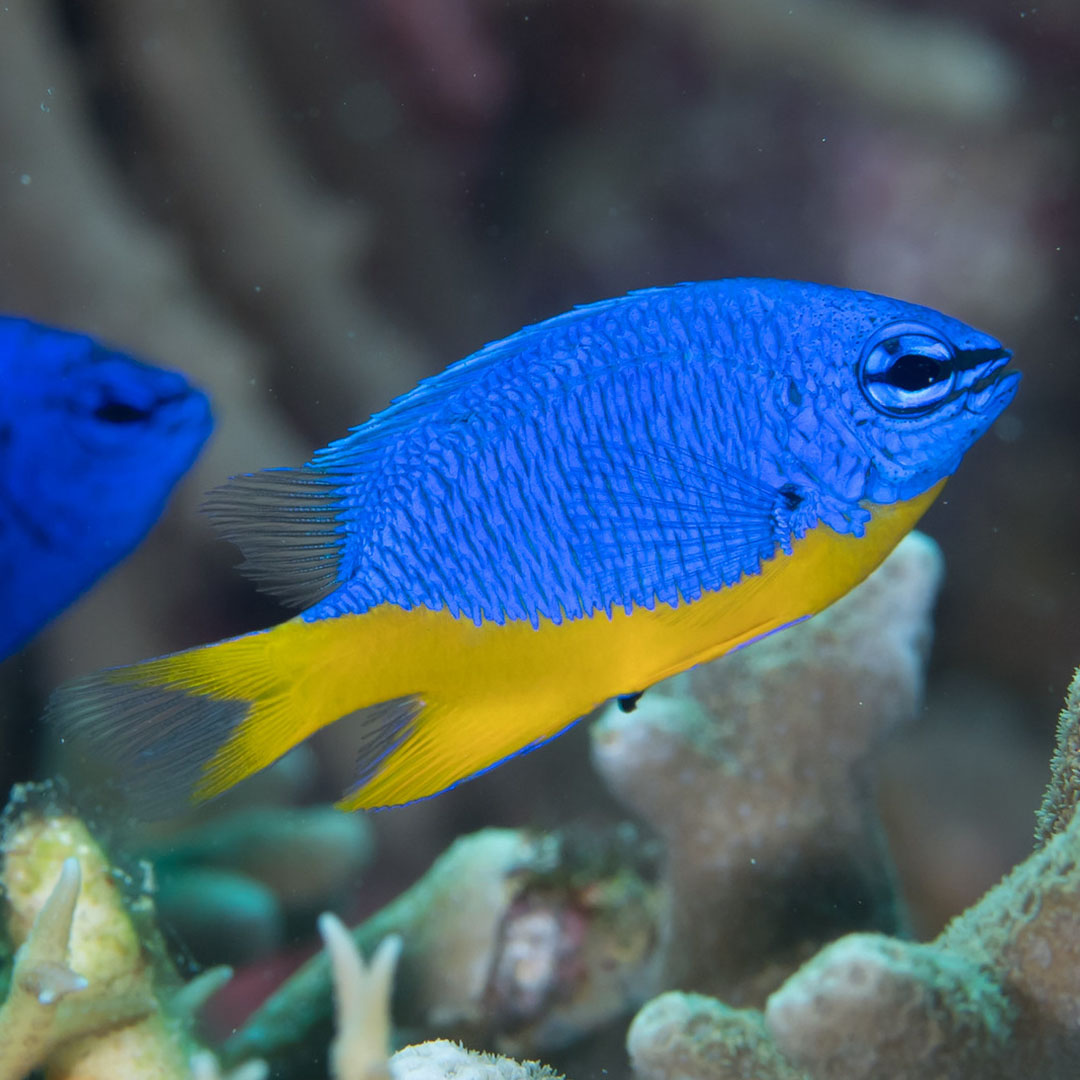
Cover Photo: Rickard Zerpe, licensed under CC BY 2.0; cropped.
The Azure Damselfish (Chrysiptera hemicyanea) needs at least 150 l (39.6 gallons) for a single fish, 24-27 °C (75.2-80.6 °F) and 1.023-1.025 specific gravity. Feed small portions of fine granules, mysis and brine shrimp two or three times a day. It is territorial and chases small, slow fish. The species is listed as Vulnerable on the IUCN Red List and its population is falling; choosing a captive-bred fish when you buy eases the pressure on the wild.
The Azure Damselfish (Chrysiptera hemicyanea) is a small reef fish whose name describes its colours. The genus name Chrysiptera comes from the Greek words for gold and fin (FishBase, 2026), and hemicyanea means half blue. Max Weber described the species in 1913 as Abudefduf hemicyaneus while publishing the fishes collected on the Siboga expedition. The WoRMS record now accepts it in the family Pomacentridae and the genus Chrysiptera (Froese & Pauly, 2026).
It is a small fish. FishBase gives its maximum total length, measured from the tip of the snout to the tip of the tail fin, as 7 cm (2.8 in) (FishBase, 2026). That is the value in the Species Info Box. Despite that size, azure damselfish care does not run like the care of a small fish, because its territorial behaviour shapes the choice of every other fish you put in the aquarium; we cover this in the Behavior and Compatibility section.
Its range is narrow. FishBase lists the species from Indonesia and the eastern Indian Ocean, on Rowley Shoals, Scott Reef and Ashmore Reef off Western Australia; Allen (2022) adds Timor-Leste in the IUCN assessment. The two sources give different figures for the depth at which it lives; FishBase reports 1-38 m (3-125 ft), while Allen (2022) reports 1-15 m (3-49 ft). Neither source explains the difference.
In the wild it lives in lagoons and on nearshore reefs, usually in small groups among branching Acropora corals (FishBase, 2026). Allen (2022) describes the species as a habitat specialist that depends on live coral. The main cause of the population decline we describe in the Conservation Status section is that dependence.
We recommend setting aside at least 150 l (39.6 gallons) for a single Azure Damselfish. The fish is small but territorial; it claims a rock cave or a coral branch and chases any fish that comes near. Volume decides how far that chasing spreads, and in a cramped aquarium the fish being chased has nowhere to go. You also need to count the total bioload together with the other fish in the aquarium. The volume and water values in this section come from established aquarium practice rather than from research.
The values you can aim for are 24-27 °C (75.2-80.6 °F) temperature, 1.023-1.025 specific gravity salinity, 8.1-8.4 pH and 8-11 dKH alkalinity. The species lives in water between 22 and 28 °C (71.6-82.4 °F) in the wild (FishBase, 2026), so it can tolerate a degree or two below and above the target range.
Keeping the values steady matters as much as the values themselves. Measuring pH and alkalinity once a week with test kits lets you see a drop before the fish reacts to it. For a fish that shelters among branching corals in the wild, the rock layout of an azure damselfish aquarium matters as much as the volume. Building several caves and rock forks it can move in and out of makes it harder for a single individual to claim the whole aquarium.
In the wild the Azure Damselfish feeds by picking plankton out of the water about 0.3-0.5 m (1-1.6 ft) above the bottom (FishBase, 2026). FishBase’s food records list benthic algae and phytoplankton alongside zooplankton. That is why the Diet field in the Species Info Box reads Carnivore; the main food is zooplankton, and the plant part is an addition to keep in mind when you choose foods.
The Azure Damselfish takes prepared food readily in the aquarium. We recommend small portions two or three times a day:
The real risk in azure damselfish feeding is not starvation but a single large portion. A plankton feeder catches food in open water; whatever it misses sinks to the bottom and returns to the water as organic load. Spreading the same total amount across the day is closer to how the fish feeds in the wild and protects your water. If there are other territorial fish in your aquarium, watching this fish actually eat at each feeding also helps.
The Azure Damselfish temperament is semi-aggressive. It chases any fish that approaches the cave or coral branch it has claimed, and that pressure falls hardest on fish that are smaller, slower and similarly coloured. Aquarists report meeting the chasing most often in fish added later to an aquarium where the species has already settled. This is why the pressure will be far lower if the azure damselfish is one of the last fish added.
Because it lives in small groups in the wild (FishBase, 2026), you can keep a single fish or a group of three or more added on the same day in the aquarium. For a group, plan on twice the volume of a single fish. Two fish is the hardest choice, because the dominant one turns all its chasing on a single target and the other has nowhere to escape. This recommendation also comes from established aquarium practice.
Adding a second damselfish species to the same aquarium escalates the territorial fighting. Keep this in mind for Allen’s Damselfish (Pomacentrus alleni) too, another blue species in the Pomacentridae; if you plan to keep the two together, adding them on the same day makes your job easier. Good neighbours are fish of similar size that can hold their own, such as clownfish, dottybacks and medium-sized wrasses.
The fish to avoid sit at two ends. At one end are slow, peaceful fish that live close to the bottom, such as gobies and small blennies; they become targets of the chasing. At the other end are predators that can swallow a 7 cm (2.8 in) fish, such as lionfish and groupers. There is no problem on the coral and invertebrate side. This plankton feeder leaves corals and shrimp alone, which is why the Reef Compatible field reads Yes, and in a reef aquarium full of branching corals you can also watch the behaviour it shows in the wild.
The Azure Damselfish is an egg layer and forms distinct pairs during the breeding season. The eggs stick to the substrate; the male guards them and aerates them by moving water over them with his fins (FishBase, 2026). No study has measured egg count, incubation time or larval size for this species.
Captive production, however, is documented. Anil et al. (2022) list the species among the ornamental fishes bred at CMFRI’s Vizhinjam Regional Centre. The paper gives no details specific to this species. For the other damselfish species bred at the same centre, the water was held around 27 °C (80.6 °F), larvae were fed copepods first and then rotifers and brine shrimp nauplii, and they settled to the bottom 60-70 days after hatching. These values belong to related species and were not measured for the Azure Damselfish.
In a home aquarium, spawning and raising the young are two separate jobs. A settled Azure Damselfish pair may lay eggs on a rock surface, but raising the larvae takes live plankton cultures and a separate larval aquarium. That is why the Breeding field in the Species Info Box reads Yes. The record rests on production at a research centre, not on an observation in a home aquarium.
There is no disease record specific to the Azure Damselfish. External parasites common in saltwater fish, such as white spot (Cryptocaryon irritans), can appear in this species as well. It is worth watching a new azure damselfish for at least 30 days in a separate quarantine aquarium before moving it to the main aquarium; this lowers the parasite risk and lets you see clearly whether the fish is taking food.
The firmest clue we have on lifespan is the IUCN assessment. Allen (2022) describes the species as short-lived and gives a generation length of 3-4 years. Generation length is the average age of the parents producing young; it is not the lifespan itself, but it shows that the lifespan is not long. The 3-5 years in the Species Info Box rests on this value, because no study has measured lifespan in the aquarium or in the wild.
It has no venomous spine and is harmless to people (FishBase, 2026). The sign to watch in daily checks is behaviour. If the fish stops leaving its cave, refuses food or its colour fades, check your water values first and then the chasing in the aquarium. In this picture the cause is often not disease but a more dominant neighbour.
The assessment rests on criterion A2c, and that criterion looks not at counting the fish but at the loss of the place they live. The population is suspected to have fallen by at least 30% over the past three generations, and that estimate is inferred from the decline of the coral reefs the species depends on. Allen (2022) reported that in eastern Indonesia, where most of the population lives, coral reefs have been lost on a large scale to major bleaching events driven by warming seawater. The population trend is listed as decreasing.
The second threat is collection. Allen (2022) reported that the species is frequently collected for the aquarium trade in Indonesia, and the IUCN record marks its use as international trade. The one region where the picture is better is the reefs off Western Australia; coral loss there has been minor, and the assessment treats that region as a refuge for the species. The species also occurs in at least one protected area.
There is no restriction on the trade side, because the species is not listed in the CITES Appendices. A search for the genus Chrysiptera in the CITES Checklist returns no record; the same search returns results for Hippocampus, a listed genus (CITES, 2026). International trade needs no CITES permit; import rules set by individual countries operate separately.
At this point the one practical step an aquarist can take is to pay attention to the supply chain. Asking your seller whether the fish is captive bred or wild caught before you buy, and choosing the captive-bred fish when you have the option, eases the second pressure on an Azure Damselfish population already shrinking with coral loss.
Have you kept an Azure Damselfish, which fish did it get along with in your aquarium, and which did it chase? Leave it in the comments below. Someone else thinking of adding the same species to their aquarium will get a far clearer picture of what their own fish will face by reading what happened in yours.
References:
Was this guide helpful?
“Your answer helps us improve our guides.”
Share:
No cookies in this category.
We use cookies to personalize content, provide social media features, and analyze our traffic. We also share information about your use of our site with our analytics partners. You can change your preferences at any time. For more information, please see our Privacy Notice and Cookie Notice. Privacy Notice Cookie Notice
We sent you a confirmation link. Click it to finish subscribing.