
Cover Photo: Daniel Benák, licensed under CC BY 4.0; cropped and resized.
Cover Photo: Daniel Benák, licensed under CC BY 4.0; cropped and resized.
The Citron Goby (Gobiodon citrinus) is a small goby that reaches up to 6.6 cm (2.6 in) and lives in branching Acropora corals. For a single fish or a pair, 60 l (15.9 gallons), 24-27 °C (75.2-80.6 °F) and a specific gravity of 1.023-1.025 are enough. Feed small frozen foods two or three times a day. Its skin mucus is toxic, but it has no stinging spine; watch new arrivals in quarantine for at least 30 days.
The Citron Goby (Gobiodon citrinus) is a small goby that spends its life among the branches of Acropora corals. Rüppell described the species in 1838 as Gobius citrinus, in his work on the fishes of the Red Sea. WoRMS lists Gobiodon citrinus as the accepted name and Gobiidae as the family, and it lists Gobiodon hypselopterus, the name Bleeker gave in 1875, as a synonym of the same species (Froese & Pauly, 2026b). The IUCN records it as the Poison Goby. In stores you will usually find it sold as a clown goby.
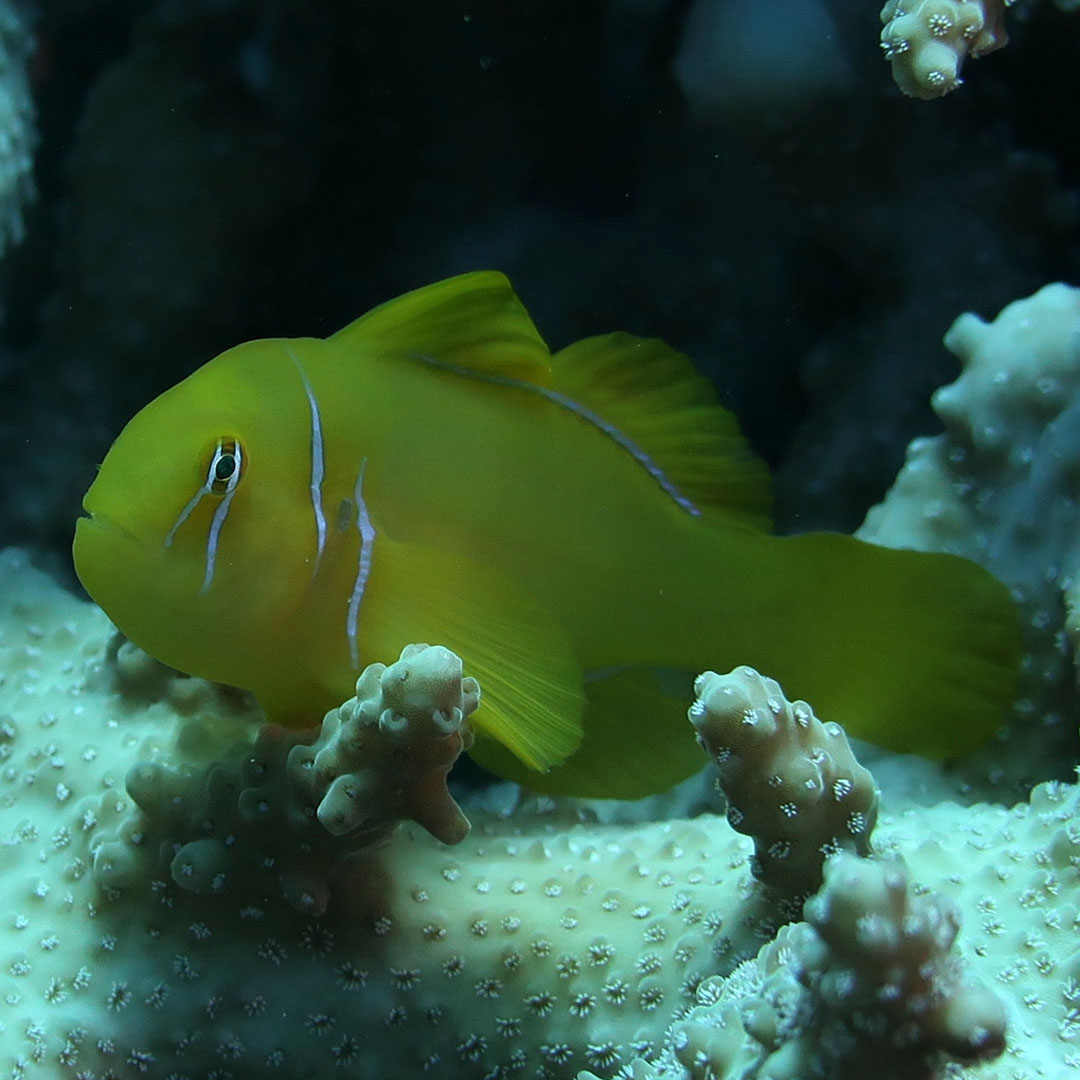
Allen & Erdmann (2012) described the color as anything from yellow to yellowish green, and even black. Its distinguishing marks are a pair of blue bars running through the eye, a second pair across the back of the head, a blue stripe along the base of the dorsal fin and a small dark spot at the upper end of the pectoral fin base. Lieske & Myers (1994) gave the maximum total length, measured from the tip of the snout to the tip of the tail fin, as 6.6 cm (2.6 in).
The Okinawa Goby (Gobiodon okinawae), from the same genus, is also yellow, but Allen & Erdmann (2012) described it as plain yellow from head to tail with no blue bars, and Randall et al. (1990) gave its maximum length as 3.5 cm (1.4 in). The quickest way to tell the two apart is therefore to look at the face: if there are blue bars, the fish in front of you is a Citron Goby.
FishBase lists the range from the Red Sea south to Delagoa Bay in Mozambique, east to Samoa, north to southern Japan and south to the Great Barrier Reef (Froese & Pauly, 2026a). Larson (2019) stated that the species lives at 1-25 m (3.3-82 ft), in the gaps between the branches of table-shaped Acropora colonies. This is why the Origin field in the Species Info Box marks the Red Sea, the Indian Ocean, the Western Pacific and the Central Pacific together.
Red Sea fish are genetically distinct from those in the Pacific. Duchene et al. (2013) showed that the Red Sea population has diverged from its Pacific counterpart more than the sister species in the same lineage have diverged from one another. In the same study, the Citron Goby came out as one of the three oldest Gobiodon species, with an origin that may reach back to the late Miocene, the geological period that began roughly 10 million years ago.
We recommend at least 60 l (15.9 gallons) for a single fish or a pair. The fish itself is small, but in the wild its home is an entire coral colony, and in the aquarium it also needs a branching coral or a rock structure to settle on. What sets the volume for this species is therefore not the fish but the size of the area it will settle in.
The values you can aim for are a temperature of 24-27 °C (75.2-80.6 °F), a salinity of 1.023-1.025 specific gravity, a pH of 8.1-8.4 and an alkalinity of 8-11 dKH. dKH is the unit aquarists use for alkalinity, the water’s buffering capacity against a drop in pH. OBIS lists records of the species at sites where sea surface temperature is between 20 and 30 °C (68-86 °F) (OBIS, 2026), so the fish can tolerate a few degrees below and above the target range.
In the wild, the life of this species plays out inside a single Acropora colony. Froehlich et al. (2021) stated that at Lizard Island the species preferred Acropora intermedia colonies most. If you want to offer the fish a branching colony like this in your aquarium, you also need to meet the light and water quality needs of Acropora care; we cover the lighting side in our guide to aquarium lighting for corals. Without a colony, the fish settles into a narrow crevice or ledge in the rockwork.
The volume and water values in this section, and the observation about settling in an aquarium without a colony, come from established aquarium practice rather than from a study.
Two sources describe its natural diet differently. Bacchet et al. (2006) stated that the species feeds on small invertebrates and zooplankton. Larson (2019), in the IUCN assessment, stated that its main food is the tissue of its host coral. At the genus level, Brooker et al. (2010) found coral stinging cells in the gut contents of three Gobiodon species and stated that coral feeding may be common in the genus; most of the gut contents were still algae, invertebrates and unidentifiable soft material.
In the aquarium it accepts prepared foods. Foods you can offer:
Two or three times a day, small portions it finishes within a few minutes are enough. The fish rarely likes to leave its branch; if the current sweeps food past it too quickly, using a pipette to bring the food close to where it sits makes feeding easier. The feeding frequency, food list and pipette tip come from established aquarium practice rather than from a study.
The Citron Goby is peaceful by temperament. In the wild it often shares one coral with several others: Hing et al. (2018) counted 37 fish in 9 corals at Lizard Island, an average of about four per coral, and classed the species among the group-forming Gobiodon species. Because an aquarium rarely has a colony large enough to hold such a group, keeping a single fish or one pair is the safest choice.
If you want a pair, starting with two juveniles makes it easier, because sex can change in this genus. Working on a related species, the Broad-barred Goby (Gobiodon histrio), Munday et al. (1998) showed that all immature fish are female, that females change into males, and that when two males are placed on the same coral one can change back into a female. The finding belongs to the related species, not to the Citron Goby; still, it is the basis for two juveniles being able to form a pair over time.
We recommend not having one colony shared by two different Gobiodon species. Munday et al. (2001) showed that at Lizard Island some Gobiodon species compete with one another for their preferred coral, and that in aquarium trials the larger fish, or the one that settled on the colony first, won.
What protects this fish is the toxic mucus on its skin. Randall & Goren (1993) stated that the species secretes toxic mucus. Schubert et al. (2003) tested the skin secretions of six Gobiodon species, and showed that all were toxic and that predatory fish rejected food coated with the secretion.
The mucus also protects the coral the fish lives in. In an aquarium experiment with related species, Dirnwoeber & Herler (2013) measured that bites by the coral-eating Exquisite Butterflyfish (Chaetodon austriacus) on Acropora colonies inhabited by the Broad-barred Goby dropped by 62-98% compared with empty colonies.
It lives without trouble alongside small, peaceful fish such as clownfish, cardinalfish, firefish and the Neon Goby. Reef compatibility, however, is marked With caution: the fish spends most of its time perched on branching stony corals and in the wild also eats the tissue of its host coral, so you may see tissue loss on the branch it sits on. The compatible fish list and the tissue loss observation come from established aquarium practice.
Larson (2019), in the IUCN assessment, describes the species as one that releases its eggs into the water and forms pairs to spawn. Chambel et al. (2014) saw a different picture in the aquarium: they formed pairs from eight adults, moved each pair into its own aquarium to observe courtship and spawning, and stated that the eggs stuck to the substrate and that the parents guarded them. The pairs spawned every 5-9 days.
In the same study they measured the oval eggs at an average of 1.05 mm (0.041 in) long and 0.44 mm (0.017 in) wide. The eggs hatched on the fifth night after fertilization, and the larvae emerged at an average length of 2.25 mm (0.089 in). The study is an abstract presented at a scientific meeting and does not say how many of the larvae survived.
Larson (2019) also states that the species has been bred in captivity; the Yes value in the Species Info Box rests on this record. There is, however, no published study that describes raising the larvae from egg to juvenile step by step.
The only measure we have for lifespan is aquarist observation: most well-kept fish live 3-5 years in the aquarium, and no study has measured lifespan either in the wild or in captivity. This figure and the transport advice below come from established aquarium practice rather than from a study.
The toxic mucus does not protect this fish from external parasites. Munday et al. (2003) showed that toxic Gobiodon species picked up gnathiid isopods, small crustacean parasites that feed on fish blood, at the same rate as a non-toxic goby species; in these species the parasites mostly attached to the fins, where toxin glands are sparse. External parasites such as white spot (Cryptocaryon irritans) and velvet (Amyloodinium ocellatum) can therefore appear in this species too.
Before moving a new arrival into the display, it is worth watching it for at least 30 days in a separate quarantine aquarium; in quarantine, a piece of PVC pipe stands in for the branch. Copper-based medication can be used in quarantine, but copper must never enter the display aquarium with corals. During this period the earliest warning sign is feeding: if the fish refuses every food you offer for three days, postpone the move to the display.
The “poison” in the species’ common name comes from its skin mucus; there is no record of the fish having a venomous spine that stings, which is why the Venomous field in the Species Info Box is No. The mucus is, however, toxic to other fish (Schubert et al., 2003). We recommend not transporting a stressed fish in the same bag or container as other fish.
On the IUCN Red List, the Citron Goby is in the Least Concern (LC) category, meaning it is not considered at risk in the near term. The assessment is by Larson (2019); it was assessed on 28 June 2018, published in 2019, and is global in scope. The population trend is recorded as unknown. Larson gives the species’ wide range and its use of several Acropora species as hosts as the reasons for the low category.
The threat is aimed less at the fish itself than at the coral it lives in. Larson (2019) states that host corals are declining worldwide because of bleaching and disease brought on by extreme heat, stronger storms and ocean acidification, and that collection for the aquarium trade is not currently a major threat. Froehlich et al. (2021) showed that at Lizard Island the species dropped out of the records after two cyclones, reappeared later, and was not recorded in the area at all after the bleaching caused by the 2016 and 2017 marine heatwaves.
The Gobiodon genus does not appear in the Checklist of CITES Species, so the species does not require CITES permits in international trade (CITES, 2026). Fish sold in the trade are collected from the wild (Larson, 2019). The most practical thing an aquarist can do is keep the fish alive for a long time: asking the seller to show you the fish eating, and not skipping quarantine, make it unnecessary for a second fish to be collected from the wild for the same aquarium.
Have you kept a Citron Goby, and did it settle on a coral colony or on the rockwork in your aquarium? Leave it in the comments below. When someone else keeping the same species reads what happened in your aquarium, they can see much more clearly where their own fish is likely to settle.
References:
Was this guide helpful?
“Your answer helps us improve our guides.”
Share:
No cookies in this category.
We use cookies to personalize content, provide social media features, and analyze our traffic. We also share information about your use of our site with our analytics partners. You can change your preferences at any time. For more information, please see our Privacy Notice and Cookie Notice. Privacy Notice Cookie Notice
We sent you a confirmation link. Click it to finish subscribing.