
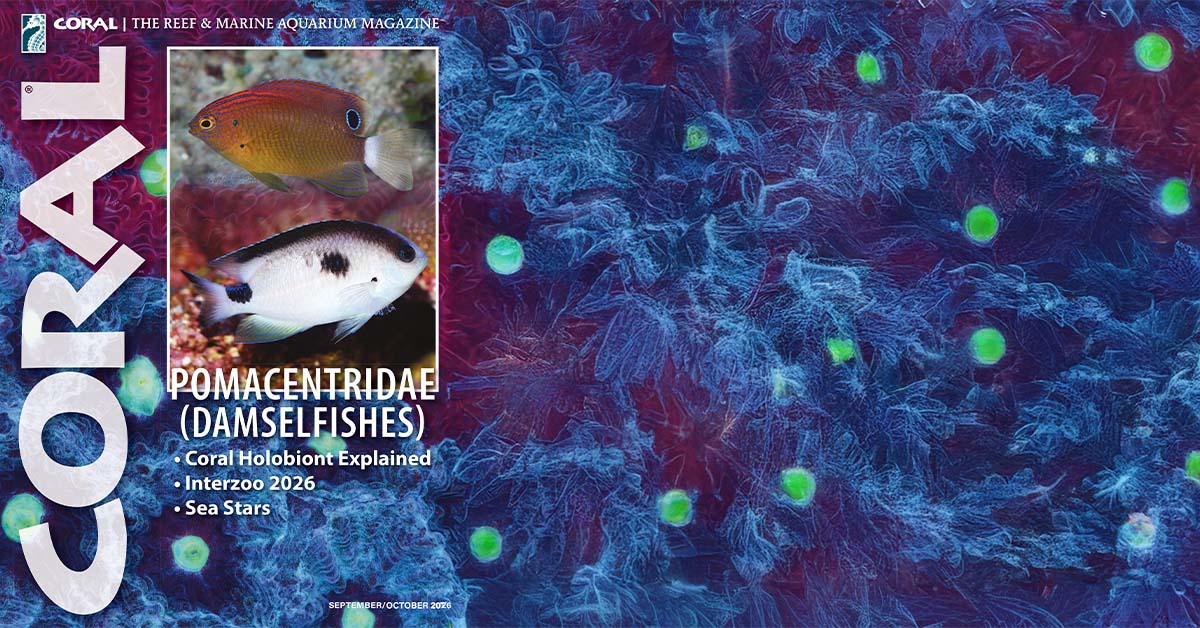

The September/October 2026 issue of CORAL Magazine (Volume 23, Number 5) puts the damselfish family, Pomacentridae, back on the cover for the first time since 2007, and the cover fish is a Speckled Damsel (Pomacentrus bankanensis). Editor Marc Levenson opens the issue with a short list of things that make the hobby easier. It includes an automatic top-off system for evaporated water, lights on a timer, a collection cup that shuts the skimmer off when full, and a weekly water test.
According to Levenson, you do not need to change water every week; a 25% water change once a month is enough, and the weekly habit is mostly carried over from freshwater keeping. The issue has two threads. One is damselfish, the other is the algae, bacteria, archaea, fungi and viruses living in and on a single coral polyp.
Pomacentridae and Its Family Tree
Dieter Brockmann introduces the family in the first two articles. With more than 400 species, Pomacentridae is the largest family of reef fishes, and a new species, the Perpetual Chromis (Chromis abadhah), was described from the Maldives as recently as 2024. For the family tree, Brockmann follows the tree McCord et al. built in 2021 by comparing 12 genes across 345 species. In that tree the anemonefishes are no longer a subfamily of their own, and 22 Chromis species have moved to the new genus Pycnochromis. The author’s own photo of an Allen’s Damselfish (Pomacentrus alleni) represents the Pomacentrini group. The family’s common ancestor lived about 55.5 million years ago.
Keeping Damselfish in the Aquarium
The third article turns to keeping damselfish in the aquarium. In 2005 alone, about one million Green Chromis (Chromis viridis) and nearly 800,000 Sapphire Damselfish were imported into the United States; those figures show how big a place the family holds in the hobby. Most species stay under 10 cm (4 in) and adapt both to water high in nitrate and phosphate and to a nutrient-poor SPS aquarium. Brockmann recommends several small meals a day and regular dried nori.
The two exceptions to their reef-safe reputation come from the author’s own aquarium. The dominant male of a Green Chromis group one day started biting the mantles of giant clams that had lived there without trouble for years; the clams stayed closed for days and had to be removed. Before spawning, the same group stripped the polyps off the branches of a Pocillopora colony, and hair algae covered the exposed skeleton.
For readers who want a pair, Brockmann’s threshold is clear. Even for small species he wants an aquarium at least 1.2 m (4 ft) long and does not consider a nano aquarium suitable for a pair. Because sex cannot be told apart in the dealer’s aquarium, he suggests adding about four juveniles at once and removing the extras with a fish trap once one fish is constantly chased and starts hiding. The belief that well-fed fish are calmer does not hold for this family. We have our own damselfish story. We bought just one, and that single fish turned the aquarium upside down. Again? Not in this lifetime!
The aggressive species list includes the Yellowtail Blue Damselfish (Chrysiptera parasema), the Bluestreak Damselfish (Neoglyphidodon oxyodon) and the Azure Damselfish (Chrysiptera hemicyanea), whose species page we have published. Talbot’s Damselfish (Chrysiptera talboti) leads the peaceful exceptions. The best species for a group is the Green Chromis, but you have to feed small amounts several times a day so the weakest fish in the group also gets food. Spiny Chromis (Acanthochromis polyacanthus) young skip the drifting larval stage in open water; both parents care for them for about a month. The article ends with a table of 13 captive-bred damselfish species found in the trade, and Brockmann recommends captive-bred fish because of their lower disease and parasite risk.
The Coral Holobiont and Its Partners
The holobiont is the community formed by a coral polyp and every organism living in and on it. The symbiotic algae we call zooxanthellae are not a single species but several genera of the family Symbiodiniaceae. The old clades A, B, C and D, meaning lineages descended from a common ancestor, now carry the names Symbiodinium, Breviolum, Cladocopium and Durusdinium.
There is a trade-off between the genera. In a branching Acropora species, colonies hosting Cladocopium grow faster but tolerate heat less, while colonies that survive bleaching mostly host Durusdinium. Bacteria living in the mucus layer outside the polyp supply up to 11% of the nitrogen the symbiotic algae need. Corals cannot make vitamin B12 at all; it comes entirely from the microbiome, the community of microorganisms living on the coral.
Brockmann draws two practical points from this section that apply straight to the aquarium. Acropora colonies taken out of the water even briefly release a lot of mucus, so they should be rinsed in aquarium water before going into the display. A coral moved from a nutrient-rich aquarium to a nutrient-poor one apparently needs time for its microbiome to reorganize, and during that period growth may slow and colors may fade.
Hands-On Coral Spawning, Part Three
In the final part of the series whose first part we covered in our Coralia Bacchanalia review and second part in our Collecting the Unthinkable review, Richard Ross takes Acropora larvae through settlement. The larvae head for the bottom 5-14 days after fertilization, and the settlement container is kept at 26-27 °C (79-80 °F). Ross explains that the larvae settle on every unwanted surface, so he lines the bottom of the container edge to edge with stemless square frag plugs.
Coralline algae are the pink and purple calcified algae that coat rock, and larvae choose where to settle by following them. Ross lets coralline algae cover the frag plugs for two to three months, then freezes the plugs 72 hours before settlement; freezing kills everything on the plug, but the algae keep attracting larvae. He raises the settled corals together with 1 mm (0.04 in) juvenile Tuxedo Urchins (Mespilia globulus) and states openly that losses of up to 99% can occur at each stage. We have not caught this moment in our own aquarium yet, but it is near the top of the things we most want to see.
Interzoo 2026 and the Marine Aquarium Industry
Danilo Ronchi, who has followed Interzoo since 2006, sums up its 2026 edition as “less show, more substance.” About 2,400 exhibitors from roughly 70 countries and 39,000 trade visitors attended, but there were fewer large saltwater aquariums on display. According to Ronchi, manufacturers now release new products throughout the year rather than timing them to the fair, which is held every two years. We haven’t made it to Interzoo yet; for now we’ve made do with Petzoo, a smaller pet trade fair. But it’s at the top of our list.
On the product side there are three trends. Chillers whose heat exchanger sits in the sump or aquarium while the cooling unit stays outside remove the need for a separate feed pump. Systems that combine a protein skimmer, a CO2 filter that captures carbon dioxide from the air and a carbon filter in one housing make pH management part of filtration. Pumps that correct dosing automatically from ICP analysis, which measures the water element by element, are still at the concept stage. Ronchi also warns that as the hobby becomes more technical, it can scare off beginners.
Unexpected Spawning in Sharpnose Pufferfish
Werner Fiedler photographs two species of one genus spawning in two different ways. Off the north coast of Bali, a pair of Compressed Toby Pufferfish (Canthigaster compressa) spawns side by side inside a clump of algae, facing in opposite directions. In the strong current of the Selayar Strait, Bennett’s Sharpnose Pufferfish (Canthigaster bennetti), normally seen alone or in pairs, spawn en masse by the thousands at 10-15 m (33-49 ft), while schools of Pyramid Butterflyfish (Hemitaurichthys polylepis) dive into the middle of the swarm to snatch fresh eggs. Why these weak swimmers pick the most current-swept reef remains an open question. Fiedler also points out that even these small species accumulate tetrodotoxin, a potent nerve toxin, in their bodies.
Aquarium Portrait, Gigi Reef
Simone La Giglia’s aquarium measures 174 x 70 x 55 cm (69 x 28 x 22 in), holds 670 l (177 gallons) gross and is built around fewer coral species and larger colonies. Some SPS colonies are more than 50 cm (20 in) across, and about 50 fish live in it, including 25 Green Chromis. The aquarium was set up in 2021 with dry rock and spent its first months fighting a long dinoflagellate outbreak.
Four circulation pumps together move about 23,800 l/h (6,290 gph) and turn over the aquarium volume 35 times an hour. PAR measured at the coral tips, meaning the amount of light usable for photosynthesis that reaches the spot where a coral sits, reaches 850 and stays between 250 and 300 near the bottom. La Giglia aims to bring nitrate down to 5-10 ppm and phosphate to 0.05-0.10 ppm.
Keeping Sea Stars in a Saltwater Aquarium
Malcolm Gray Levison takes on one of the animal groups most often lost in aquariums. WoRMS lists 2,046 accepted sea star species, and feeding habits vary widely between them. The Blue Sea Star (Linckia laevigata), Necklace Sea Star (Fromia monilis) and Luzon Sea Star (Echinaster luzonicus) feed mainly on biofilm, the layer of bacteria, diatoms and microalgae that coats surfaces, and in the aquarium they often die within a few months.
Levison wants sea stars acclimated by adding water drop by drop and never exposed to air, because air entering the water vascular system can lead first to arm loss and then to death. A box in the article sums up the latest findings on Sea Star Wasting Disease, in which the arms dissolve. In 2025 a Vibrio bacterium was shown to be the cause, and even a 39% drop in dissolved oxygen was enough to trigger the disease. Every one of our aquariums always has a Sand Sifting Sea Star (Astropecten sp.); it aerates the sand and keeps the surface clean.
Magazine Departments and Closing Page
The events calendar runs from late August 2026 to June 2027, the dealer directory lists the aquarium shops that carry the magazine, and CORALexicon explains terms such as dysbiotic, epibenthic and photosystem. The issue closes with a shot Alex Rose took on a night dive. In it, a Wire Coral Goby (Bryaninops yongei) rests among the polyps of a Wire Coral (Cirrhipathes anguina), the only coral known to host it.
CORAL Magazine is one of the world’s leading print publications for the saltwater aquarium industry. If you want to read the whole issue and subscribe, start your subscription here. You can find the previous issue in our Voracious Planktivores / CORAL Magazine 2026 Review. We can’t wait for the next issue!
Is your saltwater aquarium home to a damselfish pair or a group of Green Chromis? Tell us the length of your aquarium and how many fish are left in the comments; for a reader getting ready to set up a pair, those two numbers are the most useful information there is.