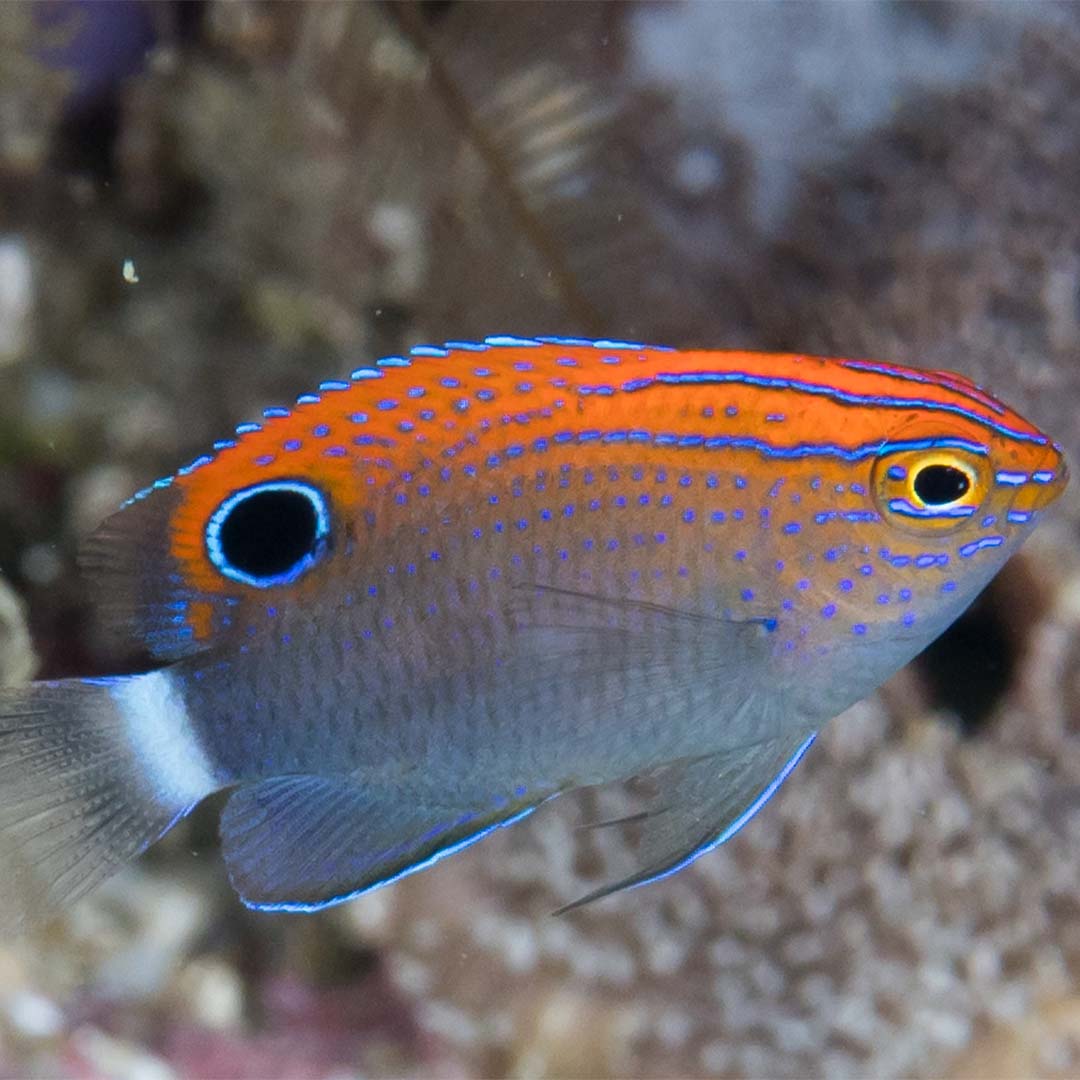
Speckled Damsel (Pomacentrus bankanensis) Care Guide: Learn about tank size, territory management, and the Spirulina-rich diet needed for this vibrant reef fish.
The Speckled Damsel, scientifically known as Pomacentrus bankanensis, is a vibrant and exceptionally hardy member of the Pomacentridae family. Native to the Western Pacific—specifically the nutrient-rich reefs of Indonesia (its name bankanensis refers to Bangka Island), the Philippines, and the Solomon Islands—this species is a staple in the marine hobby. While often categorized simply as a “starter fish,” the Speckled Damsel offers deep behavioral complexity and a striking aesthetic, featuring a blue-grey body accented by brilliant yellow speckles and a distinctive eyespot on the dorsal fin.
The Speckled Damsel is highly active and territorial, requiring a minimum of 114 liters (30 gallons) for a single individual. In smaller volumes, the fish’s cortisol levels rise, leading to heightened aggression and a suppressed immune system. For community setups, a tank of 200–300 liters is preferred to allow for natural territory mapping. The aquascape should mimic a fringing reef, with complex live rock formations, caves, and “swim-throughs.” Water parameters must be kept stable: temperature at 22–25.5°C (72–78°F), pH at 8.1–8.4, and salinity at 1.020–1.025 sg. High-quality biological filtration is essential, as ammonia spikes can trigger outbreaks of Cryptocaryon irritans (Marine Ich).
As an omnivore, Pomacentrus bankanensis requires a varied diet to maintain its iridescent sheen. In the wild, they forage on zooplankton, small crustaceans, and filamentous algae. In the aquarium, they should be fed high-quality marine flakes or pellets enriched with Spirulina. Research indicates that dietary carotenoids found in Spirulina are essential precursors for the yellow pigmentation in their speckled patterns. Supplement this with frozen mysis shrimp and artemia 3–4 times per week. Feeding small portions twice daily is recommended to reduce food waste and maintain stable nitrate levels below 20 ppm.
The Speckled Damsel is classified as “semi-aggressive,” but this behavior is specifically substrate-attached territoriality. They don’t hunt other fish; they defend a physical “home” zone. They are reef-safe and will not bother corals, anemones, or most invertebrates. To manage their feisty nature, house them with assertive tank mates like Tangs, larger Blennies, or Dottybacks. Avoid keeping them with very passive species (like Pipefish) or other damsels with similar color patterns, as this triggers intense inter-genus competition. If keeping a group, always introduce all individuals simultaneously to prevent the establishment of a “dominant resident” that might bully newcomers.
In their natural habitat, Speckled Damsels are substrate spawners. Males are responsible for cleaning a flat rock surface and courting females through high-energy swimming displays and color intensification. Once the female deposits her adhesive eggs, the male exclusively guards and aerates them by fanning his fins—a behavior that lasts 3–5 days until hatching. While they frequently spawn in home aquaria, raising the larvae is a technical challenge. It requires a dedicated larval tank and a steady supply of live rotifers and copepod nauplii to sustain the fry through their planktonic stage.
While famously durable, the Speckled Damsel is not invincible. The primary health risks are stress-induced parasites and nutritional deficiencies. Poor water quality, specifically nitrite or ammonia fluctuations, can weaken their mucus coat, making them a prime target for Marine Ich. Early warning signs include “flashing” (rubbing against rocks) or rapid gill movement. A 2–4 week quarantine period is essential for new arrivals to ensure they are eating well and parasite-free. With a stable environment and a carotenoid-rich diet, these damsels can thrive for 5 to 8 years in captivity.
Cover Photo Credit: Rickard Zerpe
Reference:
Was this guide helpful?
Like, save to your profile and reach more people.
Share:
Species Info Box
Temperature
Salinity
pH
Alkalinity
Venomous
Aquarium Size
Maximum Size
Lifespan
Color Form
Reef Compatible
Diet
Temperament
Care Level
Breeding
Genus
Family
Origin
We use cookies to personalize content, provide social media features, and analyze our traffic. We also share information about your use of our site with our analytics partners. You can change your preferences at any time. For more information, please see our Privacy Notice and Cookie Notice. Privacy Notice Cookie Notice
We sent you a confirmation link. Click it to finish subscribing.
