
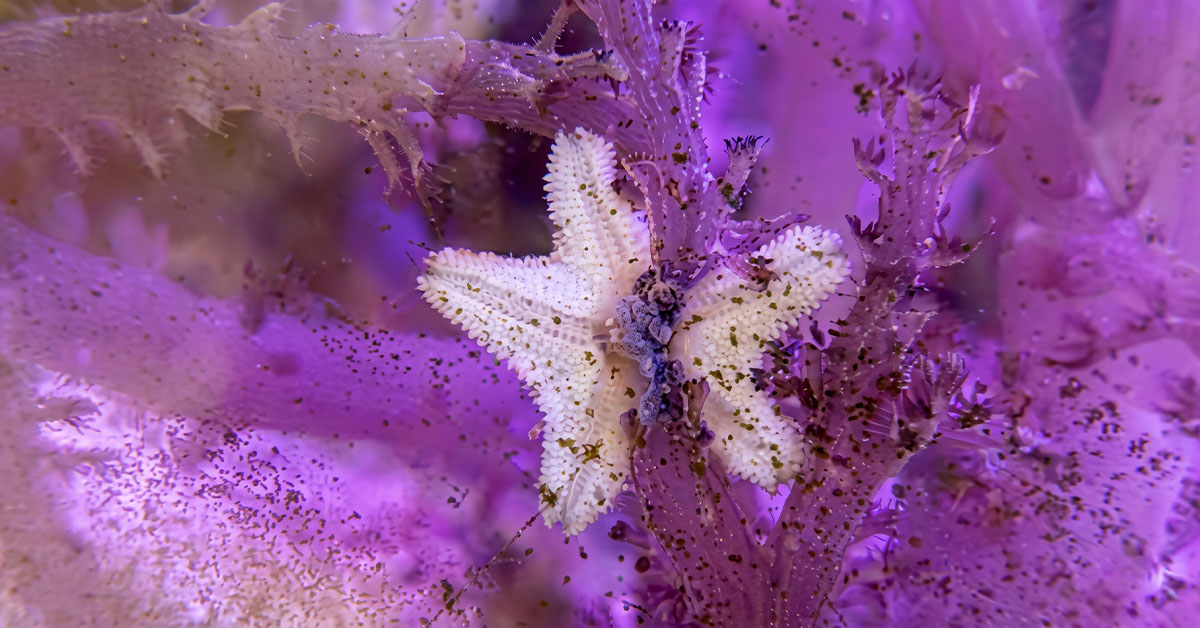

The asterina starfish is the small, lopsided star you spot on the glass one morning and then see dozens of within a few weeks. The first question it raises is almost always whether it will harm your corals. The short answer is usually no, but some individuals do feed on coral tissue, and telling one from the other at a glance is hard. In this guide we cover what you are looking at, what to watch for and how to keep the numbers under control.
What Is an Asterina Starfish?
The name asterina is a leftover from an older classification. O’Loughlin and Rowe (2006) reorganised the small asterinid sea stars of the Indo-West Pacific under the genus Aquilonastra, moved part of the species once known as Asterina into it and described thirteen new species. The genus now holds 33 accepted species (Mah, 2026a). Asterina is still a valid genus as well (Mah, 2026b), but the star that reaches your aquarium on Indo-Pacific rock or coral is most likely an Aquilonastra.
Identifying the species means examining the plates and spines that cover the body under magnification. That is why we refer to the individual in your aquarium as asterina starfish (Aquilonastra sp.), at genus level. The name aquarists use has not changed, though; you will most likely search for, and find, information on this animal under “asterina”.
The Aquilonastra species that reproduce by splitting are small. O’Loughlin and Rowe (2006) reported a maximum distance of 5-18 mm (0.2-0.7 in) from the centre to the tip of the longest arm in these species, which puts the whole star at roughly 1-3.6 cm (0.4-1.4 in) across. The colour aquarists describe is mostly pale beige, grey or greenish. This star most likely came into your aquarium on a piece of live rock or on the plug of a coral frag. It is one of the most common hitchhikers, the animals that ride into an aquarium unnoticed on rock or coral.
Why Do Asterina Starfish Multiply So Fast?
In the aquarium an asterina starfish reproduces asexually, by splitting itself in two. The body separates down the middle, each half regrows its missing arms and each becomes a star in its own right. O’Loughlin and Rowe (2006) reported that species reproducing this way can have up to nine arms and an asymmetrical body. If you see four, six or seven armed stars with arms of different lengths in your aquarium, you are looking at individuals that have recently split and are still completing their arms.
This method needs no partner. A single individual keeps splitting as long as it finds enough food, which is why the population seems to explode overnight. What really sets the pace is the amount of food in your aquarium: the more uneaten food, fish waste and film on the glass there is, the more often they split. Aquarists’ experience points the same way; in aquariums where feeding is cut back, asterina numbers drop within weeks.
Do Asterina Starfish Harm Your Corals?
According to aquarists’ observations, most of the asterinas in your aquarium feed on the thin layer of algae and bacteria on rock and glass. These individuals leave your corals alone and even help a little with keeping the glass clean. If there are no corals in your aquarium, meaning you keep only fish and live rock, you do not need to do anything about asterinas; a rising count only tells you the food is too much. The problem is that some individuals also feed on coral tissue. Aquarists say they see this damage most often on zoanthid colonies and at the base of small polyped branching stony corals.
We could not find a study that separates the forms that eat coral from those that do not. One explanation for harmless and harmful individuals living side by side in the same aquarium may be that several look-alike species go by the same name. So the decision is made on behaviour, not appearance. A white patch opening at the base of your coral is not enough on its own to tell; flow, light or another animal can leave the same mark.
How Can You Tell if One Is Doing Damage?
The most reliable way to find out whether an asterina starfish is eating coral is to catch it in the act. Asterinas become more active after the lights go out. You can look into your aquarium with a red torch an hour or two after lights off; red light disturbs animals less than white light.
The sign you are looking for is this: the star sits directly on the living tissue of the coral and returns to the same colony several nights in a row. By the next morning the polyps at that spot stay closed, or the tissue has pulled back and the white skeleton underneath shows. If tissue loss starts where the star sat and spreads outward, your suspicion is largely confirmed. Stars roaming the glass and rock that do not fit this picture are most likely harmless, and you do not need to do anything about them.
How Do You Get Rid of Asterina Starfish?
If you have seen an individual damaging your corals, or the numbers have grown to the point of bothering you, you have three options. None of them is enough on its own; you get the best result by cutting the food supply and removing them by hand together.
Cutting the Food Supply
The first and cheapest step is to reduce what the asterinas eat. You can readjust the amount of food to the bioload of your aquarium and take care not to feed more than your fish finish in 2-3 minutes. Flow that keeps uneaten particles suspended and carries them to the filter also removes food from the water before the stars reach it. With less food the splitting slows down; skip this step and new stars will fill the place of the ones you removed by other means within a few weeks.
Removing Them by Hand
For a small number of individuals fixed on a particular colony, the most direct route is to take them out by hand. After the lights go out, when the stars come up onto the rock, you can siphon them with a thin hose or pick them off with long tweezers. Do not expect to get them all in one go; repeat the removal several nights in a row and the numbers will drop noticeably.
Harlequin Shrimp
The harlequin shrimp (Hymenocera picta) is a shrimp that feeds on sea stars. Pratoomyot et al. (2018) reported that in the wild it hunts a range of sea star species and eats its prey after flipping it over. Add a pair to your aquarium and they will find the asterinas one by one among the rocks and bring the numbers down noticeably.
The cost of this solution begins when the asterinas run out. Pratoomyot et al. (2018) measured that an adult pair of harlequin shrimp eats two to three comet stars (Linckia multifora) of 6-10 cm (2.4-3.9 in) across every week. The asterina population in your aquarium cannot keep up with that appetite for long, and once the last star is eaten your shrimp go hungry. You will need to keep feeding them live sea stars, or pass them on to another aquarist who needs them once the job is done. If you are ready for neither, we recommend not taking this route.
One more warning: the harlequin shrimp cannot tell an asterina from a sea star you want to keep. If there is a Linckia or a sand-sifting sea star in your aquarium, it will hunt that too.
What Should You Check with New Corals and Frag Swaps?
The way to keep the asterina starfish out of your aquarium is to inspect every new rock and coral before it goes in. The stars usually hide on the underside of the frag plug and in shaded crevices of the rock. Watching a new colony in a separate container for 2-3 weeks before it goes into the main aquarium lets you catch asterinas and other hitchhikers in most cases.
If you swap frags, there is another side to this. If you have asterinas and share coral pieces with friends, tell them. They may not mind a harmless star, but they should make that call knowingly; whoever finds an unannounced star working through their zoanthid colony will also remember where that frag came from.
In short, the asterina starfish is not an animal to declare war on the moment you see it. Cut the food first, then watch at night, and remove by hand the individuals you catch on coral tissue. We recommend considering a solution that brings a lasting responsibility, such as the harlequin shrimp, only if those steps are not enough. We hope this guide helps you base your decision about the asterina starfish on what you observe.
Do you have asterina starfish in your aquarium, and have you ever seen them touch your corals? Leave it in the comments below. Someone who has just spotted the first star on their glass will find it much easier, with your observation, to work out which ones to remove and which to leave alone.
Frequently Asked Questions (FAQ)
Are asterina starfish harmful?
Most asterina starfish are harmless and feed on the thin film on rock and glass. Some individuals, however, eat the tissue of zoanthids and small polyped stony corals. You cannot tell the harmful form apart from the outside, so the call has to be made on behaviour: an individual that sits on coral tissue at night and starts tissue loss at that spot is harmful, one roaming the glass is not.
How do asterina starfish get into an aquarium?
They almost always arrive on live rock, a coral colony or a frag plug. Being small and flat, they stay unnoticed on the underside of the plug or in rock crevices. A single individual is enough, because it reproduces by splitting without a partner. Watching new pieces in a separate container for a few weeks before they go into the main aquarium closes this route in most cases.
How big do asterina starfish get?
In the species that reproduce by splitting, the distance from the centre to the tip of the longest arm has been reported at 5-18 mm (0.2-0.7 in), which corresponds to roughly 1-3.6 cm (0.4-1.4 in) across. Most of the individuals you see in an aquarium are in the lower half of that range. Recently split individuals have arms of unequal length, so the star can look smaller and more irregular than it is.
Will asterina starfish go away on their own?
They are unlikely to disappear completely, but their numbers rise and fall with the food supply. When you cut back feeding and stop uneaten particles from building up, splitting slows and the population shrinks within weeks. A few individuals usually stay on among the rocks; if they leave your corals alone, you can let them be.
Can I get rid of asterinas without a harlequin shrimp?
Yes. In most aquariums, cutting the food supply and removing the harmful individuals by hand at night brings the numbers down to a manageable level. A harlequin shrimp works faster, but because it feeds only on sea stars you will have to keep feeding it or pass it on to another aquarist once the asterinas are gone. If you are not ready for that responsibility, the first two methods will be enough.
References:
- Mah, C. L. (2026a). Aquilonastra O’Loughlin in O’Loughlin & Waters, 2004. World Asteroidea Database. World Register of Marine Species, AphiaID 382562. Accessed: 26 September 2026.
- Mah, C. L. (2026b). Asterina Nardo, 1834. World Asteroidea Database. World Register of Marine Species, AphiaID 123281. Accessed: 26 September 2026.
- O’Loughlin, P. M., & Rowe, F. W. E. (2006). A systematic revision of the asterinid genus Aquilonastra O’Loughlin, 2004 (Echinodermata: Asteroidea). Memoirs of Museum Victoria, 63(2), 257-287.
- Pratoomyot, J., Choosri, S., Muthuwan, V., Luangoon, N., Charoendee, W., Phuangsanthia, W., & Shinn, A. P. (2018). Sand star, Astropecten indicus Döderlein, 1888, as an alternative live diet for captive harlequin shrimp, Hymenocera picta Dana, 1852. Aquaculture, 484, 351-360.