
Cover photo: Rickard Zerpe, licensed under CC BY 2.0; background extended and resized.
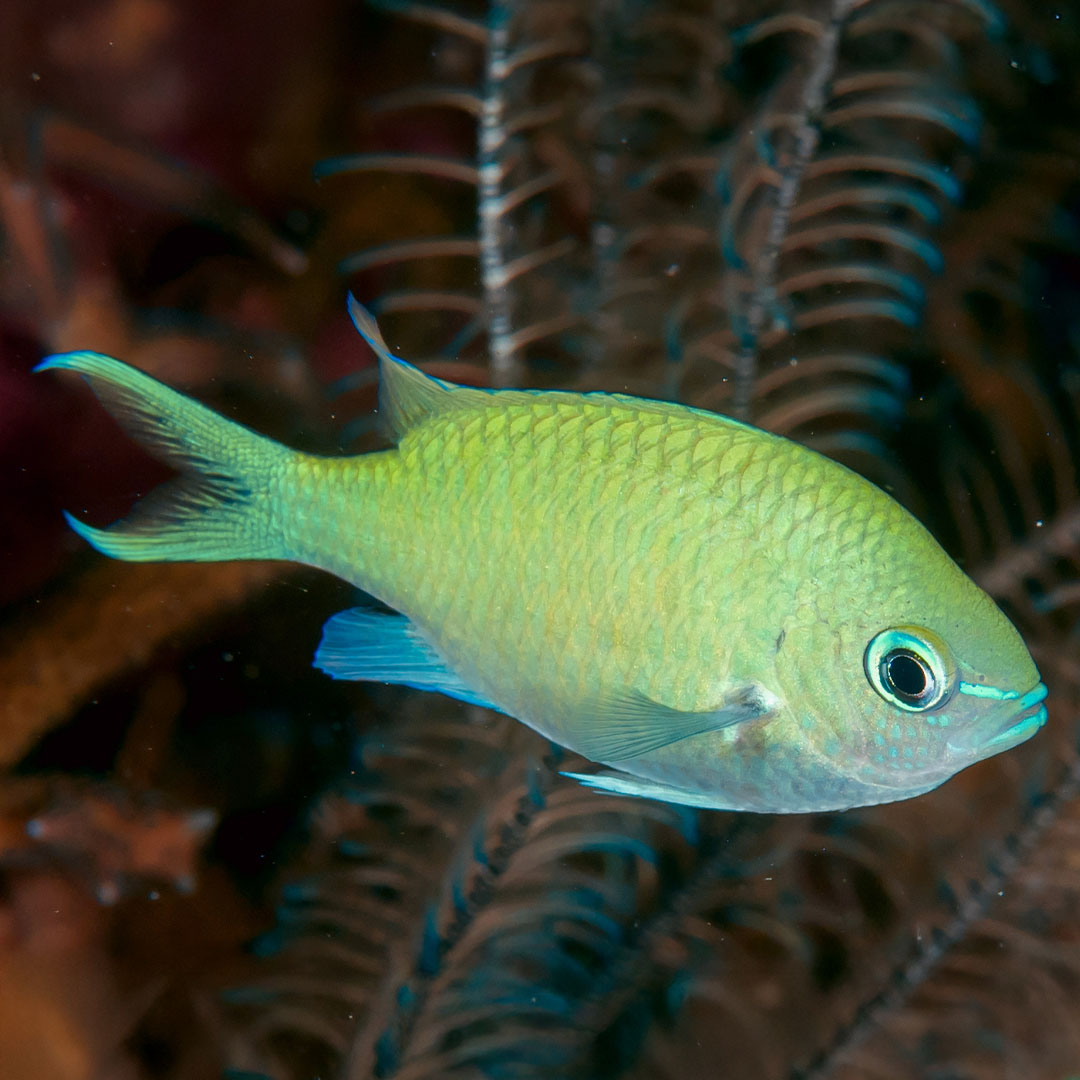
Cover photo: Rickard Zerpe, licensed under CC BY 2.0; background extended and resized.
The Green Chromis is a reef-safe damselfish that grows to 10 cm and is peaceful towards other species. It is a schooling fish; you can keep a group of 5-7 in at least 150 l at 24-27 °C and feed it small amounts of mysis, copepods or small pellets 2-3 times a day. IUCN lists it as Least Concern but states that its population is decreasing. Chromis veneta, described in 2026, may be sold under the same name.
The Green Chromis (Chromis viridis) is one of the most widely kept damselfish (Pomacentridae) in saltwater aquariums. It is also sold as the Blue-Green Chromis. The body is laterally compressed, and its iridescent color shifts from apple green to pale blue depending on the light. Allen and Erdmann (2012) state a total length of up to 10 cm (3.9 in); in the aquarium most individuals stay between 6 and 8 cm (2.4-3.1 in).
The species ranges from the Red Sea and the coast of East Africa to the Line Islands and the Tuamotu Archipelago. FishBase lists the range as reaching the Ryukyu Islands in the north and the Great Barrier Reef and New Caledonia in the south (Froese and Pauly, 2026a); Fricke et al. (2011) state a depth of 1-20 m (3.3-66 ft). Lieske and Myers (1994) state that adults hover in large groups above branching Acropora colonies in sheltered lagoons and on reef flats, while juveniles stay close to a single coral head.
The species most often confused with it at the point of sale is the Black-axil Chromis (Chromis atripectoralis). Allen et al. (2022) state that the two are easily confused. The name FishBase gives that species already tells you the distinguishing mark: a black spot where the pectoral fin joins the body (Froese and Pauly, 2026b). Chromis viridis has no such spot. Allen and Steene (1988) state that the Black-axil Chromis is slightly larger, reaching 12 cm (4.7 in).
A study published in 2026 added a new species to this picture. Rekha et al. (2026) showed with genetic and morphological measurements that some of the fish taken for Green Chromis belong to a separate species, which they named Chromis veneta. The new species has a longer body and a narrower caudal peduncle, yellowish to orange fin margins, and a deeply forked tail with long lobes. The authors state that the two species live together on the same reefs and that C. veneta ranges from Madagascar to Fiji. Part of the group in your aquarium may therefore belong to this species.
This is a schooling fish, and the aquarium should be chosen with that in mind. A single individual can live in 60 l (15.9 gallons), but for a group of 5-7, the size at which you see the species’ natural behavior, we recommend at least 150 l (39.6 gallons) in a long, horizontal aquarium. When you set the group size, you also need to count the other fish in your aquarium.
A shelter structure that mimics the natural habitat shapes how the group behaves. In their Red Sea study, Nadler et al. (2014) showed that this species prefers larger Acropora colonies and that group size increases with coral volume and with the spacing between branches. Branching coral, branching rockwork or rocks with open gaps give the group a place to shelter at night, and during the day the fish swim in open water above it.
Rekha et al. (2024) kept the fish in their breeding trial at 27 °C (80.6 °F) and a salinity of 35.4 g per litre, roughly 1.026 specific gravity. For a home aquarium you can aim for 24-27 °C (75.2-80.6 °F), 1.023-1.026 specific gravity, pH 8.1-8.4 and 8-11 dKH alkalinity; to measure salinity accurately, see our guide on using an aquarium refractometer. The volume figures and the water values outside the trial in this section come from established aquarium practice, not from research.
In the wild the species hunts small animals drifting in the water column. The FishBase record states that it feeds on phytoplankton (Froese and Pauly, 2026a). Coughlin and Strickler (1990), however, showed that it catches fast-escaping calanoid copepods in 6-10 milliseconds by thrusting its jaws forward through the water, and switches to suction feeding for slower prey. In other words, its main food is zooplankton.
In the aquarium, small, meaty foods suit it best: frozen mysis and copepods, enriched brine shrimp and small pellets. Because it takes food from the water column, it eats before the food reaches the bottom. Feeding the group small amounts 2-3 times a day lets even the shyest fish eat; a single large feeding goes to the most dominant individuals. This feeding frequency comes from established aquarium practice, not from research.
When you feed a large group, uneaten food returns to the water as organic load. To measure nitrate and phosphate regularly, see our guide on choosing saltwater aquarium test kits.
The Green Chromis is peaceful towards other species, and that is what sets it apart from the territorial members of the damselfish family. It leaves corals alone, does not harm invertebrates and is reef-safe. When kept with territorial damselfish such as the Azure Damselfish, however, the Green Chromis is usually the one being chased.
The species’ attachment to its own kind starts in the larval stage. Lecchini et al. (2005) measured that larvae ready to settle chose the compartment holding conspecifics in 75% of trials. The larvae can detect them by sight from 75 cm (2.5 ft) and by smell from 375 cm (12.3 ft). Bacchus et al. (2024) showed that groups of 16 stay tighter together than groups of 4, but that individual fish turn more slowly during an escape.
In the aquarium a pecking order forms within the group over time. Aquarists report that the most dominant fish chases the weaker ones and that a group can dwindle one by one over the months. To reduce this risk, we recommend adding 5 or more individuals on the same day, all of roughly the same size. The group size in this section comes from established aquarium practice, not from research.
A group kept with large predators such as lionfish, groupers and moray eels soon becomes prey. We recommend not keeping the Green Chromis in the same aquarium with these species.
Breder and Rosen (1966) state that the eggs adhere to the substrate and that the male guards and aerates them. FishBase gives the length at first maturity as 5.8 cm (2.3 in) (Froese and Pauly, 2026a).
Spawning in captivity has been documented scientifically. Rekha et al. (2024) measured that fish kept in 500 l (132 gallons) aquariums began spawning after four months, spawned on average once every 5.6 days and released between 3,562 and 20,651 eggs each time. The eggs hatched in 52-60 hours, the larvae emerged at 1.97 mm (0.08 in) and their mouths opened at 38 hours. Before spawning, the male cleaned the substrate rapidly.
There is one detail worth knowing when you read these results. The fish in the trial were collected from the lagoon of Agatti Island in India; Rekha et al. (2026) later showed that the two species live together on that island. So it is not certain today which species the trial fish belonged to. We found no published study that raised the larvae through to juveniles, so the species does not count as captive-bred.
The species is hardy, but because it is traded in large numbers and often travels a long way, new fish may arrive stressed and weak. External parasites common in saltwater fish, such as white spot (Cryptocaryon irritans), also occur in this species and show as white dots the size of salt grains on the body. Once a group is infected, the disease spreads quickly to every fish.
Before moving a new group into the main aquarium, it is worth observing it for at least 30 days in a separate quarantine aquarium. Fish that refuse food in quarantine, stay apart from the group or breathe rapidly are showing the first signs of disease.
Pressure within the group is a health problem too. A fish that is constantly chased stays away from food, loses color and becomes vulnerable to disease. If you see torn fins on a fish, or notice it hiding in the top corner of the aquarium all the time, you need to separate it.
No study measures the lifespan of this species or of its relatives in the genus Chromis directly. The 6-10 years in the Species Info Box and the quarantine period we give come from established aquarium practice, not from research.
The Green Chromis is listed as Least Concern (LC) on the IUCN Red List, meaning it is among the species at low risk of extinction in the near term. Allen et al. (2022) state that the species is common across most of its range but that its population trend is decreasing. According to the assessment, the species depends on live coral reefs and in particular on Acropora colonies; the decline of reefs in the Indian Ocean and Southeast Asia affects it as well. In the Gulf of Mannar in India, the species was common in 2002 but was considered rare by 2008.
The species is one of the most heavily collected fish in the aquarium trade. Rhyne et al. (2012) showed that between May 2004 and May 2005 the Green Chromis made up 8.8% of the marine aquarium fish entering the United States, making it the most imported species. In the same period it was exported from 29 countries. Allen et al. (2022) state that heavy collection in Southeast Asia may cause local declines.
The species is not listed in the CITES appendices; its international trade does not require a permit. The one practical step an aquarist can take is to ask how the group they are buying was collected.
How many fish did your Green Chromis group start with, and how many are still there a year later? Tell us in the comments below. Someone planning a group of the same species will find it much easier to decide how many fish to start with once they read how many stayed in your aquarium.
References:
Was this guide helpful?
“Your answer helps us improve our guides.”
Share:
Species Info Box
Temperature
Salinity
pH
Alkalinity
Venomous
Aquarium Size
Maximum Size
Lifespan
Color Form
Reef Compatible
Diet
Temperament
Care Level
Breeding
Genus
Family
Origin
No cookies in this category.
We use cookies to personalize content, provide social media features, and analyze our traffic. We also share information about your use of our site with our analytics partners. You can change your preferences at any time. For more information, please see our Privacy Notice and Cookie Notice. Privacy Notice Cookie Notice
We sent you a confirmation link. Click it to finish subscribing.