
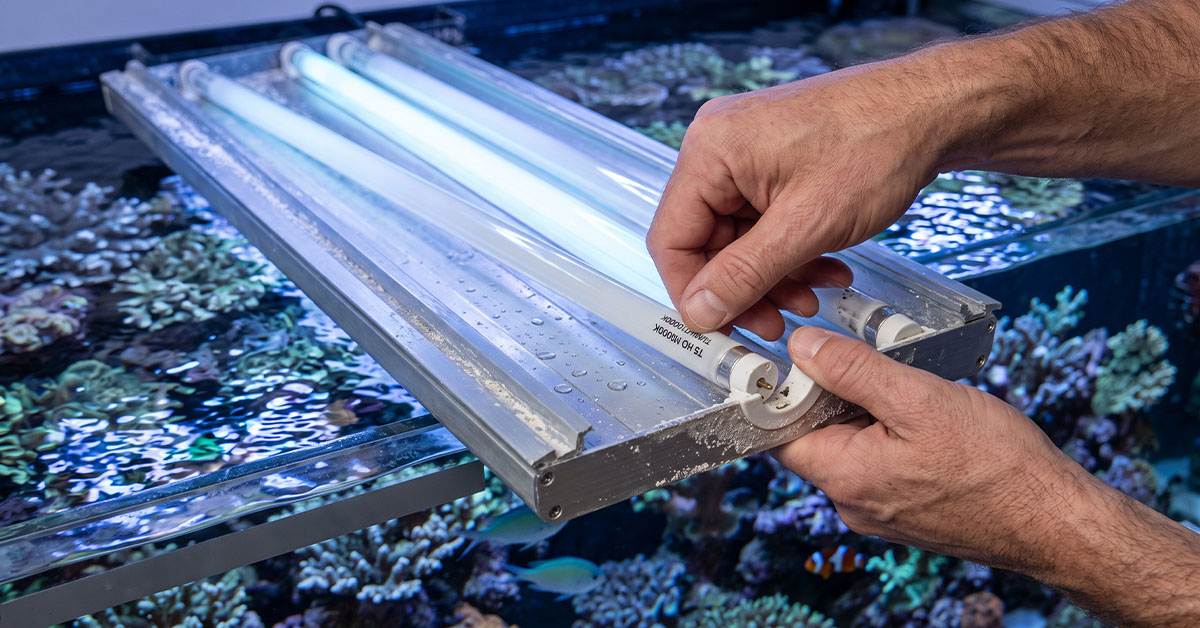

Almost every aquarist running a T5 fixture gets stuck in the same place: the bulb still lights up, so does it really need changing? A bulb that lights up is not the same as a bulb that works; the colour and the intensity of its light drift over months without you noticing. In this guide we look at how to measure when T5 bulb replacement is due, what order to swap bulbs in, and how to tell whether the decline in your corals really comes from your bulbs or from flow, salinity or nutrient load.
What Determines T5 Bulb Life
The same brand of bulb ages at very different rates in two aquariums, and that difference also sets your T5 bulb replacement interval. Four things drive it.
Running hours: A bulb burning 12 hours a day banks hours half again as fast as one burning 8 hours. Shortening your photoperiod by an hour stretches your bulb budget and pushes T5 bulb replacement further out.
Heat: T5 bulbs reach their highest luminous flux at a lamp ambient temperature of 35 °C (95 °F), and output falls off both above and below that point (OSRAM GmbH, 2014). So heat does not only shorten life, it also costs you light today and pulls your next T5 bulb replacement forward. Check that the fan in your fixture actually runs; if there is no fan, leave an opening the hot air can escape through. If the heat coming off the fixture pushes your aquarium temperature up as well, the problem has moved past lighting; we covered that threshold in saltwater aquarium chiller selection.
Ballast and overdriving: Ballast quality shapes starting behaviour and therefore electrode life. Overdriving means running a bulb on a ballast that feeds it more current than its label calls for. A fixture like that hands you more light, but you pay for that light out of the bulb’s life, which means more frequent T5 bulb replacement.
Dimming: If you run a dimmable fixture, the first hours of a bulb’s life matter a great deal, and we come back to that in its own section below.
How to Tell When T5 Bulb Replacement Is Due
The common manufacturer recommendation is 9-12 months at an 8-12 hour photoperiod (ATI North America, n.d.). The same manufacturer also quotes about 2500 (±500) hours per bulb. Those two figures do not line up at every photoperiod, and that gap is exactly what misleads most aquarists. Look at it in hours and the T5 bulb replacement decision gets much clearer.
| Daily running hours | Reaches 2000 h | Reaches 2500 h | Reaches 3000 h |
|---|---|---|---|
| 8 hours | 8.2 months | 10.3 months | 12.3 months |
| 10 hours | 6.6 months | 8.2 months | 9.9 months |
| 12 hours | 5.5 months | 6.8 months | 8.2 months |
If you run 12 hours a day, “I change them once a year” means running the bulb well past the recommended band. That is why it pays to note your photoperiod on the day you install the fixture. The rest is multiplication; your T5 bulb replacement calendar comes straight out of that sum. If you would rather not redo that sum every time, the maintenance log on your profile page counts for you.
Three observations sit alongside the T5 bulb replacement calendar. If your corals no longer open as far as they used to, or grow noticeably more slowly, intensity may have dropped. In a mature aquarium with settled parameters, algae or cyanobacteria appearing can point to a shift in spectrum. If you own a PAR meter the guesswork ends: take a reading from the same spot every six months and build your own curve. We tabulated target ranges for soft corals, LPS and SPS in the best aquarium lighting for corals, so you can compare your reading against those bands.
Is Your Bulb Really the Culprit?
An aged bulb makes a comfortable scapegoat for coral and algae problems. Fitting new bulbs and finding the problem still there costs you both money and a couple of months. So before you commit to T5 bulb replacement, we would suggest making this distinction first.
| What you see | If the bulbs are behind it | If something else is |
|---|---|---|
| Corals closed up | Came on slowly over months, across all of them | Salinity, temperature or alkalinity moved, and it started within days |
| Cyanobacteria | Spread across the whole aquarium | Sitting in particular corners where flow does not reach |
| Algae bloom | Parameters steady, system mature | Nutrient load or livestock load changed |
| Colour fading | Gradual, strongest in the corals up top | Sudden, right after new bulbs went in, so this time it is too much light |
Cyanobacteria usually feeds on dead flow zones rather than on light, so in that case reopening the flow rate you worked out in aquarium wavemaker selection will get you an answer far faster.
If your corals are sitting closed, salinity is the first place to look; an uncalibrated instrument can show you a wrong number as though it were right for months on end, and we walk through that calibration step by step in using an aquarium refractometer.
If temperature swings between day and night, a thermostat may have drifted, and we wrote about spotting that drift in aquarium heater selection. With an algae bloom, we would suggest not deciding before you measure; confirming your nitrate and phosphate with the test kits you already own costs a great deal less than an order of new bulbs.
How to Carry Out T5 Bulb Replacement
Manufacturers underline the same point: new bulbs put out noticeably more PAR than aged ones, which is why they should not all go in at once (ATI North America, n.d.). Renewing all of them in an eight bulb fixture drops your corals into a completely different light field overnight. So T5 bulb replacement is not a one afternoon job, it is a plan spread over a few weeks.
The practical plan is simple: 1 or 2 bulbs a week. An eight bulb fixture spreads across four weeks that way, so a full T5 bulb replacement takes a month rather than a morning, and your corals adjust to a small step each time. Rather than working from one end of the aquarium to the other, you can alternate between the two sides of the fixture, which keeps the light distribution even through the week.
Then there is the habit nobody enjoys and everybody benefits from: recording the date. You can write it on the end cap of the bulb, but six months on you will want to read it without opening the fixture. The maintenance log on your profile page exists for exactly this: enter your install date and photoperiod once, and it works out the date you hit 2500 hours and reminds you as that date approaches. The answer to “when did I last change these” then lives in your account rather than inside the fixture.
Show Image
The 50 Hour Burn-In on a New Bulb
The idea that dimmable fixtures shorten bulb life is a common belief doing the rounds on forums. The manufacturer rejects it directly; the real risk it points to is skipping the burn-in period on a new bulb, which is a T5 bulb replacement step rather than a fault in the fixture (ATI North America, n.d.).
The rule is this: run a new T5 HO bulb at full power, undimmed, for its first 50 hours. Those 50 hours do not have to be consecutive; you can spread them over four or five days inside your normal photoperiod. What matters is leaving your sunrise and sunset simulation switched off for that stretch. Flicker or uneven starting in the first hours is normal.
None of this is specific to the aquarium hobby; lamp seasoning for fluorescent dimming systems is on the record as a published industry recommended practice (NEMA, 2016). The burn-in period varies from one manufacturer to the next, so the safest course is to work from the figure in your own bulb’s documentation. This step is the most commonly skipped part of T5 bulb replacement.
Catalogue Life and Aquarium Life Are Not the Same Thing
There is something here that looks like a contradiction but is really two different measurements. On the catalogue side, a T5 HO bulb built for general lighting carries an average life of 30,000 hours and a luminous flux maintenance of 92% at 12,000 hours (Signify, n.d.). OSRAM’s technical guide puts maintenance at 90% at 20,000 hours (OSRAM GmbH, 2014). In other words, lamp physics gives you nothing that halves its output at 4000 hours.
The 9-12 month T5 bulb replacement figure on the aquarium side measures something else: not how long the bulb keeps working, but how long it keeps delivering enough spectrum and intensity for your corals. The manufacturer line that “a new bulb puts out twice the PAR of an old one” belongs in that frame; it is the extreme comparison between a bulb at the end of its useful life and a brand new one, not the equivalent of a catalogue maintenance curve. Our own suggestion is to stop arguing about PAR loss in the abstract and measure it in your own aquarium.
The practical result: carry out T5 bulb replacement not when a bulb stops lighting, but when what you measure or observe falls below your target.
T5 Supply: What Changes Before 2027
Mercury containing lamps are being phased out worldwide, and that timetable concerns anyone running T5 directly. The table below sums up how the manufacturing ground beneath your fixture is narrowing.
| Regulation | Scope | Date |
|---|---|---|
| RoHS exemption 2(a)(2) | T5 for general lighting purposes (diameter 9-17 mm / 0.35-0.67 in), 3 mg mercury | Expired 24 August 2023 (European Commission, 2022) |
| Minamata Convention | Phase-out of fluorescent lamps | 2027 (Minamata Convention on Mercury, 2023) |
| Canadian mercury regulations | Import and manufacture ban on straight fluorescent lamps | 31 December 2025 (Environment and Climate Change Canada, 2024) |
| State level sales bans | Pin-base and linear fluorescent lamps | Phased between 2025 and 2029 (Electrical Contractor Magazine, n.d.) |
Now the critical distinction. These regulations are written against general lighting lamps; exemptions for special purpose lamps run on a separate track and some are still under renewal (LightingEurope, 2025). The Canadian regulations explicitly exempt lamps for growing plants and for treating water (Environment and Climate Change Canada, 2024). A manufacturer of aquarium bulbs also states plainly that there is no European ban on T5 lamps for aquariums and terrariums and that production continues (Giesemann Aquaristic, n.d.).
The two sources are not contradicting each other; they are talking about different lamp categories. For an aquarist the upshot is clear enough: your T5 bulbs are not coming off the shelf tomorrow, but the enormous general lighting production behind them is shrinking. Over the medium term that means fewer models, fewer colour options and longer lead times, and keeping a spare bulb ahead of your next T5 bulb replacement is becoming a reasonable habit. If you are thinking about renewing your fixture, it is worth factoring this timetable in; it is not an urgent decision, but it is now a known direction.
T5 bulb replacement is less a maintenance line item than a calendar habit. Count the hours, put the install date in your maintenance log, spread the swap across weeks, and do not wait for your corals to tell you the light has dropped. We hope this guide helps you build that habit in your own aquarium.
Do you have a routine of your own for T5 bulb replacement on your fixture, or something you would like to ask us? Leave it in the comments below. What someone running the same fixture for years has actually seen fills in the part the catalogue data never covers, and the next person reading this guide will start straight from there. You can record your own replacement schedule in the maintenance log on your profile page; that entry stays private to you, while your comment may help everyone.
Frequently Asked Questions (F.A.Q)
Do I need to change T5 bulbs every 6 months?
It depends on your photoperiod. At 12 hours a day, 6 months comes to roughly 2200 hours and puts you inside the recommended band. At 8 hours a day the same calendar adds up to 1460 hours, which counts as early. Tracking the hour total rather than a fixed number of months gives you a more accurate answer for T5 bulb replacement.
What happens if I change all the bulbs at once?
Intensity jumps noticeably in a single day, and your corals experience that as a sudden increase. You may see colour bleaching, tissue recession and fading, and the sharpest response usually comes from SPS corals high in the aquarium. Moving at 1-2 bulbs a week paces T5 bulb replacement so your corals can follow it, and if something does go wrong you can see which step caused it.
Can I keep using a bulb that still lights but has aged?
You can, but the light you get keeps sliding downward. A bulb lighting up does not mean it is still delivering useful PAR; bulbs usually end not by going dark but by quietly weakening. If you see growth slowing or colour loss in your corals, T5 bulb replacement may be due even though the bulb still works. In a fish only aquarium the urgency is far lower.
Do I really have to run a new bulb undimmed for 50 hours?
If you run a dimmable fixture, the manufacturer recommends it. The aim is to get stable operation through the bulb’s first hours and to keep your sunrise simulation out of that window. On a classic fixture without dimming the bulb already runs at full power, so there is nothing extra to do. Some flicker during this period is normal and does not call for concern.
Are T5 bulbs being banned?
T5 lamps built for general lighting have been outside the mercury exemption in Europe since 2023, and the global timetable points at 2027. Aquarium and terrarium lamps are treated as a special purpose category, and manufacturers state plainly that production continues. No supply interruption is expected in the short term, though it is worth allowing for the range of models and colours narrowing over time.
Can I fit LED tubes in my T5 fixture?
Products that fit physically do exist, but the ballast and reflector in an aquarium fixture were designed around fluorescent bulbs. Spectrum, PAR distribution and heat behaviour all change, so the result usually lands below expectations, and in a coral aquarium that gap shows up directly in growth. Replacing the fixture outright looks more expensive but is generally far more predictable than working T5 bulb replacement around a mismatched light source.
References
- ATI North America. (n.d.). How Do I Replace T5 Bulbs and How Often Should I Do It?. ATI North America. Manufacturer data. Not peer reviewed. Accessed 22 August 2026.
- Electrical Contractor Magazine. (n.d.). Shifting Sands: 10 States Outlaw Fluorescent Lamp Sales. Electrical Contractor Magazine. Not peer reviewed. Accessed 22 August 2026.
- Environment and Climate Change Canada. (2024). Government of Canada Takes Action to Further Phase Out Mercury-Containing Lamps. Canada.ca. Gatineau, QC. Accessed 22 August 2026.
- European Commission. (2022). Commission Delegated Directive (EU) 2022/284 of 16 December 2021 amending Annex III to Directive 2011/65/EU. Official Journal of the European Union. Brussels.
- Giesemann Aquaristic. (n.d.). T5. Giesemann Aquaristic. Manufacturer data. Not peer reviewed. Accessed 22 August 2026.
- LightingEurope. (2025). LightingEurope Statement on RoHS Lamp Exemptions. LightingEurope. Brussels. Not peer reviewed. Accessed 22 August 2026.
- Minamata Convention on Mercury. (2023). Amendments to the Convention. Minamata Convention on Mercury. Geneva. Accessed 22 August 2026.
- NEMA. (2016). Recommended Practice: Lamp Seasoning for Fluorescent Dimming Systems. NEMA LSD 23-2016. Arlington, VA. Not peer reviewed.
- OSRAM GmbH. (2014). Technical Application Guide: Double Capped Fluorescent Lamps T8, T5 HE and T5 HO. OSRAM GmbH. Munich. Manufacturer data.
- Signify. (n.d.). MASTER TL5 HO 54W/830 SLV/40 Product Datasheet. Philips Lighting. Manufacturer data. Accessed 22 August 2026.
Cover Photo Credit: Reef Network AI