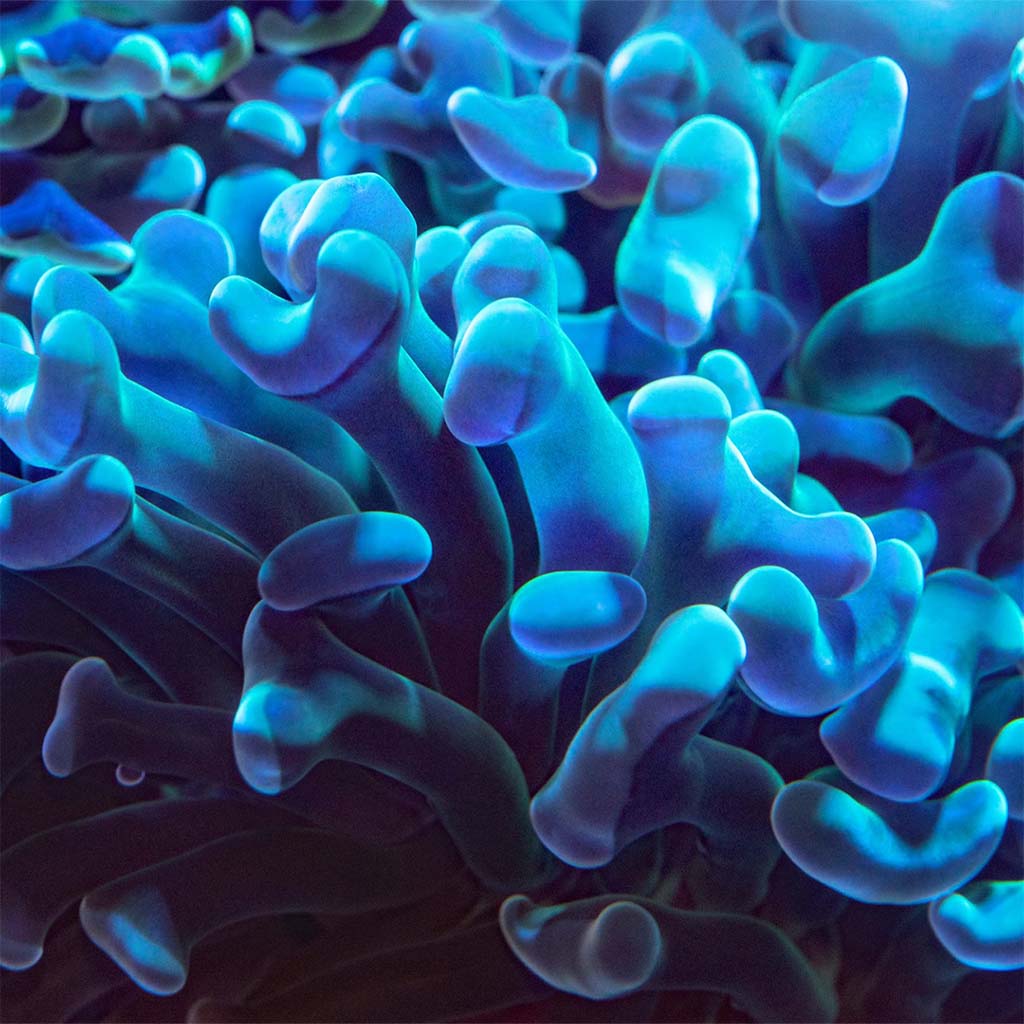
Cover Photo Credit:
Hammer Coral (Fimbriaphyllia ancora) needs moderate light and moderate flow that changes direction, and is fed a fine food once or twice a week. Set aside at least 150 litres (39.6 gallons) and keep temperature at 24-26 °C (75.2-78.8 °F) and alkalinity at 8-11 dKH. Its tentacles sting neighbouring corals, so leave at least 15 cm (5.9 in) to the nearest neighbour. The current IUCN category is Least Concern; choosing an aquacultured frag still reduces pressure on wild collection.
Hammer Coral is a large polyp stony coral named after the hammer or anchor shaped swelling at the tip of its tentacles. The tentacles are thick and tubular, and most of them carry few or no side branches; on some colonies the swollen tip looks like a letter T, on others like a crescent. Colour runs from blue-grey to orange, and the rim of each tentacle tip is often edged with a cream or green band (Veron and Pichon, 1980). That field of tentacles swaying all day in your aquarium is what makes the species one of the most sought after LPS corals.
Veron and Pichon described the species in 1980, and for many years it was placed in the genus Euphyllia. Using molecular data, Luzon et al. (2017) showed that the genus split into two separate lineages and raised Fimbriaphyllia, until then treated as a subgenus, to full genus rank. The accepted name today is Fimbriaphyllia ancora (WoRMS, 2026). The same study found that colony shape evolved independently in the two genera, and that what really separates them is tentacle shape. That is why Frogspawn Coral (Fimbriaphyllia divisa) and Branching Hammer Coral (Fimbriaphyllia paraancora) now sit in the same genus as Hammer Coral, while Torch Coral (Euphyllia glabrescens) has stayed in Euphyllia.
The difference between Hammer Coral and Branching Hammer Coral lies in the skeleton. The first builds wall shaped, winding valleys with the polyps lined up along them; in the second each polyp sits at the end of its own branch (Veron and Pichon, 1980). Because their tentacles are almost identical, the two species can only be told apart by looking at the base of the colony. In the aquarium this difference shows up during propagation. We cover it in the Breeding Behavior section.
The species lives only in the Indo-Pacific: Corals of the World records it in 68 marine ecoregions and has no record of it in the Atlantic (Veron and Pichon, 1980). The weight of the 1,146 records gathered in GBIF lies in the Western Pacific, led by Australia, New Caledonia, Indonesia, Japan and the Philippines, with a handful of records on the Indian Ocean side from Mayotte, the Maldives and Chagos (GBIF, 2026). Fiji and Tonga, often named in older care sheets, do not appear in those records. Depth records cluster largely between 2-15 m (6.6-49 ft), and the deepest record is 29 m (95 ft).
The sources diverge on colony size. Corals of the World writes that individual colonies seldom exceed 1 m (3.3 ft) across, but that on shallow ground exposed to moderate wave action the species can form a continuous cover many metres wide (Veron and Pichon, 1980). Shikina et al. (2024), on the other hand, reported colonies 1-6 m (3.3-19.7 ft) in diameter at a depth of about 10 m (33 ft) in Nanwan Bay, southern Taiwan.
There is a marked gap between the figures the two sources give, and neither explains it; we report the values as the authors gave them. Both measurements are the diameter of the colony on the substrate, not the size of a single polyp. The pieces sold for aquaria, by contrast, carry one or a few heads, and their size is set less by growth rate than by your own propagation schedule.
In Hammer Coral care the first decision is volume: we recommend setting aside at least 150 litres (39.6 gallons). The reason is not the size of the colony but the reach of its tentacles. The polyps can extend much further than they do by day, especially after the lights go out, and they start tissue loss wherever they touch a neighbouring coral. In a small aquarium keeping that distance for every coral becomes hard. If you plan to keep several colonies or close relatives in a mixed reef, a volume of 250 litres (66 gallons) or more makes placement far more comfortable.
The values you can aim for are 24-26 °C (75.2-78.8 °F) temperature, 1.024-1.026 specific gravity (32-35 ppt) salinity, 8.1-8.4 pH and 8-11 dKH alkalinity. Hammer Coral builds its skeleton from calcium and carbonate in the water, so you need to keep calcium at 400-450 ppm and magnesium at 1,250-1,350 ppm, and keep both stable. Measuring them weekly with test kits lets you catch a drift before the coral reacts to it.
Moderate light intensity is enough. When the lighting is too strong, Hammer Coral shortens its tentacles and stays closed; when it is too weak, the colony loses colour. You can place the colony in the middle or lower zone of the aquarium and adjust its position by watching how the polyps open over a week or two.
In the wild, large colonies are found on shallow ground exposed to moderate wave action (Veron and Pichon, 1980), and that is what you are after with flow as well. The tentacles should sway without being pushed flat in one direction. A strong flow that always comes from the same side wears down the tentacle tips and stops the polyps opening fully. To build a flow that arrives from two points and keeps changing direction, all you need to look at is wavemaker placement.
Hammer Coral carries single-celled algae called zooxanthellae in its tissue and takes a significant share of its energy from their photosynthesis. The tentacles are not long for nothing, though: their cnidocytes, the stinging cells that fire tiny harpoons, catch small organisms and particles from the water. We found no published study measuring how much of this species’ energy comes from light and how much from prey, so the recommendations below rest on established aquarium practice.
For Hammer Coral feeding, offering a fine food once or twice a week is enough. The options that will do the job are these:
You can feed with a pipette, in small amounts, placing the food where the flow will carry it over the tentacles. Switching the wavemakers off for a few minutes while you do this keeps the particles on the tentacles. The polyps pull inward to carry captured food to the mouth; it is better not to give a large piece to a colony that does not open its mouth fully, because a piece it cannot swallow rots on the tissue.
With this species overfeeding is the most common mistake. Uneaten food returns to the water as organic load, raises phosphate and opens the door to an algae bloom. If your colony opens well and keeps its colour, there is no reason to increase feeding.
Its temperament is aggressive. Hammer Coral uses its tentacles to claim space, and its cnidocytes cause tissue loss wherever they touch another coral. Stony corals can develop tentacles that serve only to attack rivals, many times longer than normal tentacles, and these usually extend at night. That is why you need to leave at least 15 cm (5.9 in) between the colony and its nearest neighbour, measured from the tentacle tips of the fully open colony.
Relations with species of the same genus are much gentler. Aquarists commonly report Frogspawn Coral and Branching Hammer Coral colonies living next to Hammer Coral without trouble, even touching it. The same observation is reported less consistently for Torch Coral. When you put two colonies side by side for the first time, it is worth watching the first week closely; if you see tentacle tips retracting or tissue tearing, move them apart.
With soft corals the pressure comes from the other direction. Species such as Neon Pineapple Tree Coral, which claim space by releasing chemical compounds into the water, can disrupt this colony’s opening without any contact. In a mix like that, keeping activated carbon running permanently and not placing the two colonies in the same line of flow makes your job easier.
Fish rarely cause trouble for Hammer Coral. In some aquaria clownfish adopt Hammer Coral in place of an anemone and settle into the colony; because this can keep the colony closed for long periods, you need to watch it. The ones to be careful with are polyp nippers: most butterflyfish species and some angelfish genera bite the tentacles. Small shrimp and snails, for their part, can be caught if they get too close to the tentacles. That is why the Reef Compatible field in the Species Info Box is marked With caution: the species is a natural member of a reef aquarium, but its placement needs planning.
Hammer Coral propagation is documented in aquaria, and that production is asexual. Aquacultured colonies are multiplied by fragging, which means growing pieces cut from a mother colony on their own. CITES records track these pieces under a source code separate from wild collected colonies, and Hoeksema (2026) showed that exports of this species recorded as cultivated peaked in Indonesia in 2017 at 27,100 pieces a year.
On a wall shaped colony the cut runs through the skeleton, and you need to leave at least one healthy polyp on every piece; with Branching Hammer Coral separating a branch at its base is enough. You can fix the cut piece on a plug or a piece of rock. In shops these stones are usually sold as frag plugs.
Sexual reproduction in the wild has been the more talked about topic in recent years. The species has separate sexes, meaning a colony produces either only eggs or only sperm in a given breeding season. Gametes are released into the water and fertilisation takes place in open water (Luzon et al., 2017). In Nanwan Bay spawning happens in late April or May (Shikina et al., 2024). Twan et al. (2003) measured that the hormone estradiol peaks in colony tissue just before spawning, and that a water-soluble form of the hormone rises in the water during spawning.
The real surprise concerns sex. Shikina et al. (2024) ran monitoring spread over eight years at two sites in Nanwan Bay and showed that about 70% of colonies changed sex after spawning every year; the change repeated for at least three to four consecutive years. The switch from female to male was complete 4-5 months after spawning, while the switch from male to female happened within the first 0-3 months. No size difference was found between colonies that changed sex and those that did not.
The same authors also note that the species is among the most sought after in the ornamental coral trade, that pieces are largely collected from the wild and propagated asexually, and they write that establishing a full life cycle through sexual propagation would benefit both conservation and the industry. We found no documented record of Hammer Coral being bred sexually in an aquarium. Although coral spawning under laboratory conditions has succeeded in another LPS species, Open Brain Coral (Trachyphyllia geoffroyi), there is no record for this species. The absence of a documented record does not mean the species cannot be bred.
The fastest moving problem in Hammer Coral is tissue melt. In the condition aquarists call brown jelly disease, a brown, jelly-like layer builds up on the polyps and the tissue dissolves within a short time. One of the agents linked to this condition is ciliates, single-celled organisms that swim with the tiny hairs on their surface. Ding et al. (2022) identified a ciliate called Philaster lucinda in cultured corals: it entered the coral’s gut cavity through the mouth, settled in the inner tissue, caused polyp shrinkage within 12 hours and 100% mortality within 72 hours. The infection started in a related species, Torch Coral, and spread to other corals including Acropora and Goniopora.
When you see brown jelly, move the affected colony to a separate container immediately, because the problem can pass to neighbouring corals in the same water. Clearing the jelly away from the tissue with a pipette or a gentle stream of water, then separating the section of skeleton that holds dead tissue from the healthy part, is common aquarium practice. On a wall shaped colony, cutting off the healthy heads and saving them one by one is far better than losing the whole colony. Commercial coral dips are also used in this process; following the manufacturer’s dose and timing is all you need to do.
Observing every newly arrived colony in a separate container for 2-3 weeks before it goes into the main aquarium largely prevents both this risk and hitchhikers such as flatworms. Sudden temperature swings, falling alkalinity and tissue damaged in transport prepare the ground for an infection to take hold. Copper-based medications should never enter an aquarium with corals under any circumstances.
The Venomous field in the Species Info Box is marked No. That field asks about a sting that is dangerous to people, and we found no such record for this species; the cnidocytes do their real work on neighbouring corals. Wearing gloves during maintenance is still a good habit.
We found no published data on lifespan. Shikina et al. (2024) were able to follow the same colonies for years and reported colonies 1-6 m (3.3-19.7 ft) in diameter, but they did not measure colony age. The 11-20 years in the Species Info Box rests on aquarium practice. For a colony that is propagated by cutting, the practical limit is not the age of the colony anyway but the continuity of your care.
The assessment (Shlesinger et al., 2024) looks at the global total of the species; it does not show losses on individual reefs. A low category does not mean that every colony collected from the wild comes without a cost either.
Hammer Coral is one of the most sought after corals in the aquarium trade. Hoeksema (2026) examined CITES records from 1990-2021 and showed that Hammer Coral was among the most traded stony corals over that period, at about 700,000 pieces. For wild collected colonies the annual peak was 30,500 pieces for Indonesia in 2005 and 53,600 pieces for Australia in 2021. According to the same study, Australia has taken the lead in exports of wild collected colonies, and numbers have risen steeply in recent years.
The trade regulation picture is clear. All stony corals have been listed in CITES Appendix II since 1989 (Hoeksema, 2026). That means trade in Hammer Coral is not banned, but every shipment requires documentation, and its source, whether wild collected or cultivated, goes on record.
The practical step open to an aquarist is the choice of supply. Choosing an aquacultured frag when you buy keeps you out of the pressure on wild collection, and an aquacultured colony is already used to aquarium conditions. Asking the seller where the colony came from is all it takes.
Have you kept Hammer Coral, and how did your colony get along with its neighbouring corals? Leave it in the comments below. Someone else keeping the same species will see far more clearly where to place their own colony once they read what happened in your aquarium.
References:
Was this guide helpful?
Like, save to your profile and reach more people.
Share:
Species Info Box
Temperature
Salinity
pH
Alkalinity
Venomous
Aquarium Size
Maximum Size
Lifespan
Color Form
Reef Compatible
Diet
Temperament
Care Level
Breeding
Genus
Family
Origin
We use cookies to personalize content, provide social media features, and analyze our traffic. We also share information about your use of our site with our analytics partners. You can change your preferences at any time. For more information, please see our Privacy Notice and Cookie Notice. Privacy Notice Cookie Notice
We sent you a confirmation link. Click it to finish subscribing.
