
Cover Photo: Pauline Walsh Jacobson, licensed under CC BY 4.0; cropped and resized.
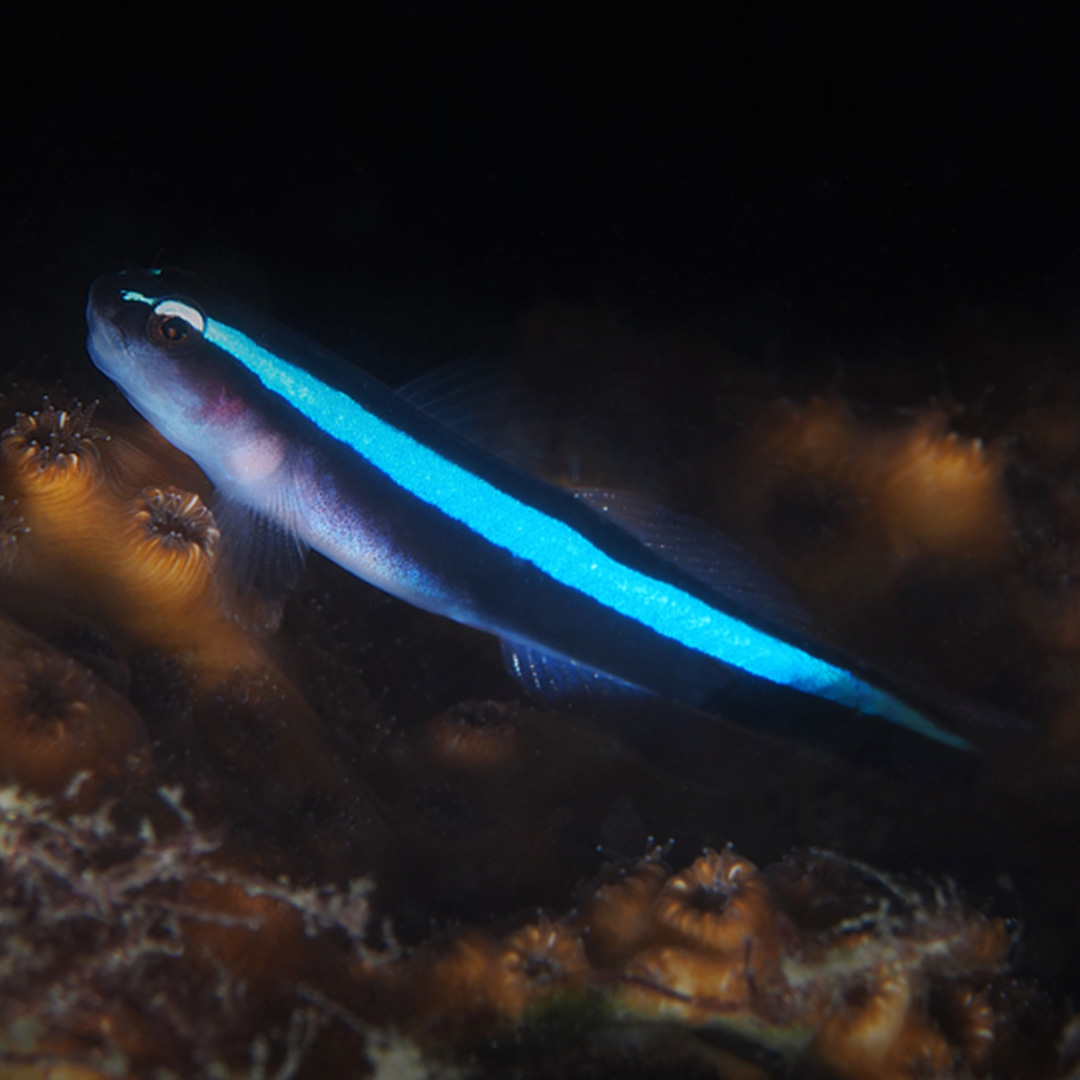
Cover Photo: Pauline Walsh Jacobson, licensed under CC BY 4.0; cropped and resized.
The Neon Goby (Elacatinus oceanops) is a small cleaner goby that reaches 5 cm (2 in) at most. A single fish or a pair needs 40 l (10.6 gallons), 24-27 °C (75.2-80.6 °F) and a specific gravity of 1.023-1.025. Feed small frozen foods two or three times a day. It is listed as Least Concern and bred in captivity, so choose a captive-bred fish.
The Neon Goby is the cleaner goby you are most likely to meet in the aquarium trade, and it takes its name from the bright blue stripe that runs from just in front of the eye to the base of the tail. Jordan described the species in 1904 from specimens collected in the Tortugas, south of Florida. It was placed in the genus Gobiosoma for a time; today WoRMS records the accepted name as Elacatinus oceanops and the family as Gobiidae (Froese & Pauly, 2026b). If you see the name Gobiosoma in an older book or on a dealer’s label, it refers to the same fish.
The back is dark, almost black, the belly is pale, and a dark blue stripe runs along the body between the two. FishBase notes that the pale stripe in front of the eye does not reach the tip of the snout (Froese & Pauly, 2026a). The largest total length the same source reports, measured from the tip of the snout to the end of the tail fin, is 5 cm (2 in). That is the value in the Species Info Box; most aquarium specimens stay a little below it.
Its range is limited to the Western Central Atlantic. FishBase records the species from southern Florida to Texas and south to Belize, at depths of 1-45 m (3-148 ft) and water temperatures of 21-28 °C (69.8-82.4 °F) in the wild (Froese & Pauly, 2026a). The Gulf of Mexico falls under Northwest Atlantic in the Species Info Box and the coast of Belize under Caribbean, so two origin boxes are ticked. The Neon Goby does not live in the Pacific; the Red Head Goby (Elacatinus puncticulatus), which lives in the Eastern Pacific, is a different species of the same genus.
Stripe colour varies from species to species in this genus, and there is a reason for it. Lettieri et al. (2009) showed that the ancestral stripe in the genus was yellow and that the blue stripe appeared later. By modelling the colour vision of 25 reef fishes, they also measured that a blue stripe stands out more clearly than a yellow one to most client fishes against a reef background; the blue-striped species they measured was the Neon Goby. Among the related species we have published, the Yellow Line Goby (Elacatinus figaro) still carries a yellow stripe.
For a single fish or an established pair, at least 40 l (10.6 gallons) is enough. The Neon Goby is a small fish that swims little, so it barely counts when you work out the total bioload of your aquarium. In neon goby care, the number of fish sets the volume: FishBase records the species as monogamous (Froese & Pauly, 2026a), so the aquarium is planned around a single pair of one male and one female, or a single fish. This volume rests on established aquarium practice, not on a published study.
The values to aim for are 24-27 °C (75.2-80.6 °F), 1.023-1.025 specific gravity salinity, 8.1-8.4 pH and 8-11 dKH alkalinity. dKH is the unit aquarists use for alkalinity, the water’s capacity to buffer against a drop in pH. In the wild the species lives in water between 21 °C and 28 °C (69.8-82.4 °F), which means it tolerates a few degrees below and above the target range. What the Neon Goby asks of you is not a narrow range but values that do not swing from day to day.
In the wild it lives on coral heads, and client fishes come to these spots to be cleaned (Froese & Pauly, 2026a). The aquarium equivalent is a rockwork with plenty of ledges and holes. The fish spends most of the day on a rock or coral surface, always at the same few spots; an open, flat surface near the top of the rockwork makes a natural place for it to run its cleaning station.
Small gobies jump when startled. Covering the aquarium, or keeping the water level a few centimetres below the rim, prevents most of these losses. Gaps left around the lid count too, because a fish this size can slip through an opening the width of a finger.
In the wild the Neon Goby is an obligate cleaner, meaning it gets almost all of its food from the external parasites it picks off other fishes. FishBase records that it takes these parasites from the client’s skin, fins, mouth and gill chambers, and that its clients include large fishes such as groupers (Froese & Pauly, 2026a). Ranucci et al. (2024) describe the species as a dedicated cleaner and note that in the wild it moves large clients with heavier parasite loads to the front of the queue.
The most important of these parasites are gnathiid isopods, small crustaceans that feed on fish blood and are hard to see with the naked eye. Working on a related species, the Sharknose Goby (Elacatinus evelynae), Artim et al. (2017) found gnathiids in the gut of 93% of cleaner gobies collected in the morning and counted an average of 6.3 per fish. The finding belongs to the related species, not the Neon Goby; still, it shows how narrow the natural diet of this genus is.
In the aquarium that narrow diet is rarely a problem, because captive-bred fish arrive already used to prepared food. Foods you can offer:
Feeding two or three times a day, in portions small enough to finish within a few minutes, is enough. If the current carries the food away quickly, bringing it close to where the fish sits with a pipette makes things easier.
The most expensive mistake with this species is buying a Neon Goby to solve a parasite outbreak in your aquarium. Its cleaning behaviour continues in the aquarium, but we found no study showing that it can stop an outbreak of white spot (Cryptocaryon irritans). A small cleaner added to an aquarium full of sick fish is no substitute for parasite treatment and takes its own share of the outbreak.
The Neon Goby’s temperament is peaceful, and it causes no trouble with other species. FishBase records the species as monogamous (Froese & Pauly, 2026a); in the wild one male and one female live together. Keeping a single fish or a single pair in your aquarium is therefore the safest choice.
If you want a pair, the easiest time to tell the sexes apart is just before the breeding season. Valenti (1972) reported that at that time the female’s belly becomes swollen and translucent while darker pigment appears on the male’s belly; outside that period the two sexes are hard to tell apart.
The cleaning behaviour carries on in the aquarium; the fish runs a spot on the rock as its station and moves over the fishes that come near it. In an experiment with captive-bred fish, Ranucci et al. (2024) measured that 10 of 13 fish learned to choose the larger of two plates standing in for a client fish, while only 2 of 12 succeeded when the cue was colour or position. The authors linked the difference to the species’ natural preference for large clients.
The compatibility list is short and clear. It lives without trouble alongside clownfish, cardinalfish, firefish and other small, peaceful reef fishes. Species that can hunt a fish small enough to fit in their mouth, such as lionfish and larger hawkfish, must not share the aquarium; you cannot count on a predator that leaves cleaners alone in the wild to do the same in an aquarium. It shows no interest in corals or invertebrates, which is why reef compatibility is marked Yes in the Species Info Box.
Neon goby breeding has been documented in the aquarium, and two scientific studies followed the process from egg to larva. Valenti (1972) reported that three pairs kept in 40 l (10.6 gallons) aquariums at 28 °C (82.4 °F) spawned two or three times a month from mid-December to early May. The pair attaches its eggs to the inside ceiling of an upturned shell, and each spawning counted 300-450 eggs. Feddern (1967), for his part, reported a clutch of about 100 eggs and, in one pair, 9 successive spawnings at two-week intervals.
After fertilisation the egg capsule reaches 2.3 mm (0.091 in) in length, and the two studies agree on this value. Valenti (1972) measured that hatching takes 150-160 hours at 28 °C (82.4 °F), that the larva hatches at 4.0 mm (0.16 in) and that it reaches 4.5 mm (0.18 in) in three days. Feddern (1967) reported about 175 hours and 3.4 mm (0.13 in) at 24-27 °C (75.2-80.6 °F). Around 4% of embryos fail to turn the right way inside the egg and never hatch (Valenti, 1972).
Only the male guards the eggs. Valenti (1972) showed that when the male was removed, development was delayed by up to 12 hours and the eggs seldom hatched; a fine stream of air bubbles over the eggs in place of the male restored normal development and hatching. In the same study, frequent disturbance did not lead the male to abandon or eat the eggs. The natural spawning season runs from February to April (Feddern, 1967). The Yes value in the Species Info Box rests on this documented aquarium breeding; the fish in the experiment by Ranucci et al. (2024) also came from an ornamental aquaculture facility.
There is no scientific measurement of lifespan; no study has measured it in the aquarium or in the wild. The 1-2 years in the Species Info Box rests on aquarists’ observation that most specimens live one to two years in the aquarium. If that expectation holds, losing a fish that has passed its second year is, in most cases, not a sign of a mistake in your care.
Before moving a new fish into the main aquarium, it is worth observing it for at least 30 days in a separate quarantine aquarium. A cleaner fish comes into direct contact with other fishes’ parasites; quarantine protects both it and the fishes you already keep. The earliest warning sign during this time is feeding: if the fish refuses every food you offer for three days, or holds its fins clamped to its body and breathes rapidly, postpone the move to the main aquarium.
In small aquariums most problems come from water chemistry. Measuring ammonia, nitrite and nitrate regularly with your test kits lets you see a value drifting in a volume as small as 40 l (10.6 gallons) before the fish is affected.
On the safety side there is nothing to worry about. The Neon Goby has no venomous spine, and FishBase lists the species as harmless to humans (Froese & Pauly, 2026a). The Venomous field in the Species Info Box is therefore No.
On the IUCN Red List the Neon Goby is in the Least Concern (LC) category, meaning it is not considered to be under any near-term threat. The assessment is by van Tassell et al. (2015). It was assessed on 1 March 2010, published in 2015 and is global in scope. No new assessment has been made since. The record lists the population trend as unknown. IUCN lists the species under the name Northern Neon Goby.
As threats, the record lists coastal housing, industrial and tourism development, pollution from urban, industrial and agricultural sources, and extreme temperature events; it also notes that the species is used in the ornamental fish trade at national and international level (van Tassell et al., 2015). The genus Elacatinus does not appear in the CITES Checklist at all, so the species needs no CITES permit in international trade (CITES, 2026). National import rules work separately from this.
The one practical thing an aquarist can do is on the supply side. The Neon Goby can be bred in aquariums and captive-bred fish are available in the trade, so there is no reason to buy a wild-caught specimen. Asking the seller whether the fish is captive-bred or wild-caught is the quickest way to tell the difference.
Have you kept a Neon Goby, did you keep it alone or as a pair, and did it set up a cleaning station in your aquarium? Leave it in the comments below. Someone else keeping the same species will see far more clearly how their own pair is likely to behave once they read what happened in yours.
References:
Was this guide helpful?
“Your answer helps us improve our guides.”
Share:
Species Info Box
Temperature
Salinity
pH
Alkalinity
Venomous
Aquarium Size
Maximum Size
Lifespan
Color Form
Reef Compatible
Diet
Temperament
Care Level
Breeding
Genus
Family
Origin
No cookies in this category.
We use cookies to personalize content, provide social media features, and analyze our traffic. We also share information about your use of our site with our analytics partners. You can change your preferences at any time. For more information, please see our Privacy Notice and Cookie Notice. Privacy Notice Cookie Notice
We sent you a confirmation link. Click it to finish subscribing.