Feed small portions two or three times daily: chopped frozen mysis, enriched brine shrimp, cyclops and micro pellets under 3 mm (0.12 in). It cleans parasites off tankmates but cannot live on that alone. At 3 cm (1.2 in) with no fat reserves it loses condition in days, so watch it eat. Keep one fish or a bonded pair in 60 l (15.9 gallons), and buy captive bred: a Brazilian endemic listed as Vulnerable.
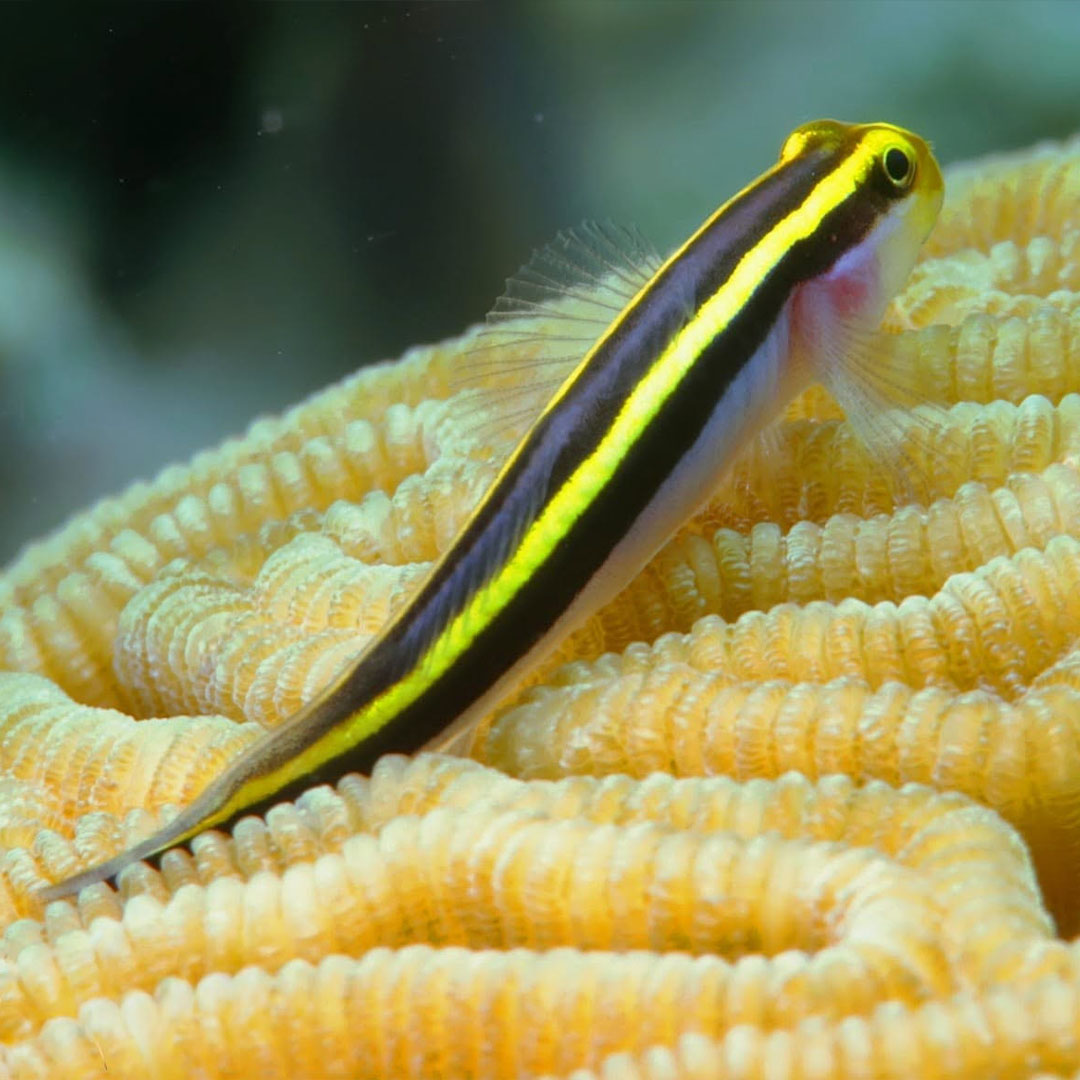
Most saltwater fish are named for how they look. The Yellow Line Goby is named for what it does. Sazima, Moura and Rosa described the species in 1997 and took figaro from Beaumarchais’s barber, for a plain reason: this fish runs a cleaning station and spends its day picking parasites off its customers. The body is close to black, carrying a bright yellow stripe along the back and a second one along the belly. The pectoral fins are opaque blue. The pelvic fins have fused into a suction disc, and the fish grips bare rock with it.
The yellow stripe is the shop sign. Dias et al. (2015) found a white individual on a rocky reef in southeastern Brazil, running its own station right beside normally coloured neighbours. Their reading: this fish could not advertise for itself, and it owed its visibility to the group around it.
The species is endemic to Brazil and lives nowhere else on Earth. Its range runs from Santa Catarina in the south to Pedra do Sal in Piauí in the north. Almeida et al. (2016) drew that northern limit, collecting five specimens about 550 km (342 mi) past the previously known boundary, in water only 0.5-2 m (1.6-6.6 ft) deep. Its normal working depth is 3-20 m (10-66 ft) over coral and rocky bottom (FishBase, 2026).
Conservation is not a detail you can skip with this fish. The IUCN assessment lists it as Vulnerable (read through FishBase, 2026, not from the Red List page itself), but Almeida et al. (2016) argued for the next category up, Endangered. Their case rests on the area the species actually occupies: not the span between its outermost records, but the seabed it genuinely lives on. They measured only 340 km² (131 sq mi), and set beside it an estimated 30% decline over a decade driven by reef degradation and illegal collection. So buy captive bred stock. With this species there is nothing to be said for a wild caught fish.
A single fish or a bonded pair needs 60 l (15.9 gallons) as a floor. That number does not come from swimming distance, because this goby barely swims. What sets it is layout: the pair needs a rock perch with open water in front of it, enough clear volume for clients to queue in, and enough distance that other bottom dwellers are not crossing the station all day. In a small aquarium two unpaired adults will fight over the best perch. The loser stops feeding.
Target values are these: 23-27 °C (73.4-80.6 °F), 1.023-1.025 specific gravity (34-36 ppt), pH 8.1-8.4 and 8-12 dKH alkalinity. Published larval rearing ran at 24.9 ± 1.6 °C (76.8 ± 2.9 °F) and 36.1 ± 1.6 g/l salinity (Meirelles et al., 2009). So the range above is not guesswork; the temperature at which this species was comfortable enough to spawn sits right in the middle of it.
Sand depth matters less here than mature live rock with vertical faces and small caves. The fish sleeps in a crevice, cleans from a ledge, and in the wild backs into sea urchin spines when something large comes past (FishBase, 2026). Gobies jump when startled; a tight lid or a mesh screen over the aquarium will remove a loss that is common and entirely avoidable. One note on where these numbers come from: the minimum volume, pH and alkalinity targets rest on established aquarium practice, since no husbandry trial has been run on this species yet. Temperature and salinity have the rearing study above behind them.
Calling this fish a cleaner is correct but incomplete. Mazzei et al. (2021) sampled populations across Brazilian marginal reefs and found high feeding and behavioural plasticity: diet varies markedly from site to site, the ectoparasite load it takes in does not match how heavily local fish are infested, and goby density shows no relationship with client abundance or diversity. Cleaner fish are usually sorted into two types: those that get almost all their food from cleaning, and those whose main food is something else and who clean when the chance comes. Their conclusion: this species fits neither type, and which one it leans toward is set by the reef it lives on.
For aquarists that is good news. A Yellow Line Goby does not need an aquarium full of parasitised fish to survive, because it takes prepared food readily. Feed small portions two or three times a day:
The risk with this species is not fussiness, it is starvation. A 3 cm (1.2 in) fish with no fat reserves can lose condition in days rather than weeks. In a busy community aquarium it is easily outcompeted at feeding time, so do not assume it is eating, watch it eat.
Sazima et al. (2000) recorded 484 cleaning sessions on rocky reefs in southeastern Brazil and counted 34 client species from 16 families coming in to be cleaned. Damselfish accounted for 37.9% of sessions and grunts for 16.9%, with planktivores dominating overall. The fish coming in ran 4.5-55 cm (1.8-21.7 in), mostly 12-30 cm (4.7-11.8 in). The cleaner itself is 2-4.5 cm (0.8-1.8 in), so its clients are 1.5 to 15 times longer than it is.
The same study puts about 109 sessions and 30 minutes of active cleaning per station per day. The shop opens at dawn and closes shortly before dark. The busiest hours are early morning and mid-afternoon; trade slows at midday. Expect the same in the aquarium: your tangs and angelfish will start queueing, and the goby will get to them on its own schedule.
Toward other fish this is a peaceful species, but not toward its own kind. Keep it singly or as a bonded pair, and buy the pair together rather than adding a second adult later. Good companions are the usual small to medium reef community: clownfish, cardinalfish, firefish, dartfish, blenny, anthias, small wrasse and small tang.
Do not house it with anything that can swallow a 4 cm (1.6 in) fish. That rules out lionfish, frogfish, moray eel, larger grouper, hawkfish, larger dottyback and heavy bodied wrasse such as Coris. Being a cleaner does not buy immunity. On the reef a dusky grouper is a client, but that truce depends on a working cleaning station and open water to leave through, and a closed aquarium has neither.
This section gets a rare Yes. Meirelles et al. (2009) documented the full cycle in captivity. The eggs are elongated: about 2.1 mm (0.08 in) on the long axis and 0.7 mm (0.03 in) on the short one. Clutches run 140-700 eggs, averaging 411 ± 158. Incubation took 6.8 ± 0.8 days at 25.2 ± 1.7 °C (77.4 ± 3.1 °F), hatching averaged 69.7 ± 24.1%, and the best clutch reached 99.5%.
Larvae hatch at roughly 3 mm (0.12 in). They eat rotifers for the first 25 days and Artemia nauplii after that, on a 16 hours light, 8 hours dark photoperiod. They settle to the bottom 44 ± 4.9 days after hatching, with metamorphosis complete between days 30 and 44. Best larval survival to metamorphosis was 30.6%, and losses after that were negligible. The hard part is not getting them to spawn, it is carrying the larvae through that long planktonic stretch.
Feed quality decides the outcome. Shei et al. (2012) gave first feeding larvae n-3 HUFA enriched rotifers and compared them against an unenriched control group. At 14 days survival was 35.7% against 11.1%, and larvae in both groups had reached about 6 mm (0.24 in) standard length. The gap is threefold, but the sample was small enough that it fell just short of significance (P = 0.055).
Captive production is commercial now, not experimental. Mota et al. (2023) modelled small scale urban breeding of this species and found six of nine scenarios profitable. Sale prices run US$5.71-9.52 per fish and production costs start at US$3.99. This is the economics that lets a threatened Brazilian endemic be bought without taking one from the wild.
A cleaner goby really does work as parasite control, within limits. Martins et al. (2025) infected 108 Lebranche mullet (Mugil liza) with the monogenean Neobenedenia melleni and stocked groups with one, two, three or six cleaners. Fish kept with one to three cleaners returned haemogram values close to the uninfected group. In parasitised fish left without cleaners, erythrocyte and lymphocyte counts rose. So the cleaners cut the parasite load without adding measurable stress.
Do not generalise that to disease management as a whole. The published evidence covers only a large bodied monogenean living on the outside of the host. Cryptocaryon and Amyloodinium work differently: they leave the host and reproduce in the substrate, and no goby clears those. Quarantine every new fish, and treat in that separate system.
Copper and formalin are the main chemical risks. Small thinly scaled gobies tolerate both poorly, and a dose calculated for a tang can kill the cleaner in the same aquarium. If a shared system needs copper, take the goby out first, and remember that copper bound in rock and sand leaches back for months.
Drip acclimate new arrivals over 45 to 60 minutes. Watch for a fish that abandons its cleaning station and settles on the sand; that is usually the first visible sign of starvation or gill irritation. Lifespan is short by reef fish standards, commonly reported at two to three years in aquaria. That is the species’ own limit, not a husbandry failure.
Cover Photo Credit: Joseph Binns
References:
Was this guide helpful?
Like, save to your profile and reach more people.
Share:
Species Info Box
Temperature
Salinity
pH
Alkalinity
Venomous
Aquarium Size
Maximum Size
Lifespan
Color Form
Reef Compatible
Diet
Temperament
Care Level
Breeding
Genus
Family
Origin
We use cookies to personalize content, provide social media features, and analyze our traffic. We also share information about your use of our site with our analytics partners. You can change your preferences at any time. For more information, please see our Privacy Notice and Cookie Notice. Privacy Notice Cookie Notice
We sent you a confirmation link. Click it to finish subscribing.
