
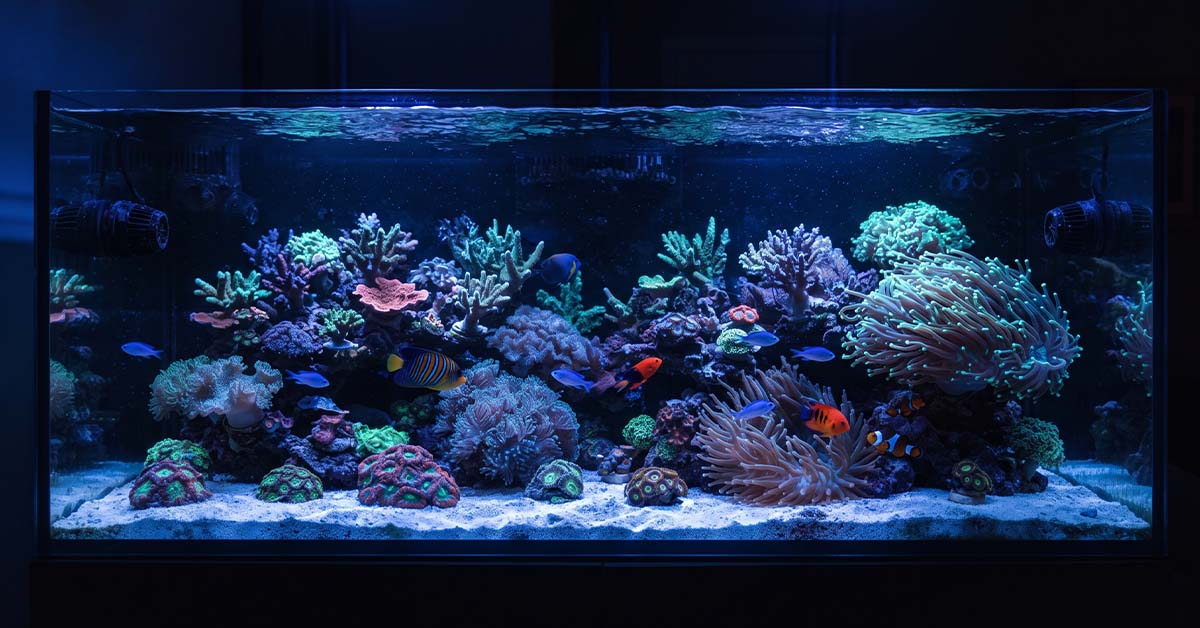

Switching from T5 to LED changes, in a single day, the light your corals have been living under for months. You take the old fixture down, hang the new one, and within the first week you may see polyps staying shut during the day or colours going pale. This guide covers what actually changes between the two fixtures, what to measure before the new one goes up, and which steps to open the light through over four weeks.
What Actually Changes When Switching from T5 to LED?
Most aquarists treat this as a question of intensity and ask only whether the new fixture is stronger. Three things change at once: how the colour of the light is distributed, how large the source is, and how the light spreads through the aquarium. A T5 fixture sets several bulbs side by side and produces a wide, even field; an LED is built from small, directional sources with gaps between them. Switching from T5 to LED is therefore not a simple fixture change.
Your corals feel all three differences at once. The rise in light intensity is only the most visible one. Photoinhibition, meaning damage to the photosynthetic chain from too much light, was described long ago: Warner et al. (1999) measured the D1 protein at the centre of that chain in naturally bleached Montastrea colonies and found it down by roughly 60%. Making the switch gradual is not optional.
Your corals need weeks to settle into new light. DiPerna et al. (2018) measured photoacclimation in a branching Acropora species and found it running longer than 20 days. Jeans et al. (2013) showed that colonies held under high light for two weeks became more dependent on a cycle that continuously repairs the photosynthetic centre. Coral bleaching begins the moment repair falls behind damage.
Measure What Your Old T5 Fixture Really Puts Out
The whole plan for switching from T5 to LED rests on one measurement. Start while the old fixture is still hanging, because once it comes down you have no reference left. The value to read is PAR, the light that reaches the spot where the coral sits and can be used in photosynthesis. If you do not own a PAR meter you can borrow one from a local aquarium group or rent one for a day; a single set of readings frames the entire transition.
When you are switching from T5 to LED, what you measure is not the number in the fixture’s catalogue. Fluorescent bulbs lose part of their output long before they stop lighting up, so the figure you get from a one year old set sits below what it was on the first day. That works in your favour: your corals have been living under a reduced intensity for months, and the gap between a worn T5 set and a new LED can be wider than you expect.
The same logic runs in reverse. Move to an underpowered LED and the light does not rise, it falls, and your corals decline from too little of it instead: DiPerna et al. (2018) reported growth down by as much as 90% under a low light regime. If you have not chosen the fixture yet, we covered which technology suits which coral group in our guide to the best aquarium lighting for corals.
The Same PAR Reading Is Not the Same Light
PAR is a total, and a total says nothing about which colours it is made of. Wijgerde et al. (2014) compared different spectra at the same two intensity levels, 128 and 256 PAR, across 6 weeks; survival, symbiont density and the chlorophyll proxy all shifted with spectrum. This does not mean T5 is warm and LED is blue. The T5 control in that same study was blue heavy as well, carrying roughly 3 times as much blue as red. What changes is not the direction of the colour but how narrow the bands are that the light gathers into.
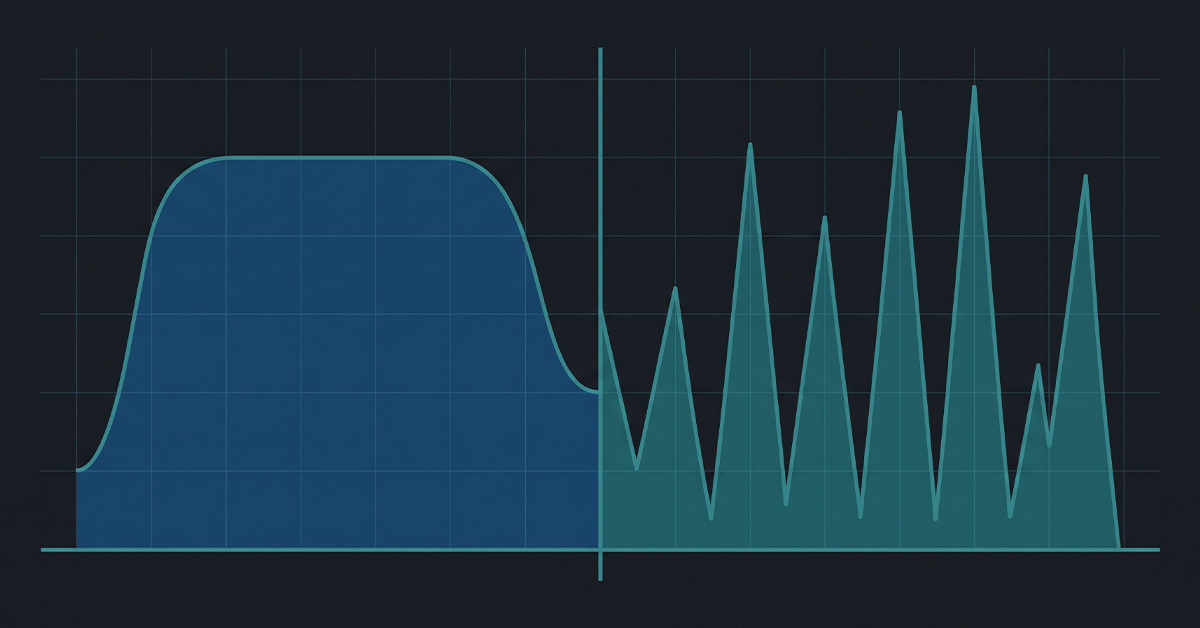
The second difference is the size of the source, and you can see this one with your own eyes. Because an LED is a small, directional source, it focuses the light whenever the water surface breaks; those bright lines travelling across the sand are the result. The number your meter shows is the average of those lines, while the instantaneous peak landing on the coral surface sits above that average. A T5 has no such peak, its light is wide and steady.
Together they mean this: an LED set to exactly the same PAR reading as your old fixture is a harder light for your coral. That is why the first day of switching from T5 to LED cannot be a straight match, and you start a little below the threshold.
Map the Light Across Your Aquarium
Under a T5 fixture the gap between one end of the aquarium and the other is narrow; under an LED the same gap multiplies. A colony directly beneath the fixture body takes the peak value while another one in the corner takes far less. Instead of a single reading you therefore need a grid of about 10 cm (3.9 in), taken at every height where corals sit.
Once the PAR measurements are done the work gets easier. You note the highest and the lowest value and see which colony sits in which zone. The most common mistake when switching from T5 to LED is an intensity set for the middle of the aquarium, which leaves the edge colonies hungry and the middle ones overloaded. The fix is usually moving the fixture a few centimetres or swapping two colonies around.
Open the Light Step by Step over Four Weeks
These are the steps to follow when switching from T5 to LED. The programme below treats your old T5 reading as the start and the new fixture’s target value as the destination. The percentages in the table are not percentages of the control panel but percentages of the measured PAR; you repeat the reading at the end of every step.
| Step | Peak PAR | Photoperiod | What you watch |
|---|---|---|---|
| First day | 70% of your old T5 reading | 6 hours | Whether polyps stay open during the day |
| Week 1 | Your old T5 reading | 7 hours | The first shift in colour tone |
| Week 2 | 70% of the target value | 8 hours | Tissue tension and polyp extension |
| Week 3 | 85% of the target value | 9 hours | The pale sections on growing tips |
| Week 4 | The full target value | 9-10 hours | The overall look of the colonies |
One thing needs attention as you read the photoperiod column, because it trips up most people switching from T5 to LED. A T5 fixture switches on and off, so 9 hours really is 9 hours at full power. An LED has sunrise and sunset ramps, and perhaps 5 of those same 9 hours sit at peak intensity. Comparing the two fixtures by the time spent at peak is more accurate than comparing their clock hours.
If you cannot measure PAR you do not know your starting point, so the same steps stretch to 6 weeks; what shortens the calendar is not the fixture but the reading in your hand. If polyps start staying shut during the day or colours go pale at one step, you can drop back to the previous one and stay there for a week. Your corals set the schedule, not you.
Three Fallback Methods for Fixtures You Cannot Dim
Most LED fixtures sold for saltwater aquariums can be dimmed, but models with nothing but an on/off switch still exist at the cheap end. If your fixture cannot be dimmed you lower the intensity physically, and switching from T5 to LED still spreads across four weeks.
Raising the fixture: this is the cleanest method on a hanging or legged system. You take the fixture 15-20 cm (5.9-7.9 in) above its target height and bring it down 5 cm (2 in) each week. Greater distance does not only weaken the light, it spreads it more evenly across the bottom, which is why you map the light again at every step of the descent.
Shade cloth: garden and agricultural suppliers sell netting with a shading percentage printed on it. The percentage on the packaging is how much light the cloth blocks; a net marked 50% holds back half of it. Stretch the cloth between the fixture and the water surface rather than over the fixture, because the top of the fixture both heats up and needs its fan intakes clear.
Shortening the photoperiod: this method is the fallback to the fallback. It does not lower the peak intensity, so it does not prevent photoinhibition; it only reduces the daily total load. If neither of the other two is possible you can start at 4 hours a day and add 1 hour each week.
When the T5 Goes, So Does the Heat
A four bulb T5 fixture puts heat into the water and the room for as long as it burns. An LED draws less power for the same light and sends most of its heat upward through the fans. After switching from T5 to LED you may therefore see your aquarium temperature drop a little, and your heater will cut in more often to close the gap.
Watching the temperature twice a day through the first week is worth the effort. If you run a chiller the opposite happens and the unit works less often. Keeping a written record of the temperature stops you confusing this shift with a coral response and lets you see, at the end of switching from T5 to LED, which variable did what.
What Your Corals Tell You?
The signs arrive in a set order while switching from T5 to LED. The first is usually polyps staying shut during the day, then colour fades, tissue turns translucent and the skeleton beneath starts to show. There is a sign in the other direction too: if your colony darkens and turns brown the light is too little rather than too much, because the algae have raised their pigments and their density.
What to do at the first sign of stress is drop back one step and wait. Recovery is not quick, and it is the part of switching from T5 to LED that no schedule can speed up. Warner et al. (1999) measured naturally bleached colonies regaining their photosynthetic efficiency and their D1 protein level only three months later. What you gain in a week is always smaller than what you would spend three months repairing.
Is the Light Really the Culprit?
Change nothing else during the week of switching from T5 to LED. A swing in alkalinity or a change in the flow pattern produces a picture in corals that looks a great deal like light stress. If you also moved your wavemaker that same week you cannot tell which variable is speaking.
One criterion is enough to separate them: light driven decline starts in the colonies closest to the fixture and highest on your map, while the ones in shade look well for longer. A problem coming from water chemistry shows up more or less everywhere in the aquarium at once.
Differences by Coral Group
When switching from T5 to LED you cannot apply this programme to every coral in the same way. Most soft corals, Neon Pineapple Tree Coral among them, do well at moderate intensity and are commonly kept in the 50-100 PAR range. Large polyp stony corals are usually targeted at 100-200 PAR and branching stony corals at 200-400 PAR.
A colony that has spent years in the shade under a T5 becomes the fastest to react when it lands under an LED peak. Marking those colonies while you map the light, and moving them if needed, makes the job easier. Every week you do not rush while switching from T5 to LED erases a colour loss that would otherwise cost you months.
How did you handle switching from T5 to LED, and at which step did your corals tell you to stop? Leave it in the comments below. That way someone about to take their T5 fixture down reaches on day one what took you four weeks to learn.
Frequently Asked Questions
How long does switching from T5 to LED take?
Switching from T5 to LED takes four weeks if you can measure PAR at coral level; without a reading the same steps stretch to 6 weeks. The length is not arbitrary: DiPerna et al. (2018) reported photoacclimation in a branching Acropora species running longer than 20 days. If you see decline the calendar extends on its own.
Will there be a problem if I match the PAR of my old T5 fixture?
There can be. PAR is a total and says nothing about which colours it is made of; Wijgerde et al. (2014) reported that different spectra at the same intensity changed survival and symbiont density. An LED is also a point source, so its instantaneous peaks sit above the average. On the first day of switching from T5 to LED, start a little below the old reading rather than matching it.
Can I fit LED tubes into my T5 fixture?
Products that fit physically do exist, but the ballast and the reflector of the fixture were designed for fluorescent tubes, so the spectrum and the spread do not come out the way you expect. The result is usually the worse half of both worlds. Replacing the whole fixture looks more expensive and is the route with a predictable outcome, which is why switching from T5 to LED usually means a new fixture.
I do not own a PAR meter, can I still make the switch?
You can, but you will be working blind. Without a meter the safest route is to start the new fixture at its lowest setting, run it 6 hours a day, and stretch the same steps to 6 weeks rather than four. A meter borrowed for a single day moves the whole transition from guesswork to measurement.
My aquarium temperature dropped after the switch, is that normal?
It is, and it is a normal part of switching from T5 to LED. A T5 fixture puts heat into the water and the room for as long as it burns, while an LED draws less power for the same light and sends most of its heat upward. Your heater cuts in more often to close the gap. Watching the temperature twice a day through the first week is enough to keep this apart from a coral response.
My corals have started to bleach, what should I do?
Drop the intensity back one step and stay there for at least a week. Switching the light off entirely is not the answer, because the algae then face darkness stress and recovery takes even longer. Check your water parameters as well; if coral bleaching started only in the high value zone of your map the problem is most likely the light.
Should I open the blue channels or the whites first?
Common practice runs towards starting with the blues. White channels raise the total light intensity quickly and look bright to your eye, which leads you to open them further than you meant to. Bringing the blues to target first and adding the whites in the last two weeks gives you a cleaner reading and shows which channel produced a colour change.
Cover Photo Credit:
References:
- DiPerna, S., Hoogenboom, M., Noonan, S. and Fabricius, K. (2018). Effects of variability in daily light integrals on the photophysiology of the corals Pachyseris speciosa and Acropora millepora. PLOS ONE. 13(9), e0203882.
- Izumi, R., Tan, E. S., Higa, H. et al. (2023). Effects of light intensity and spectral composition on the growth and physiological adaptation of Acroporid corals. Coral Reefs. 42, 385-398.
- Jeans, J., Campbell, D. A. and Hoogenboom, M. O. (2013). Increased reliance upon photosystem II repair following acclimation to high-light by coral-dinoflagellate symbioses. Photosynthesis Research. 118(3), 219-229.
- Warner, M. E., Fitt, W. K. and Schmidt, G. W. (1999). Damage to photosystem II in symbiotic dinoflagellates: a determinant of coral bleaching. Proceedings of the National Academy of Sciences. 96(14), 8007-8012.
- Wijgerde, T., van Melis, A., Silva, C. I. F. et al. (2014). Red light represses the photophysiology of the scleractinian coral Stylophora pistillata. PLOS ONE. 9(3), e92781.