
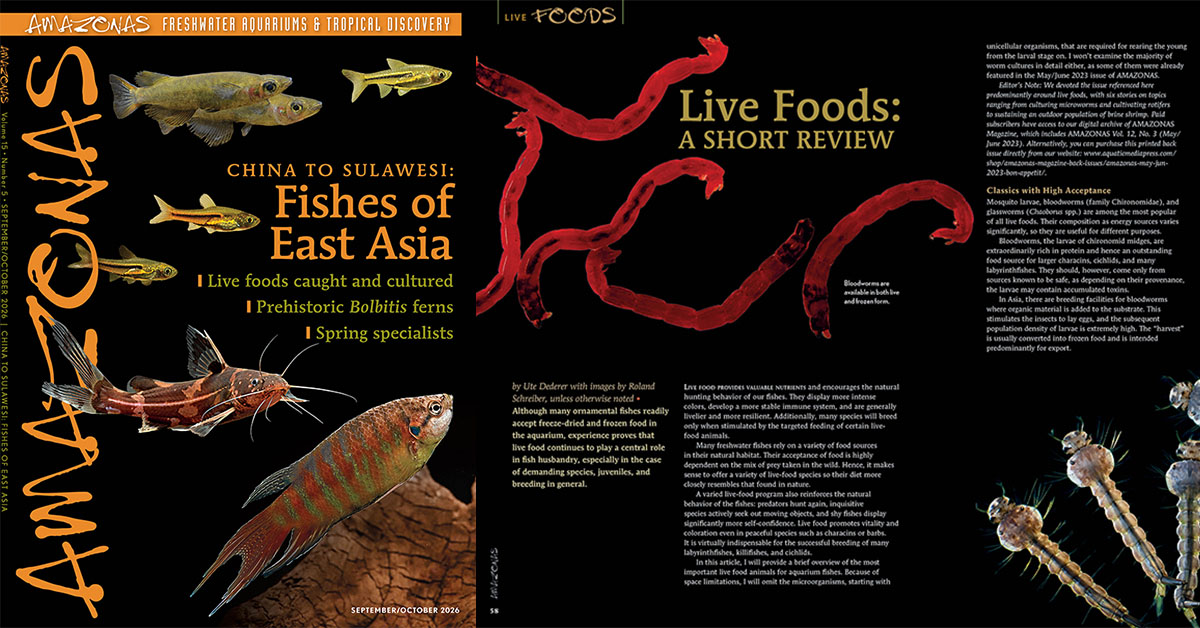

We start the Fishes of East Asia / AMAZONAS Magazine Review at the editor’s desk. Alex Rose opens with a confession about time: AMAZONAS goes to press six Tuesdays a year, and those weeks always turn out shorter than they look. Things were tighter still in this issue, because the team attempted something they had never tried before: designing an aquarium inspired by a story in the magazine’s own pages. The author of one of those articles supplied his aquarium-bred fish to fill it; the story was still being retouched on the night of the print deadline. The editor’s letter carries a second, muddier adventure too, one where the camera fails to see through the water.
The Aquatic Notebook is unusually sobering this time. Marijke Puts reports on a study that finally names one of the bacteria behind the black spot lesions that wipe out Neocaridina davidi (Cherry Shrimp) colonies; the truly worrying part is not the bacterium itself but what it shrugged off in the laboratory. Beside it, Alex Rose sums up a revision that re-examines all thirteen wild Betta species of Thailand: 138 specimens and a mountain of measurements. One single body proportion separated the mouth-brooders from the bubble-nesters more clearly than anything else; the identification key that came out of it is the kind hobbyists have waited decades for.
Fishes of East Asia / AMAZONAS Magazine Feature Articles
Macropodus: New Discoveries in a Classic Fish Genus
Rudolf Suttner takes on a genus that has been in our aquariums since 1869. Macropodus opercularis (Paradisefish) was one of the first tropical fish imported into Europe, yet the state of the genus is still not settled. Suttner divides it into four phylogenetic complexes built around the long-known species, and shows how undescribed forms keep surfacing one after another. Macropodus sp. ‘Da Nang’ reached Germany only in November 2025, and M. minnanensis was described in 2024. Males of the classic species stay at around 10 cm (4 inch) including the fin extensions, while females stay near 6 cm (2.5 inch).
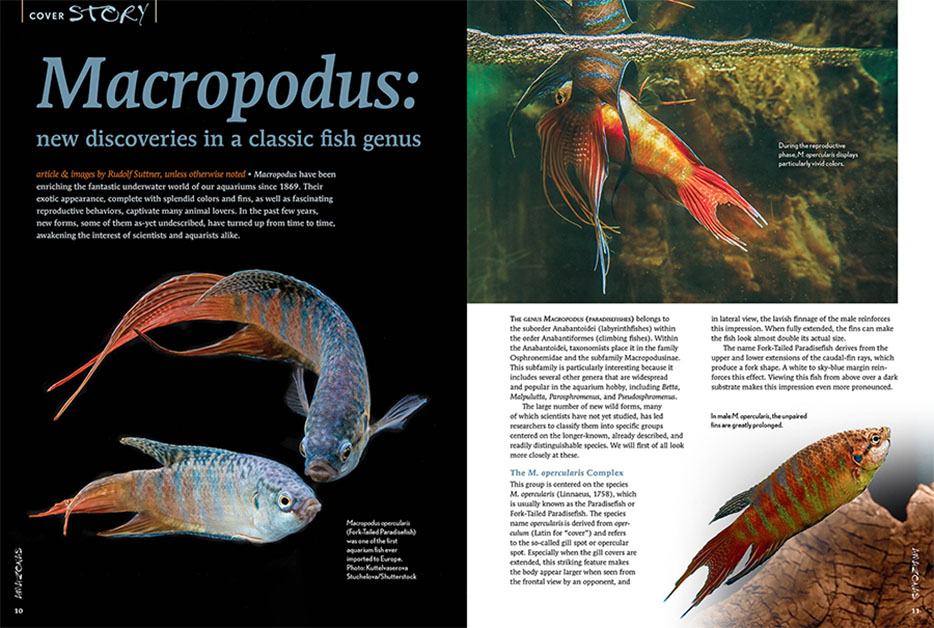
What really stopped me is how simple the sorting becomes once you know what to look at. Suttner reduces the four complexes to a compact set of criteria built on the opercular spot, the eye stripe and the shape of the caudal fin, and it is the kind of box you’ll want open beside your aquarium. His breeding notes are just as practical: every complex builds a different bubblenest, and the differences are surprisingly consistent. Most species settle for ordinary room temperatures of 18-26°C (65-79°F), and some can even be kept outdoors. Which complex builds the deepest nest is something you’ll find in the pages of Fishes of East Asia / AMAZONAS Magazine.
Trigonostigma somphongsi: Saving a Species
Mitchell Brennan tells the story of a fish that barely grows to 2.5 cm (1 inch) and carries the weight of an entire wetland on its back. Trigonostigma somphongsi (Somphong’s Rasbora) is Critically Endangered; it has even made a list of the hundred most threatened species on the planet. It disappeared from the trade for decades and was presumed lost, until three individuals turned up inside a shipment of Boraras urophthalmoides in 2006. That accident became the foundation of a breeding programme; a field survey years later finally found the species again in central Thailand.
What stayed with me is everything we still do not know. Nobody has recorded where these fish spend the dry season, and that gap sits right in the middle of any serious conservation plan. The care, by contrast, is surprisingly plain: a mature, densely planted aquarium, soft and slightly acidic water, leaf litter and 23-28°C (74-82°F). Breeding is easier still, because the females attach their eggs to the undersides of broad leaves. Two things kept me on the page: a stubbornly male-skewed sex ratio nobody can explain, and one simple change that reliably puts them in a spawning mood. Brennan explains both; those answers are waiting for you in Fishes of East Asia / AMAZONAS Magazine.
Pseudomystus heokhuii: A Dwarf Bumblebee Catfish from Sumatra
Anja Katzschmann introduces a bagrid that almost nobody keeps. Pseudomystus heokhuii (Mottled Bumblebee Catfish) was described in 2008 from the Batang Hari drainage in central Sumatra and carries the name of the ichthyologist Heok Hui Tan. It stays under 9 cm (3.5 inch) including that unusually large caudal fin, and it comes from peat swamp blackwater where the pH was measured at only 3.5-4.5 at some sites. Palm oil development is draining exactly those swamps; the IUCN therefore lists the species as Endangered.
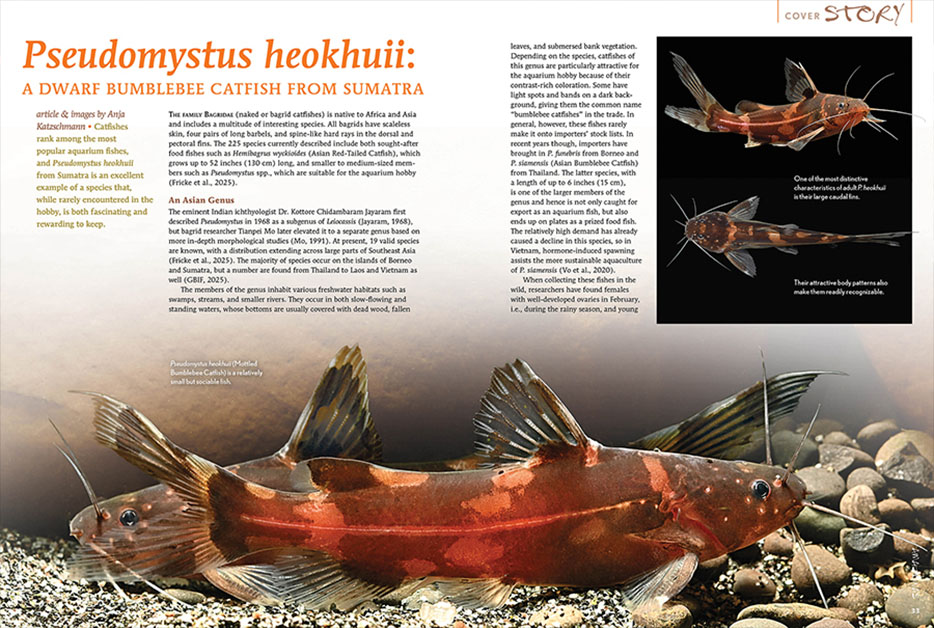
The frustrating and exciting point here is the blank page: there is still not a single record of targeted, repeatable breeding of any Pseudomystus in the hobby. Field data point to seasonal reproduction, which means a very obvious lever an aquarist could try at home. Keeping them is not difficult. Katzschmann recommends aquariums of 80-100 cm (32-40 inch), groups of five or more, soft and slightly acidic water at 22-25°C (72-77°F), and enough bogwood caves for these crepuscular fish to feel safe enough to come out. Which companions bring them into the open is the most practical gem in the article.
Two New Ricefishes from Sulawesi
Hans-Georg Evers has been returning to Sulawesi since 2007, and this article explains why. The island hosts 35 species of Adrianichthyidae; 27 are endemic and most are confined to a single lake or a single stream. Oryzias kalimpaaensis (Lake Kalimpa’a Ricefish) was described in 2022 from a small lake at about 1,660 m (5,450 ft); that is the highest altitude on record for a ricefish. It is also a pelvic brooder: the female carries the fertilised egg cluster until the fry hatch. A second species from the same drainage followed in 2025.
The real sensation is that the two species live side by side in the same river; this has never been recorded for the family, because a body of water on Sulawesi normally holds exactly one ricefish. Evers collected his founder stock among plastic waste and used diapers, which tells you enough about the state of these habitats. His males approach 7 cm (2.75 inch) and the females stay about a third smaller; during display they turn almost black and behave like surface predators. Whether the two species could share one aquarium is a question he leaves hanging.
Green Horizons: Rasbora Biotope
This is the aquarium Alex Rose mentioned in her editorial; Jen Williams walks us through the process from the first phone call to the final photograph. The goal was the feel of a rice field drainage ditch in Thailand’s Mae Khlong basin; it was built in an Oase ScaperLine 90 of roughly 190 L (50 gal), measuring 91 x 46 x 46 cm (36 x 18 x 18 inch). She used spider wood for its tangled, spiky character, deliberately carved caves and crevices into it, and planted Limnophila indica, Rotala wallichii and Cryptocoryne retrospiralis. The inhabitants are a nano parade led by the rasbora from Brennan’s article.
What I liked most is her honesty. She shows the ugly phase nobody posts on Instagram, the moment filamentous algae took the layout apart, and she counts every mistake that allowed it: a stuck CO2 needle valve, a relaxed water change schedule and heavy feeding before the shoot. Then, right in the middle of that despair, two Trichopsis pumila (Sparkling Gourami) claimed one of the hiding nooks she had built and behaved in a way that overturns what most of us assume about where this species spawns. The layout details at the end of the article are worth noting down on their own.
Live Foods: A Short Review
Ute Dederer argues that live food is not a luxury but a working tool, especially for demanding species, juveniles and any serious breeding project. She starts with the classics that get high acceptance, then moves to the high-fibre options like Daphnia and Moina, to the omega-3 rich Cyclops and of course to Artemia, which she cultures at 25-30 grams of salt per litre, 26-28°C (79-83°F) and strong aeration. The list runs considerably longer than that, and some of the animals on it have never crossed most of our minds.
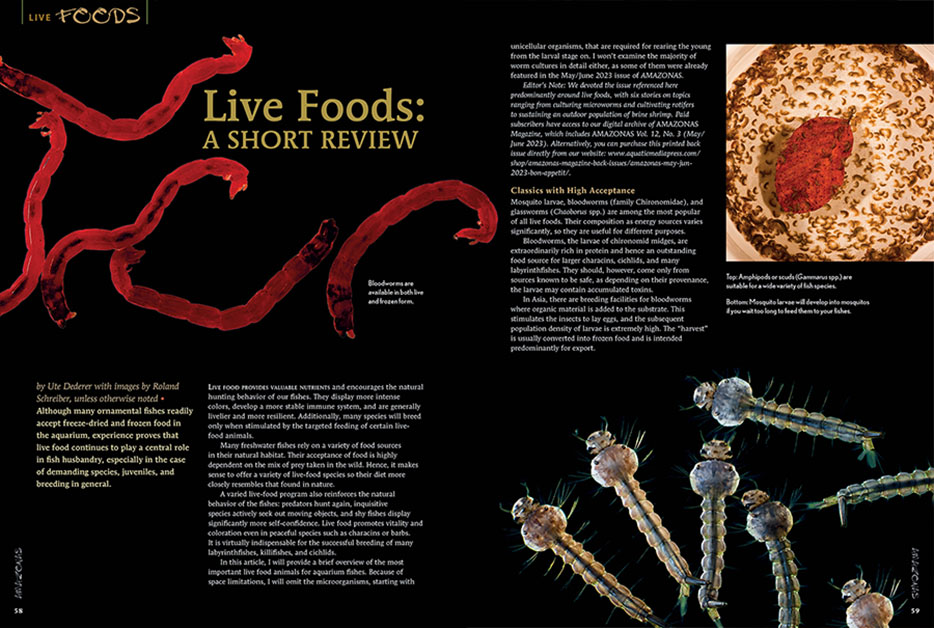
The part I enjoyed most is how much of this happens outdoors: in a rainwater barrel or a tub on the balcony, seeded with dead leaves and left to do its own work. Dederer is equally clear about the traps: one popular larva is itself a predator and eats fry and even Artemia nauplii; a classic worm’s bad reputation is only half deserved; and one culture will fill your rooms with mosquitoes the moment you look away. Her notes on which food primes which fish for breeding are the real reason to read this one closely.
Aquatic Travel: The Río Negro, an Aquarist’s Paradise
Ralf Britz went to the Río Negro with Brazilian colleagues in 2011 and spent three weeks collecting in bays, rapids, sandbanks and the shaded igarapés that drain the flooded forest. The basin holds 1,165 fish species; his team found more than 80 of them in ten days of fieldwork. His focus was the miniatures, meaning species that mature under 20 mm standard length. The article is a parade of fishes almost none of us will see for sale: transparent pygmy anchovies, larva-like Priocharax tetras, tiny catfishes and sleeper gobies from the leaf litter.
The thread that caught me was fragility. Some of these fish die the moment they are lifted out of the water; Britz had to invent a workaround just to photograph them alive, and I will not write here what that solution was. There is a genuine discovery inside as well: a tiny tetra that flashed blue in the beam of a headlamp during a night seine, which later turned out to be not just a new species but a new genus. Most of these miniatures have never entered the trade, and Britz argues persuasively that aquarists could be the ones to change that.
Aquatic Plants: From the Age of Dinosaurs, the Fern Genus Bolbitis
Rudolf Suttner returns this time with plants and with a very long view: the ferns evolved in the Devonian, and spore traces place Bolbitis in the late Cretaceous. Of the 62 recognised species, only a couple concern us. Suttner found Bolbitis heudelotii (African Water Fern) himself in the Lokoundjé River in Cameroon in January 2025; there he measured 27°C (80°F), a conductivity of only 18.8 µS/cm and a pH of 4.55. The plant clings to smooth, water-worn rock with strong, heavily branched roots, and it shares that shoreline with Anubias heterophylla and Crinum natans.
The genuinely useful surprise is the Asian side of the genus. Only two small forms of Bolbitis heteroclita hold up submersed in the long run, and since neither has a settled common name, Suttner proposes one for each. He closes the article with a complete West African aquarium of 100 x 50 x 40 cm (40 x 20 x 16 inch), a numbered planting scheme, and a stocking plan that deliberately spreads three species across the lower, middle and upper water. Add the fern’s odd two-phase reproduction and you have a plant article that is genuinely about deep time.
Conservation: Season on Springs, Fishes from Tiny Waters
Michael Edmondstone writes for SHOAL about habitats that can be smaller than a dining table and still hold the entire global population of a species. Cyprinodon diabolis (Devil’s Hole Pupfish) lives in one geothermal limestone fissure in Nevada; Mexico’s goodeids are squeezed into isolated spring basins; and Australia’s Great Artesian Basin keeps Scaturiginichthys vermeilipinnis (Red-Finned Blue-Eye) alive in a single reserve in Queensland. SHOAL’s 1000 Fishes Blueprint counts at least 176 priority fishes tied to spring habitats.
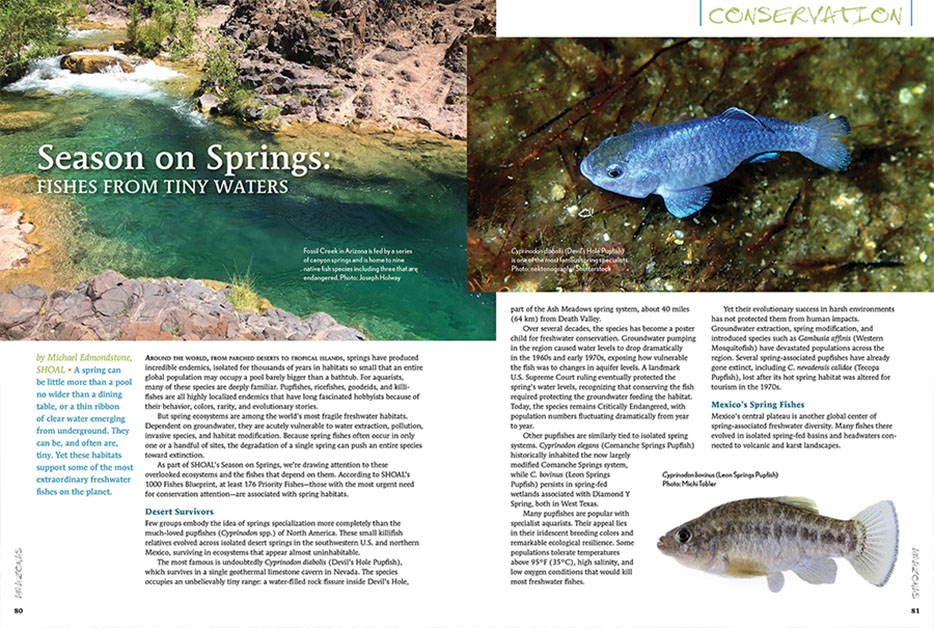
The reason to read this one is that it is not a lament. Zoogeneticus tequila (Tequila Splitfin) exists only because aquarists and conservation breeding programmes kept it alive after it was erased from the wild; it then went back into a restored river. Skiffia francesae (Golden Skiffia) followed a similar path after years of breeding at a Mexican university. Edmondstone says plainly that this is a role hobbyists can take on, and he points the reader to where the projects actually run. The invitation is the part I would not skip.
Departments: Events, Shops, Lexicon and Snapshots
The Events Calendar runs from late summer into 2027 and is worth a look even from this side of the Atlantic; the All-Aquarium Catfish Convention in Seattle on October 9-11 and the Ohio Cichlid Association Extravaganza in November are among the highlights. The LFS Locator remains one of my favourite pages in the magazine: a hand-picked list of shops that stock AMAZONAS, this time covering South Korea alongside the United States and Canada. It is a small detail that reminds us the print hobby travels further than we assume.
The AMAZONAS Lexicon decodes the technical vocabulary of this particular issue; terms like clupeomorphs, epilithic and nomina dubia are explained on the page instead of being left to a search engine. Species Snapshots brings two fish worth chasing: a newly described cory that many of us already owned under a code name, and a Rineloricaria from a small Tapajós tributary with what the author considers the finest woodgrain pattern in the genus. Underwater Eye closes the issue with two male Paradisefish locked mouth to mouth.
AMAZONAS Magazine is one of the world’s leading print publications for the freshwater aquarium industry. If you’d like to subscribe and read all the content, you can start your Subscription Here. Browse our other freshwater aquarium magazine reviews in our Publications & Literature category, and find our review of the previous issue, Lots To Love: Big Beauties / AMAZONAS Magazine 2026 Review, Here! We’re eagerly awaiting the next issue!
Join the Discussion! Do you have a question or a tip to share about the Fishes of East Asia / AMAZONAS Magazine Review? Whether you’re a beginner or a professional, we value your experience, so leave a comment below to help our community grow! We read every comment and we’d be happy to help you. Let’s build a better reef together!
Cover Photo Credit: Reef Network
References:
- AMAZONAS Magazine: Fishes of East Asia / Last Access Date: 08.30.2026