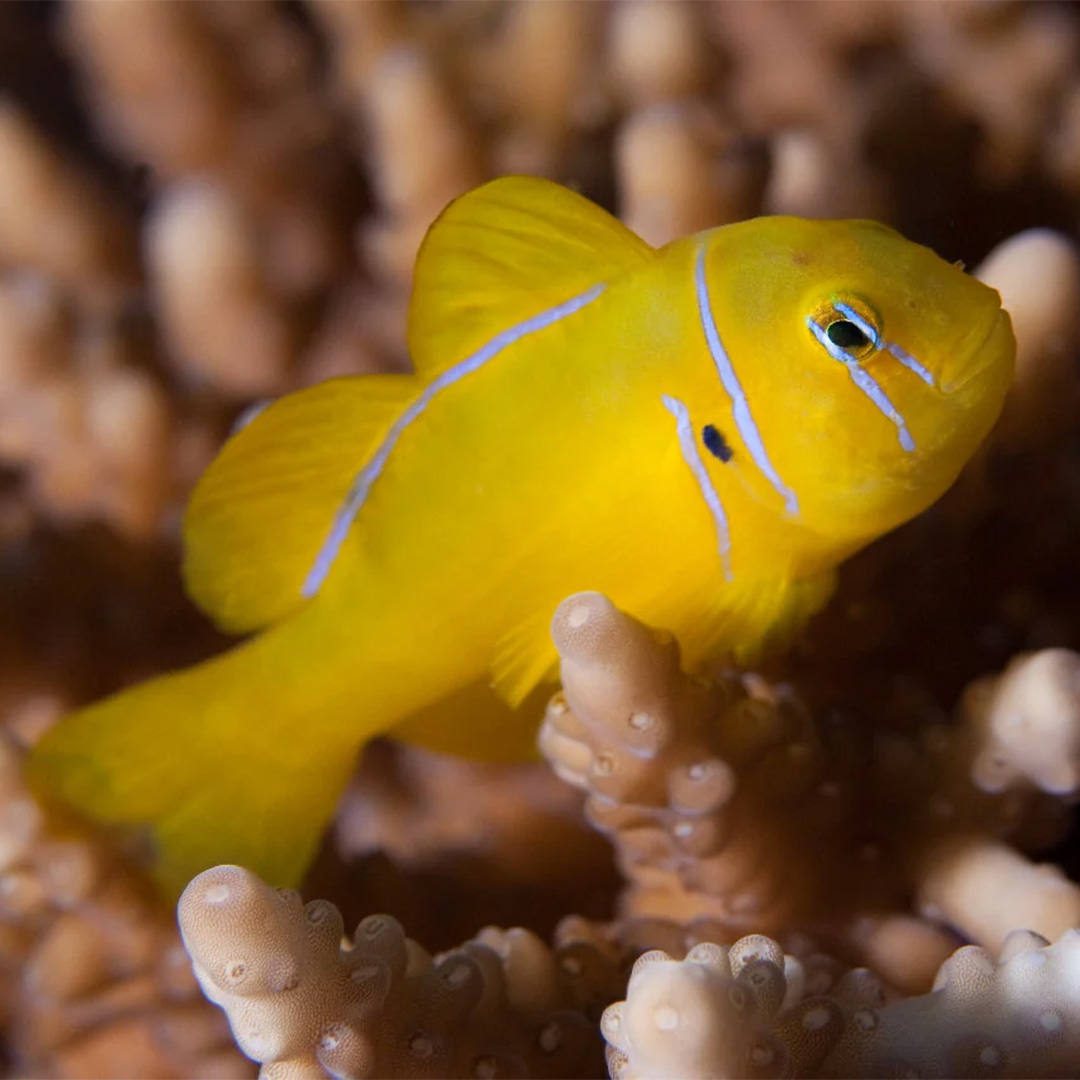
The Citron Goby (Gobiodon citrinus) needs a branching Acropora or similar SPS colony with branches over 5 cm (2 in); without one it wanders in the open and is lost. Allow 60 l (15.9 gallons) for one fish, 100 l (26.4 gallons) for a pair. Keep 24-27 °C (75.2-80.6 °F) and 1.023-1.025 specific gravity. Its mouth is tiny, so feed food that fits it, twice a day. A second fish of the same species works only as an established pair.
The English name listed on FishBase is Poison Goby, and while the name is not an exaggeration, it is slightly misleading. The Citron Goby injects nothing; it has no venomous spine and no venomous bite. The fish defends itself with its skin. A layer of toxic mucus coats the body and puts off any predator that tries to swallow it. In the aquarium trade the species is sold as Citron Goby, while the literature also calls it Lemon Coralgoby.
Body colour ranges from bright yellow through yellow-green to a dark brown in some individuals. The markings that identify it sit on the head: two pale blue bars running across the eye, and immediately behind them a further blue bar crossing the back of the head. Thin blue stripes run along the base of the dorsal and anal fins, and a small black spot sits at the base of the pectoral fin. Like every member of the genus, the Citron Goby carries no scales; the skin is bare and slippery, and the mucus defence works directly off that bare skin (Bray, n.d.).
Rüppell described the species in 1838, and the name he gave it is still treated as valid today (WoRMS, 2026). Its range is a wide one: it runs from the Red Sea down to Delagoa Bay in Mozambique, east as far as Samoa, north to southern Japan and south to the Great Barrier Reef. It is usually found between 2-20 m (6.6-66 ft), and water temperature across that range has been reported at 22-27 °C (71.6-80.6 °F). Maximum size is 6.6 cm (2.6 in) total length, so the measurement includes the tail. In an aquarium most individuals stop around 5-6 cm (2-2.4 in) (Froese and Pauly, 2026).
On the conservation side this is a comfortable species. The IUCN Red List places it in Least Concern (LC), the category for species not considered at risk, and the assessment dates from 2018. What the category tells us is this: the species is widespread, common, and shows no known population decline. That category measures the global total, however, not individual reefs. Because the Citron Goby depends on its host coral, it can disappear locally from a reef that loses its Acropora colonies in a bleaching event, and the global category will not show that local loss (GBIF, 2026).
Its habitat is narrow and clearly defined. The fish lives inside branching Acropora colonies, wedges itself between the branches and almost never leaves the colony. Dirnwöber and Herler (2007) examined 1,626 individuals across 1,731 coral colonies in the northern Red Sea and showed that Gobiodon species differ sharply from one another in host choice: some stayed with a single Acropora species, while others were far more flexible. The Citron Goby sits at the flexible end of that spectrum and will accept more than one branching SPS species in your aquarium.
Set aside at least 60 l (15.9 gallons) for a single fish, and 100 l (26.4 gallons) for an established pair. The Citron Goby does not ask for a large tank relative to its size, because it does not really swim; it perches on a branch and shifts position in short hops. Two things push the volume up. First, it is territorial towards its own kind, and individuals outside a pair will not share a colony. Second, a healthy pair only forms in a system large enough to hold a host colony of decent size. The reasoning is biological; the number we give comes from established aquarium practice.
Citron goby care rests largely on a single decision, and that decision is not litres but the host coral. Untersteggaber et al. (2014) compared occupied and unoccupied colonies in the northern Red Sea and found that the strongest predictor of occupation was a branch length above 5 cm (2 in); the colonies gobies chose also had wider gaps between branches. That measurement was taken on G. histrio and G. rivulatus, so for the Citron Goby it counts as related-species evidence rather than a direct finding. The aquarium translation is simple enough all the same: this fish cannot shelter in a colony with short, tightly packed branches.
The values to aim for are 24-27 °C (75.2-80.6 °F) temperature, 1.023-1.025 specific gravity (34-35 ppt) salinity, 8.1-8.4 pH and 8-11 dKH alkalinity. Keep flow moderate, and choose lighting strong enough to feed the branching SPS corals themselves. The fish is indifferent to light; its host coral is emphatically not.
Gobies jump when startled. Putting a tight lid or a mesh screen over the tank removes that loss entirely. This species is less shy than its relatives and willing to sit out in the open, but in the first few days a sudden light or a shadow falling from above can still trigger a jump.
Sources do not fully agree on the natural diet, and that disagreement is useful to you at the aquarium end. FishBase describes the species as feeding on small invertebrates and zooplankton (Froese and Pauly, 2026). Fishes of Australia reports that it also takes tissue from its host coral (Bray, n.d.). Brooker et al. (2010) examined gut contents in three species of the genus and found algae, invertebrates and coral cnidae, the stinging cells of the coral. That work covered G. brochus, G. histrio and G. quinquestrigatus, and the Citron Goby was not sampled. The conclusion for the genus is clear regardless: these are opportunists, not specialists.
The Citron Goby is an easy species to feed in an aquarium. Offer small amounts, varied, twice a day:
The mouth is very small, which makes food size the deciding factor. Offer food small enough to fit that mouth; a large pellet will not go in and the fish simply goes hungry. The real risk with this species is starvation, not disease. Individuals housed alongside fast feeders can end up never reaching the food, and in that case you can drop food near the coral colony, at the point where the current will carry it to the fish. A belly line that starts to sink inwards and a head that begins to look pronounced are the first signs of chronic underfeeding, and the longer it runs the harder it is to reverse.
The Citron Goby spends its day on and inside its host colony. Its temperament is peaceful towards other fish, territorial towards its own kind and towards other coral gobies. Two adults will only feed peacefully in the same aquarium if they have formed an established pair; if they have not, one of them is under constant pressure. It also competes with other Gobiodon and Paragobiodon species for the same colony, so in a small aquarium you are better off keeping a single individual or an established pair.
The toxic skin secretion sits right at the centre of that defence. Schubert et al. (2003) tested the skin secretions of six Gobiodon species at Lizard Island; all of them proved toxic to the assay fish, and toxicity varied markedly between species. In the same study both small-gaped and large-gaped predators avoided food that had goby secretion applied to it, and avoided a whole goby. The defence therefore works in two directions: it protects the fish, and indirectly the coral as well.
The coral side of that has been measured too. Dirnwöber and Herler (2013) reported that on Acropora colonies occupied by gobies, the bite rate of the coral-feeding butterflyfish (Chaetodon austriacus) dropped. The reduction was 62-98% on colonies holding G. histrio, and 64-68% on colonies holding a second Gobiodon species. The experiment did not include the Citron Goby, so this too counts as related-species evidence; it does show clearly, though, that the genus is not simply a tenant of the coral.
The toxin is a deterrent, not a shield. Do not keep it with predators whose mouths can take a fish this size: lionfish, larger grouper, frogfish, moray eel, larger hawkfish and the wrasse species that grow big in the genera Coris and Thalassoma all belong on that list. Safe tank mates are the familiar small reef community: clownfish, cardinalfish, firefish, dartfish, blenny, small anthias and fairy wrasse species of the genus Cirrhilabrus.
It is worth being honest about reef safety. This fish is not a polyp eater, but you can expect tissue abrasion and bare branch bases where it perches day after day. Do not read that as a disease; as the colony grows the fish moves on. It likes to sit on fleshy LPS corals and can keep such a coral closed all day, so placing your LPS colonies where the fish cannot use them as a bridge will handle most of it.
Citron goby breeding is backed by a documented aquarium record, which is not a common thing among coral gobies. A 1993 spawning report from the C-Quest team describes three pairs spawning regularly; the fish measured 6.2 cm (2.4 in) and were kept in 75 l (19.8 gallons). The pairs spawned every 4 days on the outer upper edge of a clay pot, laying 300-1,000 demersal eggs, meaning eggs that adhere to the substrate. Incubation ran 4 days, and hatching happened after dark (C-Quest, 1993).
The larval stage was followed step by step in the same report. Fry were raised in 304 l (80.3 gallons); survival was 80% in the first week and 50% by the fourth. Metamorphosis was complete on day 33, and the first yellow colour appeared on day 40. The team who filed the report rated the species very easy to spawn and moderately difficult to rear. Keep in mind that this is a hobby breeding record rather than a peer-reviewed study, and read the numbers accordingly.
The sex side is the most interesting thing about the genus. Bidirectional sex change has been documented in Gobiodon. Munday et al. (1998) found in G. histrio that all immature individuals begin as females, and that when two females settle on the same colony one of them readily becomes male. The reverse change also occurred, but at less than half the frequency of the female-to-male direction. Fishes of Australia reports the same ability for the Citron Goby (Bray, n.d.).
The practical translation for your aquarium is straightforward: do not try to sex them. Place two young individuals of the same size together with a large enough branching colony and let the pair form on its own. Forced pairing is entirely unnecessary in this species.
The thick, toxic mucus layer gives the Citron Goby a natural advantage, but it does not confer immunity. External parasites such as white spot (Cryptocaryon irritans) and velvet (Amyloodinium ocellatum) occur in this species too, and they move very fast in a fish this small. Quarantine every new arrival for 3-4 weeks in a separate aquarium. You can use copper-based medication in quarantine; the rule that matters is the other one: copper never enters a display tank that holds corals.
Acclimation is worth some time as well. Gobies are sensitive to sudden changes in salinity and temperature, so you can drip acclimate a new arrival over 45-60 minutes. Shipping strips part of the mucus layer, and the fish may look paler than normal for the first few days. That is usually temporary, but if the pallor runs past a week, or if the fish visibly increases its breathing rate, run a parasite check.
The two most common causes of loss are not diseases at all. The first is jumping, the second is the loss of the host colony. When the coral dies the Citron Goby is left without shelter and starts wandering in the open, which raises both its stress and its exposure to predators. Keeping a spare branching colony, or a coral skeleton of similar structure, solves that permanently.
On lifespan, let us be honest: no published figure for its life in the wild could be found. In aquariums 3-5 years is commonly reported, and that value rests on established aquarium practice rather than on literature. We do not know what drives the gap either; without comparison data from the wild we cannot say whether it reflects the limit of the species or the limit of the care. Drift in water chemistry hits the coral before it hits the fish, and the fish is affected second-hand, which is why keeping pH and alkalinity stable also counts towards the Citron Goby’s lifespan.
Cover Photo Credit: Freakin Corals
References:
Was this guide helpful?
Like, save to your profile and reach more people.
Share:
Species Info Box
Temperature
Salinity
pH
Alkalinity
Venomous
Aquarium Size
Maximum Size
Lifespan
Color Form
Reef Compatible
Diet
Temperament
Care Level
Breeding
Genus
Family
Origin
We use cookies to personalize content, provide social media features, and analyze our traffic. We also share information about your use of our site with our analytics partners. You can change your preferences at any time. For more information, please see our Privacy Notice and Cookie Notice. Privacy Notice Cookie Notice
We sent you a confirmation link. Click it to finish subscribing.
