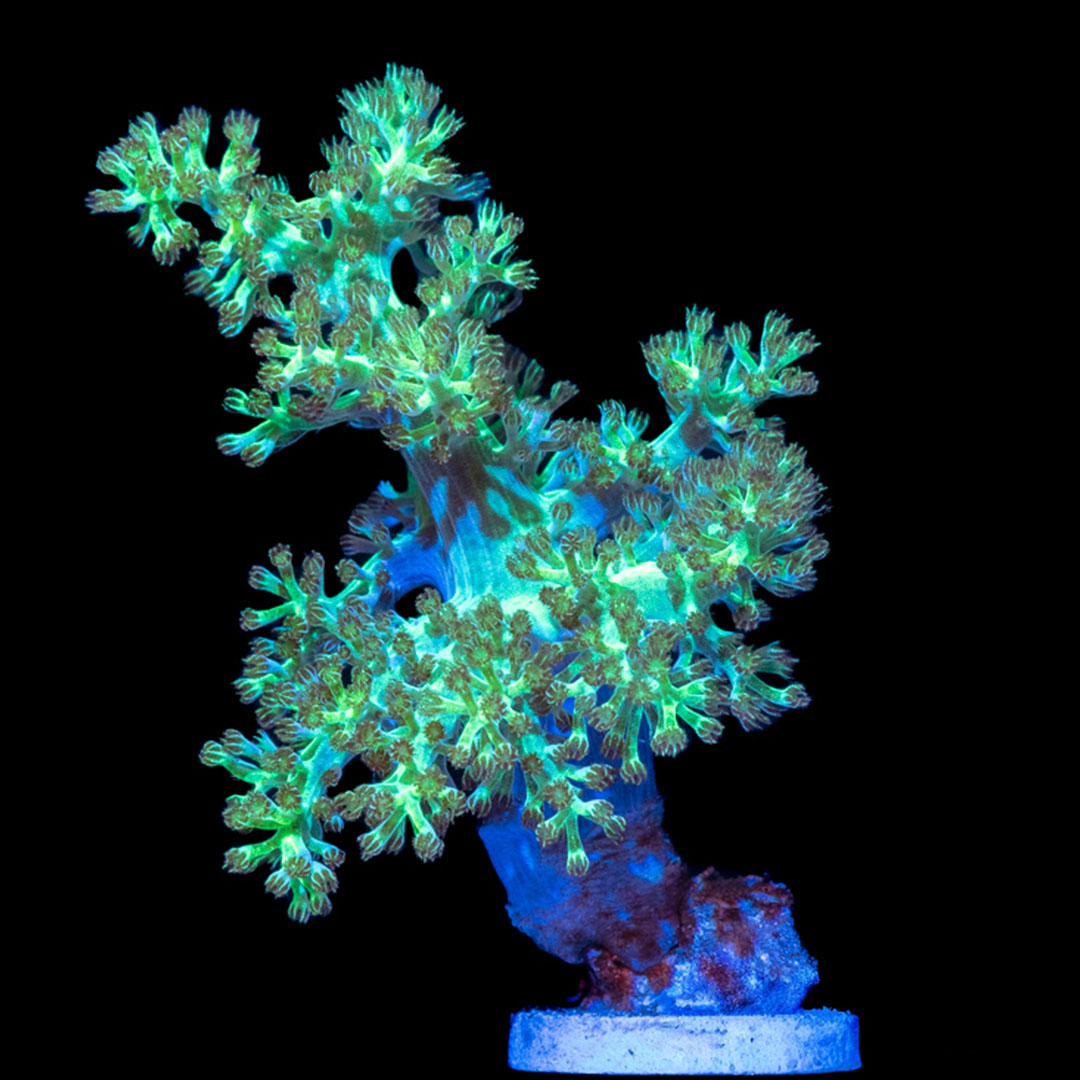
Neon Pineapple Tree Coral (Capnella sp.) is not fed by light; offer a fine particle coral food once or twice a week. Set aside at least 100 litres (26.4 gallons), and more than 200 litres (52.8 gallons) in a mixed reef. Temperature 24-27 °C (75.2-80.6 °F), salinity 1.023-1.025 specific gravity. It releases compounds into the water: leave 10-15 cm (3.9-5.9 in) to stony corals and run activated carbon. Every dropped branchlet starts a new colony.
Neon Pineapple Tree Coral is the trade name given to the bright green colour form of the genus Capnella. It rises on a thick, fleshy stalk, and short branches crowd into a dense crown at the top of that stalk. When the colony deflates and contracts, the crown really does look like a pineapple; once the polyps open the picture changes completely and you are looking at a small furry tree. The same genus is also sold as Kenya Tree Coral and Pineapple Tree Coral, and retailers usually list it at genus level rather than species level, as Capnella sp.
Colonies in the trade are generally associated with Capnella imbricata (Quoy & Gaimard, 1833), and that name is still accepted today (WoRMS, 2026). Older care sheets are worth treating with caution on one point in particular. The genus sat under Nephtheidae for many years, but after octocoral classification was rewritten with phylogenomic data it moved to the family Capnellidae and the order Malacalcyonacea (McFadden et al., 2022). The taxonomic address of your Neon Pineapple Tree Coral has therefore been different since 2022, and a great many care pages still print the old family.
Records gathered in GBIF put the centre of gravity of the genus in the Western Pacific: Australia, Indonesia, Papua New Guinea, the Philippines, Palau, the Solomon Islands and Malaysia (GBIF, 2026). Depth in those same records clusters largely between 1-17 m (3.3-56 ft), and the deepest record is 54 m (177 ft). Trade listings sometimes add the Red Sea, but verified records give no support for that, so reading the origin as Western Pacific is far safer.
The natural habitat of Neon Pineapple Tree Coral is inshore rubble ground and reef slopes, in clear and turbid water alike, wherever there is movement. The colony grows larger than you would expect from a small soft coral. The largest reported colony height is around 45 cm (17.7 in), and that measurement covers total height from the base of the stalk to the branch tips (Goemans, n.d.). In an aquarium most colonies stay in the 15-25 cm (5.9-9.8 in) band, because the aquarist prunes before they reach that size.
In Neon Pineapple Tree Coral care the volume decision follows growth rate rather than size. Setting aside at least 100 litres (26.4 gallons) is the sensible call, and that figure is not the volume the colony fits into but the volume that keeps pruning to a reasonable frequency. In smaller systems the colony unbalances your aquascaping within a few months, and dropped branchlets start new colonies all over the aquarium. If you are building a mixed reef and keeping SPS corals in the same aquarium, working with 200 litres (52.8 gallons) or more will be far more comfortable.
The values you can aim for are 24-27 °C (75.2-80.6 °F) temperature, 1.023-1.025 specific gravity (34-35 ppt) salinity, 8.1-8.4 pH and 8-11 dKH alkalinity. The reported temperature tolerance runs well outside that, with a range of 20-28 °C (68-82.4 °F) given (Goemans, n.d.); holding a stable middle band still works out better for everything else in the aquarium.
Light and flow work together in Neon Pineapple Tree Coral. Moderate to strong lighting is enough, because the colony is not as hungry for light as a light-saturated stony coral. With flow you can afford to be generous: moderate to strong, changing direction, which noticeably improves polyp extension and clears the detritus that settles between the branches. To build a broken flow arriving from two points instead of one steady jet, all you need to look at is wavemaker placement. Position the colony in the middle to lower zone, on a solid ledge of rock.
There is a common error about how this coral feeds: light is assumed to finish the job. The most detailed feeding study in the genus was done on a temperate relative, Capnella gaboensis. Farrant et al. (1987b) measured that colonies carry zooxanthellae but that only around 10% of the carbon the algae produce is translocated to animal tissue, and that the contribution of the symbionts to respiratory carbon demand stayed well below 50% in every season apart from one summer. The same study reports colonies feeding on zooplankton, fine suspended particles and dissolved organic matter.
Because the finding comes from a related species it is not direct evidence for Neon Pineapple Tree Coral, but its practical meaning is clear: light alone will not feed this colony. Once or twice a week you can offer a fine particle coral food. The options that will do the job are these:
Cutting the flow for a few minutes while you feed Neon Pineapple Tree Coral keeps the particles among the branches. There is no benefit in going overboard, though; the organic load that builds up after feeding comes back first as an algae bloom and then as a water quality problem.
Its temperament is semi-aggressive, and the reason is chemistry rather than contact. This coral takes ground not by stinging but through compounds released into the water. Capnella imbricata is the source of a compound family named after the genus, the sesquiterpene group called capnellenes; Lai et al. (2023) isolated seven compounds from that group in a single sampling study, three of them previously undescribed. Inside an aquarium the effect of those compounds is neighbouring corals slowly pulling back.
The scale of the effect has been documented in another genus too. Aceret et al. (1995) tested diterpenes obtained from soft corals on stony corals; at concentrations above 5 ppm Acropora and Porites colonies first expelled zooxanthellae, then discharged cnidocytes and went on to lose tissue. Because the experiment used Sinularia and Lobophytum compounds we cannot call it directly valid for Neon Pineapple Tree Coral, but as a demonstration of what soft coral chemistry can do to a stony coral it is still instructive.
That has three practical consequences in the aquarium. First, place the colony at least 10-15 cm (3.9-5.9 in) away from your stony corals. Second, keep activated carbon running permanently in your system; carbon strips the compounds accumulating in the water and stops neighbouring corals from receding. Third, take every branch you prune out of the aquarium, because a piece left on the substrate starts a new colony within weeks in a spot you did not choose.
On the fish side there is no trouble. You can keep Neon Pineapple Tree Coral with peaceful reef fish, with shrimp and with grazing molluscs. What you do need to watch for are the soft coral eaters: some angelfish genera, most butterflyfish species and filefish will nip at this colony.
Neon Pineapple Tree Coral propagation is documented in aquaria, but that production is asexual. A branch cut from the colony and attached to a plug or a piece of rock turns into a new colony within a few weeks, and every aquacultured frag sold in the trade is multiplied this way (Goemans, n.d.). The colony does the same job on its own: it forms a swelling at the base of a branch and releases the branchlet, and every dropped branchlet starts a new colony. Once you have established Neon Pineapple Tree Coral you do not need to do anything special to propagate it; you need to limit it instead.
On the sexual side there is no documented record from an aquarium; what is known comes from the wild and again from a related species. Farrant (1986) showed that gonad numbers in Capnella gaboensis colonies peaked weeks before spawning and that spawning fell in late autumn and early winter. Larvae develop on the colony surface before release, sink to the bottom and settle quickly, and about a week after settlement they turn into a polyp with a mouth, tentacles and sclerites.
The picture in the wild is the exact opposite of the one in an aquarium. Farrant (1987a) calculated in situ settlement success in the same species at 0.26% and first year mortality at 99.75%; asexual reproduction was almost never seen apart from fission of large colonies. In the wild the real card this group plays is the larva, in the aquarium it is fragmentation. Flow, predation pressure and competition decide the difference, and none of the three is present in your aquarium.
The real risk in Neon Pineapple Tree Coral is tissue loss rather than parasites. When the colony deflates and stays closed for days, or when a brown film or softening starts on the stalk surface, you need to step in. The cause is usually one of three: stagnant flow, accumulated organic load or chemical pressure from a neighbouring coral. Raising the flow and refreshing the activated carbon solves most cases in the first week.
There is value in not putting a newly arrived Neon Pineapple Tree Coral colony straight into the main aquarium. Quarantine works differently for corals than for fish: what you are looking for here is not a parasite but a hitchhiker. A 5-10 minute dip in a commercial coral bath and 2-3 weeks of observation in a separate container largely closes the risk of carrying flatworms or nudibranchs into your aquarium. No copper-based medication ever enters an aquarium with corals in it; this rule has no exception.
It is worth being honest about lifespan: no published lifespan figure was found for Neon Pineapple Tree Coral. The closest measurement we have again comes from a related species. Farrant (1987a) reported that colonies passing three years of age kept a high life expectancy through to the fifteenth year, after which it fell year on year. That is why the spec box says 11-20 years. Since the colony renews itself in an aquarium anyway, in practice the limit is not the age of the colony but your pruning discipline.
There is no assessment in hand for Neon Pineapple Tree Coral on the conservation side. The category on the IUCN Red List is Not Evaluated (NE), meaning it has not yet been assessed. To spell the abbreviation out: NE says nobody has measured the population of this species. Do not confuse it with Data Deficient (DD), which reports insufficient data; in DD an assessment was made but the data fell short, in NE the assessment never started. In short, “not written down” and “not threatened” are not the same thing.
The reason for the gap is the scope of the assessment rather than the species itself. The IUCN global coral assessment dated 2024 examined 892 warm water coral species and found 44% of them threatened (IUCN, 2024). The scope stayed limited to the stony corals that build the reef; soft corals such as Capnella sit outside that work and most of them are still unassessed.
A similar split exists on the trade regulation side. CITES coral trade regulation is built on five stony coral orders: Helioporacea, Milleporina, Scleractinia, Stolonifera and Stylasterina (CITES, 2010). Soft corals fall outside that scope, which means Neon Pineapple Tree Coral is not tracked through a paper trail the way a stony coral is. The implication is plain: there is no record system counting collection pressure.
The practical answer fits on one line. Choosing an aquacultured frag over a wild collected colony reduces both that uncertainty and your own risk, because an aquacultured colony is already used to aquarium conditions.
Have you kept Neon Pineapple Tree Coral, how fast did the colony grow for you and what did it do to your neighbouring corals? Leave it in the comments below. Someone else keeping the same species will see far more clearly what to expect in their own colony once they read what happened in your aquarium.
Cover Photo Credit: Tidal Gardens
References:
Was this guide helpful?
Like, save to your profile and reach more people.
Share:
Species Info Box
Temperature
Salinity
pH
Alkalinity
Venomous
Aquarium Size
Maximum Size
Lifespan
Color Form
Reef Compatible
Diet
Temperament
Care Level
Breeding
Genus
Family
Origin
We use cookies to personalize content, provide social media features, and analyze our traffic. We also share information about your use of our site with our analytics partners. You can change your preferences at any time. For more information, please see our Privacy Notice and Cookie Notice. Privacy Notice Cookie Notice
We sent you a confirmation link. Click it to finish subscribing.
