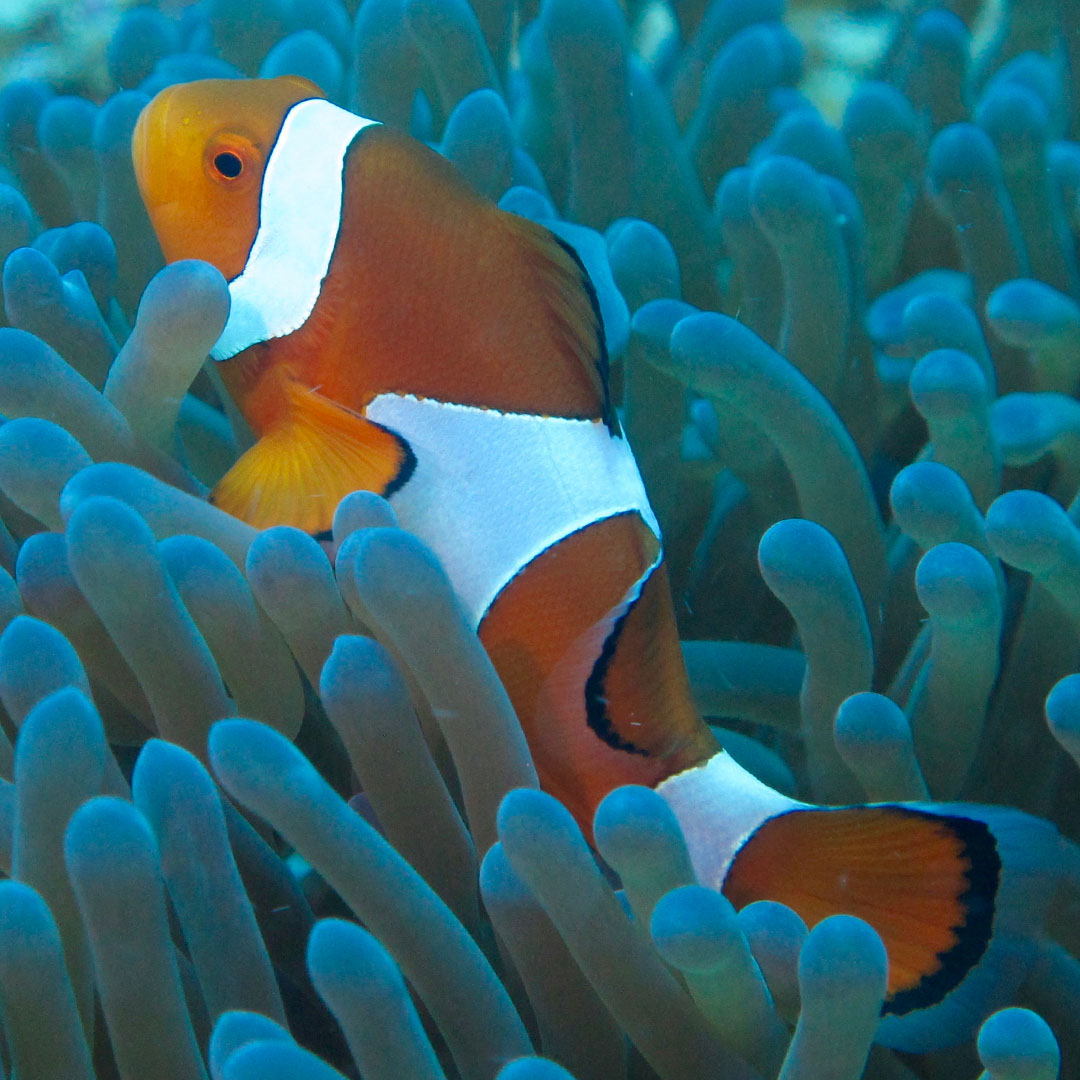
Cover Photo: Dmitry Domrin, licensed under CC BY 4.0; cropped.
A pair of Ocellaris Clownfish (Amphiprion ocellaris) can be kept in at least 80 l (21.1 gallons), at 26-28 °C (78.8-82.4 °F) and a pH of 8.0-8.5. It eats both zooplankton and algae, and small meals 2-3 times a day are enough. An anemone is not required, and captive-bred fish raised without one are slow to accept it. The species is Least Concern (LC); choosing a captive-bred fish reduces demand for wild collection.
Ocellaris Clownfish (Amphiprion ocellaris) is a small reef fish of the family Pomacentridae that lives among the tentacles of sea anemones. Cuvier described the species in 1830 from specimens collected in Sumatra (Bray, 2021). WoRMS accepts Amphiprion ocellaris today, while Amphiprion bicolor and Amphiprion melanurus are older names for the same species that are no longer valid (Froese and Pauly, 2026). In the trade it is also sold as the False Percula Clownfish, because it looks almost identical to its close relative, the Percula Clownfish (Amphiprion percula).
Lieske and Myers (1994) stated that the species reaches up to 11 cm (4.3 in) in total length, measured from the tip of the snout to the tip of the tail fin, while Bray (2021) gives the largest size as 9.5 cm (3.7 in). Allen et al. (2022) described its range as stretching from the coasts of the Andaman Sea in the eastern Indian Ocean to Indonesia, Malaysia, Singapore, the Philippines, Taiwan and the southern islands of Japan, as well as northwestern Australia and Palau. According to the same assessment, the species lives at depths of 1-15 m (3.3-49 ft).
In the wild it lives on inshore reefs and in sheltered lagoons in partnership with three large anemone species. Bray (2021) lists these host anemones as the Magnificent Sea Anemone (Heteractis magnifica), the Giant Carpet Anemone (Stichodactyla gigantea) and Mertens’ Carpet Anemone (Stichodactyla mertensii).
Bray (2021) gives two signs for telling the Ocellaris Clownfish and the Percula Clownfish apart when you buy. The front part of the Ocellaris Clownfish’s dorsal fin usually has 11 sharp bony spines, while the Percula Clownfish usually has 10. In the aquarium, the easier way to tell them apart is to look at the edges of the white bands. In the Ocellaris Clownfish these edges carry either no black line or only a very thin one; in the Percula Clownfish the white bands are outlined by a thick black line.
The species is best known as the main character of Finding Nemo, released in 2003. Militz and Foale (2017) stated that the film’s Nemo represents the species group made up of Amphiprion ocellaris and Amphiprion percula. We also cover the film’s effect on the trade in the Conservation Status section.
A pair of Ocellaris Clownfish needs at least 80 l (21.1 gallons). If you plan to keep juveniles alongside the pair or add other fish, it is worth working out the total bioload with the method we cover in our guide on how many fish can fit in an aquarium. The volume, the alkalinity and the order for adding an anemone in this section come from established aquarium practice rather than research.
The firmest basis for the water values in Ocellaris Clownfish care is laboratory work. Roux et al. (2021) stated that their breeding pairs needed a temperature of 26-28 °C (78.8-82.4 °F), a salinity of 30-35 g/l (4.0-4.7 oz/gal), which is roughly a specific gravity of 1.023-1.026, and a pH of 8.0-8.5. They also kept the length of the daylight period the same every day. An adjustable heater and a thermometer at the far end of the aquarium are enough to hold the temperature steady in this range throughout the day.
The same study kept ammonium at 0-0.5 mg/l, nitrite at 0-0.2 mg/l and nitrate at 0-5 mg/l. These are the experimental conditions of a laboratory raising offspring; if you only want to keep the fish, nitrate this low is not necessary, but ammonia and nitrite should be too low to measure. Temperatures in the wild match this range as well. OBIS (2026) lists nearly all of the species’ 2,612 records in waters with a surface temperature of 25-30 °C (77-86 °F).
You can keep alkalinity at 8-11 dKH. An anemone is not required, but if you plan to add one, wait for the anemone to settle first and add the fish afterwards; the anemone needs far more light and flow than the fish does.
Khoo et al. (2018) found mostly zooplankton and algae in the stomach contents of Ocellaris Clownfish collected around Pulau Tioman, Malaysia. They also calculated the species’ position in the food chain and showed that it takes both animal and plant food. This is why Carnivore and Herbivore are both checked in the Species Info Box.
Roux et al. (2021) fed their laboratory breeding pairs once a day with a frozen mix rich in unsaturated fatty acids that contained pellet food and nori. In a home aquarium, small meals 2-3 times a day are enough. The species accepts mysis, copepods and small pellet foods. Offering an algae-based food at one of the meals brings its feeding closer to what it eats in the wild.
Captive-bred Ocellaris Clownfish usually recognize pellet food from the first day. If a newly bought fish takes no food at all within two days, treat this as the first warning sign in quarantine. The number of meals, the food list and this appetite threshold come from established aquarium practice rather than research.
The Ocellaris Clownfish is peaceful toward other species but territorial toward its own kind and toward fish that approach its anemone. Bray (2021) stated that the species lives in small groups made up of one breeding pair and several non-breeding juveniles. The largest member of the group is the female. If the female disappears, the male turns into a female and the largest juvenile becomes the male. Khoo et al. (2018) found no male tissue in the reproductive tissue of females and showed that this change may not be reversible.
This is why the safest choice is to keep a single pair in your aquarium, or two juveniles added on the same day. The larger of the two juveniles eventually turns into the female and the pair forms on its own. We recommend not adding a second pair or another clownfish species to the same aquarium, because the dominant pair will chase the newcomers constantly.
The most common surprise around anemones has a scientific explanation. Arvedlund and Nielsen (1996) measured that juveniles raised without an anemone showed no interest in a host anemone for almost 48 hours, while siblings hatched beside an anemone settled into it within the first 5 minutes. That is why it is no surprise when an Ocellaris Clownfish raised without an anemone ignores one for days or even weeks.
Compatible neighbors are small, peaceful reef fish such as the Green Chromis (Chromis viridis), the Neon Goby (Elacatinus oceanops) and cardinalfish. We recommend not keeping it with predators such as lionfish and groupers that can swallow a fish small enough to fit in their mouth. The species does not eat coral, but individuals without an anemone can settle into a large-polyp coral colony and push against it constantly, which can make the polyps close. This is why Reef Compatible is set to With caution. The pair recommendation, the neighbor list and this observation about corals come from established aquarium practice rather than research.
Khoo et al. (2018) counted between 23 and 1,518 eggs, 582 on average, in the ovaries of wild females. In the aquarium the eggs are attached to a hard surface (Roux et al., 2021) and the parents create a water current over them. Yamanaka et al. (2024) showed that hatching depends on two signals. When it gets dark, the embryos release an enzyme that dissolves the eggshell, and the water current created by the parents sets the embryo moving so that it tears through the shell.
The Ocellaris Clownfish is bred regularly in aquariums. Roux et al. (2021) measured that four pairs laid 100-500 eggs every 12-15 days and that one pair spawned 24 times a year on average. At 26 °C (78.8 °F) the eggs hatched 10 days after fertilization, about 1 hour after the lights went out. A newly formed pair can take anywhere from 6 months to 2 years to lay its first eggs.
At 26 °C (78.8 °F) Ocellaris Clownfish larvae take about 15 days to look like juvenile fish. Roux et al. (2021) fed the larvae rotifers, a microscopic live food, for the first 8 days, newly hatched Artemia larvae from day 3 to day 30, and pellet food after day 30; this is why breeding requires a steady live food culture. Rodríguez-Ibarra et al. (2024) kept eggs at five different temperatures between 26 and 34 °C (78.8-93.2 °F). Larvae grew more slowly at 26 °C (78.8 °F), spinal deformities appeared most often at 34 °C (93.2 °F), and the authors gave 28-30 °C (82.4-86 °F) as the optimal range.
No study has measured the lifespan of the Ocellaris Clownfish, but its closest relative offers a solid clue. Buston and García (2007) followed a Percula Clownfish population in Papua New Guinea for a year and, with the model they built, calculated that females can live 30 years on average in the wild. The lifespan of more than 20 years in the Species Info Box is based on this data from the related species; it is far above what you would expect for a fish of this size.
It is worth watching a newly arrived Ocellaris Clownfish in a separate quarantine aquarium for at least 30 days before moving it into your main aquarium. External parasites common in saltwater fish, such as white spot (Cryptocaryon irritans) and velvet (Amyloodinium ocellatum), also affect this species.
Lom and Nigrelli (1970) described Brooklynella hostilis, a single-celled parasite that settles on the gills, and showed that it causes tissue damage in the gills of marine fish ranging from mild inflammation to severe bleeding. Aquarists report finding this parasite most often in clownfish species. If your fish is breathing fast, a whitish layer of mucus appears on its skin and it refuses food, we recommend consulting a veterinarian or an experienced aquarist without delay. The symptoms and the quarantine period in this section come from established aquarium practice.
Allen et al. (2022) assessed the Ocellaris Clownfish as Least Concern (LC), meaning that on current data the species is not close to qualifying for any threatened category. The population trend is unknown. The assessment lists collection for the aquarium trade and the habitat change caused by climate change as threats. The species is not listed in the CITES appendices, so its international trade does not require a special permit.
It is a common belief that Finding Nemo increased the collection of this species from the wild. Militz and Foale (2017) looked at import and export figures and found little sign that fans bought wild-caught fish in the 1.5 years after the film’s release. The authors stated that this perception, which has weak scientific support, may do conservation efforts more harm than good.
Rhyne et al. (2012) measured that more than 11 million saltwater fish of 1,802 species were imported into the United States between May 2004 and May 2005, and stated that the most frequent species in shipments from Great Britain was Amphiprion ocellaris from breeding facilities. Choosing a captive-bred Ocellaris Clownfish when you buy reduces demand for wild-caught fish.
Have you kept Ocellaris Clownfish, and how long did your pair take to accept an anemone? Leave it in the comments below. Someone about to add this species to their aquarium for the first time will see much more clearly what to expect from their own fish by reading what your pair went through.
References:
Share:
The month's guides and new species profiles in one email.
By subscribing you agree to the Conditions of Use and Privacy Notice. One email a month, unsubscribe at any time.
If something was missing or wrong, tell us.
We use your note only to improve this page. Please don’t include personal information. Privacy Notice
No cookies in this category.
We use cookies to personalize content, provide social media features, and analyze our traffic. We also share information about your use of our site with our analytics partners. You can change your preferences at any time. For more information, please see our Privacy Notice and Cookie Notice. Privacy Notice Cookie Notice
We sent you a confirmation link. Click it to finish subscribing.
