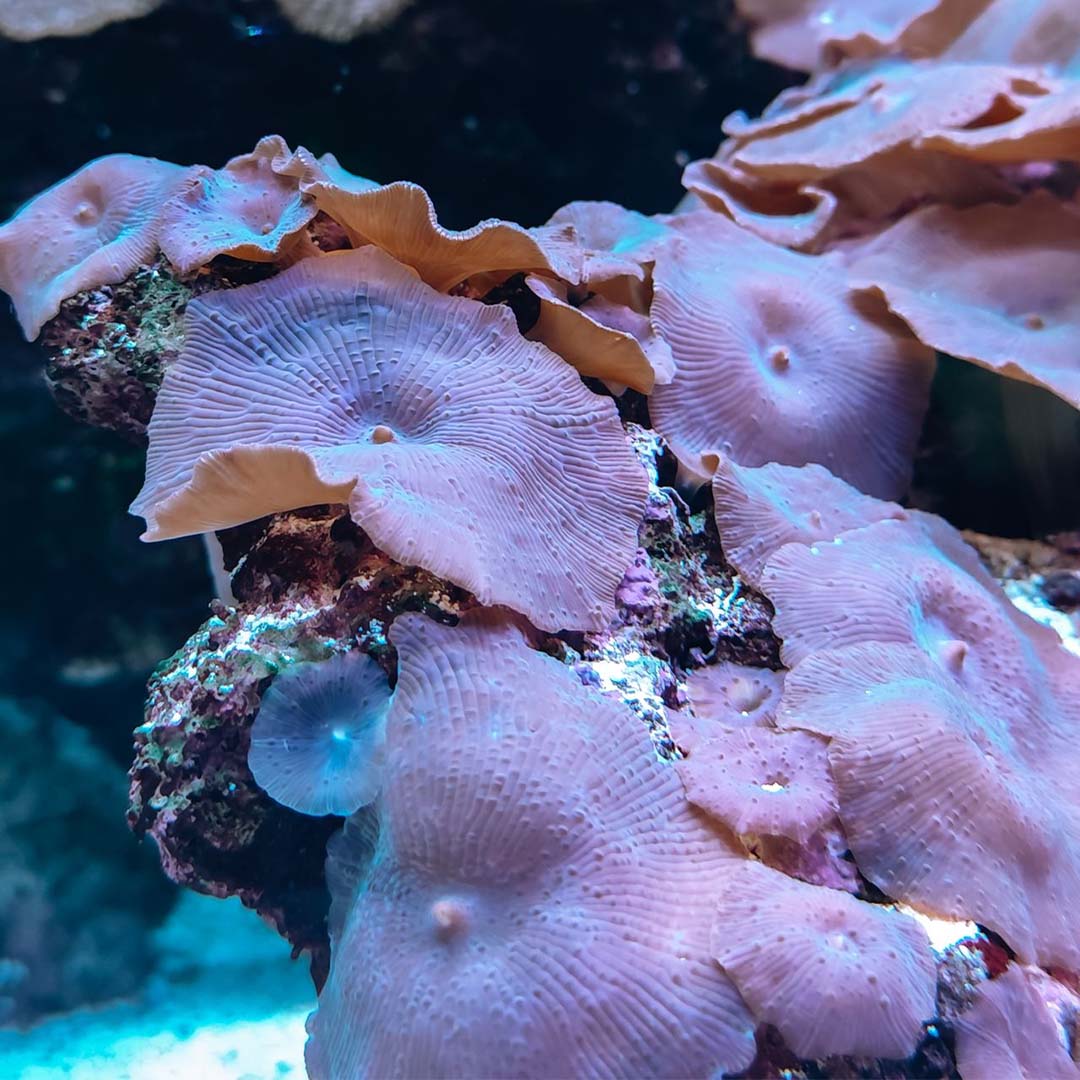
The Mushroom Coral (Discosoma sp.) wants moderate light: too much and the disc shrinks, too little and the colour drains. One piece needs 40 l (10.6 gallons), 23-27 °C (73.4-80.6 °F) and 1.023-1.025 specific gravity. Put the colony on its own rock rather than the main rockwork, and leave 10 cm (3.9 in) to your stony corals; it spreads by splitting.
The Mushroom Coral is usually sold in the aquarium trade under the label Actinodiscus sp., yet that name is no longer valid. WoRMS records Actinodiscus, erected by de Blainville in 1830, as a synonym of Discosoma, the name Rüppell and Leuckart published in 1828; the accepted genus is Discosoma and the family is Discosomidae (WoRMS, 2026a; 2026b). Whatever the label says, the animal in your hands is the same: a corallimorph in the order Corallimorpharia that lays down no skeleton. It looks like a coral and has no calcium carbonate skeleton at all.
The body is a single disc on a short stalk that anchors it to the rock. The disc is flat and carries no long tentacles. Surface colour varies widely across the genus, running from metallic blue through green and red to dark brown, and the mouth area is usually lighter than the rest of the disc. The tissue produces a great deal of mucus, which is why it feels slippery when you pick it up (Sprung, 2002). A Mushroom Coral does not stay a single polyp either; it multiplies side by side and builds a carpet across the rock.
We could not find a study that measured disc diameter. The only figure we have is the 2.5-7.5 cm (1-3 in) range reported by Goemans (n.d.), and that comes from an article on an aquarium website rather than from research. This is why the Species Info Box carries 7.5 cm (3 in). The measurement covers the diameter of one disc, not the area the colony covers; in an aquarium most Mushroom Coral individuals stop around 3-5 cm (1.2-2 in).
Colour forms do not correspond to any split at species level. Carlgren separated two varieties, one blue and one dark, when he described Discosoma unguja in 1900, but WoRMS treats neither as a separate taxon today and records both directly as synonyms of Discosoma unguja (WoRMS, 2026c). The pieces sold in the trade as Blue Mushroom Coral, Green Mushroom Coral and Red Mushroom Coral are colour forms of the same genus and their care does not differ. That is why we wrote this page at genus level and gave the scientific name as Discosoma sp.
The range of the genus is wide and the records show it plainly. Most of the 1,090 Discosoma records held by GBIF come from the Central Pacific, and there are Western Pacific, Indian Ocean and Red Sea records as well (GBIF, 2026). The genus also has members living in the Caribbean, but the pieces that enter the trade come from the Indian Ocean and the Pacific, and the origin field in the Species Info Box marks those four regions.
Setting aside at least 40 l (10.6 gallons) will be enough. Volume is not really the limiting factor in Mushroom Coral care; this animal will live in a 20 l (5.3 gallons) nano system. What pushes the number up is stability. In a small volume temperature and salinity drift far faster, and the rock area you have to give the colony grows as it spreads. The number we give rests on what aquarists have settled on through experience rather than on published work.
The values you can aim for are 23-27 °C (73.4-80.6 °F) temperature, 1.023-1.025 specific gravity (34-35 ppt) salinity, 8.1-8.4 pH and 8-11 dKH alkalinity. This animal asks for a stable range rather than a narrow one; alkalinity that swings from day to day does far more damage than a value sitting slightly high and holding steady.
Light is where the most common mistake with this animal starts, and the mistake runs in two directions. Kuguru et al. (2008) compared two corallimorph species off Eilat in the northern Red Sea across the reef flat (0.5 m), the shallow slope (3 m) and the deep slope (18 m); they measured Discosoma unguja as markedly more sensitive to high light than Rhodactis rhodostoma, and as the only species that changed the type of the symbiotic algae in its tissue.
The other direction exists too. Sprung (2002) reported that Discosoma individuals thrive even under low light, but that the metallic blue forms need stronger light to hold their colour. Moderate light is therefore the target in Mushroom Coral care: too much upsets the symbiotic algae balance, too little drains the colour, and the brighter the piece you have the larger that second risk becomes. If you set your lighting around your SPS corals, meaning your small-polyp stony corals, you can move the colony to the shaded lower zone, but not into a fully dark corner.
Sources disagree on flow, and both readings are worth knowing. Sprung (2002) reported that these animals tolerate strong flow but open widest in low flow. Goemans (n.d.) tied the disc detaching from its stalk and drifting away not to strong flow but to overcrowding and very intense light. In practice the two arrive at the same place: do not point your wavemaker straight at the colony, and let the flow pass over it indirectly.
Nutrient load is the most interesting thing about this animal. Kuguru et al. (2004) compared Rhodactis rhodostoma with a branching Acropora species across three reefs in Tanzania; they showed that corallimorph density was highest in the area with the highest nutrient load, and that in a transplant experiment the corallimorph outcompeted the coral. The finding belongs to a related genus, but it still points the way: the Mushroom Coral grows comfortably in water where your SPS colony struggles.
Most of its energy comes from the zooxanthellae in its tissue, the single-celled algae that live in symbiosis with it. The Mushroom Coral adds two more things on top: it absorbs dissolved organic matter straight from the water and carries particles caught in its mucus to its mouth. Sprung (2002) reported that in low flow it will even wrap and swallow pieces as large as flake food and worms, so its stinging cells do real prey-catching work as well.
In practice that makes feeding useful rather than compulsory. You can target feed it once or twice a week:
Turning the flow down for a few minutes before you feed makes the job easier; with the flow running, food will not stay on the disc. Food size matters too, because the mouth opening is small and a large piece sits on the disc and then falls off. The real risk in Mushroom Coral feeding is not starvation but overfeeding: food that goes unused turns into a cyanobacteria and algae outbreak, which then cuts the light and sets the colony back.
Mushroom Coral temperament is semi-aggressive, and that has to do with the distance it keeps from its neighbours. Langmead and Chadwick-Furman (1999) worked on Rhodactis rhodostoma from a related genus; they showed that the marginal tentacles swell on contact, carry thicker outer tissue and a higher proportion of stinging cells, and damage and overgrow zoanthids, sponges and small-polyp branching stony corals.
Neighbours that resist that pressure have been documented as well. In the same study large-polyp massive stony corals from the families Faviidae and Mussidae held their distance and did not let the corallimorph within 1-3 cm (0.4-1.2 in); soft corals producing chemical defences were not damaged either. The authors rated Rhodactis rhodostoma a mid-ranking competitor, which is to say not a species that crushes every neighbour.
The aquarium translation is to choose selectively. The findings belong to a related genus, so read them as direction rather than guarantee: a soft coral producing chemical defences, such as the Neon Pineapple Tree Coral, holds up better beside a Mushroom Coral carpet than a small-polyp branching stony coral does. Keeping that order in mind while you pick the neighbour will serve you well.
What the same ability can do at reef scale has been documented too. Work et al. (2008) reported a shift on Palmyra Atoll associated with a vessel that grounded there in 1991: the corallimorph Rhodactis howesii reached 288 (±47) individuals per square metre and spread as far as 1,100 m (3,609 ft) from the wreck. The authors proposed leaching iron from the wreck as the cause, because iron is a trace element that accelerates the growth of the symbiotic algae.
What happened next matters more to aquarists. Work et al. (2018) measured cover on the same atoll at 1 km² (0.4 sq mi) in 2007 and 3.3 km² (1.3 sq mi) in 2011; after the vessel was removed in 2013 the infestation in the core area receded markedly. Cut the nutrient source and the corallimorph recedes with it. The translation for your aquarium is this: what feeds the spread is usually not the rock but the water.
The real decision you make in the aquarium is where to put the colony: place the colony on its own rock rather than on the main rockwork. A Mushroom Coral carpet growing on a separate piece can be lifted out and moved on any day you choose; one that has spread across the main rockwork can only be stopped by breaking it up. Leaving at least 10 cm (3.9 in) between it and your stony corals will also serve you well.
On the fish side the list is short. Thanks to its thick mucus the Mushroom Coral holds little interest for most reef fish; larger angelfish, most butterflyfish and some filefish species, on the other hand, will pick at the disc. You are better off not putting those three groups in the same aquarium. Safe aquarium mates are the familiar small reef community: clownfish, damselfish, goby, blenny and cardinalfish. Shrimp, crabs and marine snails cause no trouble either.
Discosoma reproduction runs asexually in the aquarium and does so on its own. Goemans (n.d.) and Sprung (2002) count three routes: tissue fragments torn from the base of the stalk that grow into new polyps, the disc splitting in two, and budding on the stalk. The two sources disagree on the axis of that split; Goemans reported a longitudinal split starting at the mouth, Sprung a transverse one. The Mushroom Coral uses these routes together, which is why a rock that starts with a single disc can carry dozens within a year.
If you want to propagate it yourself, the method follows from the same biology. Cutting the disc into wedges with a sharp blade and fixing each piece onto its own piece of rock under mesh is enough; within a few weeks the pieces complete their own mouth and margin. It is worth doing the cutting outside the main aquarium, because cut tissue releases a great deal of mucus and cell content.
On sexual reproduction it is worth being honest. We could not find a documented record of sexual propagation in an aquarium for Discosoma, and the genus’s sexual reproduction pattern in the wild is not well known either. No documented record does not mean it cannot be propagated. The Yes in the Species Info Box rests on the aquacultured frags widely sold in the trade, not on sexual reproduction.
There is no named disease specific to the Mushroom Coral. Almost everything you will run into is environmental and falls under two headings: the disc staying permanently shrunken, and the disc detaching from its stalk and drifting around the aquarium. Kuguru et al. (2008) measured high light as producing enough pressure in this group to change the type of the symbiotic algae, so if colour loss and shrinking appear together, first reduce the light intensity in steps.
Do not miss the opposite picture. If the disc is open but its colour is fading and drifting towards grey, the problem is not too much light but too little; Sprung (2002) reported this particularly in the metallic blue forms. The sign that separates the two pictures is how the disc sits: a shrunken, pale disc points to too much light, an open disc with drained colour points to too little.
It is worth not rushing when you bring a new piece into your aquarium. Shipping strips part of the mucus layer and the colony may not open for the first few days. Matching temperature and salinity with a 45-60 minute drip, then putting the piece in the shadiest spot and moving it up over a few weeks, will be enough. Flatworms arriving on the rock are also common; the method aquarists have used for this for years is a short freshwater dip outside the aquarium.
On the safety side two ideas need separating. The stinging cells of corallimorphs work by stinging and their real target is the neighbouring coral; the effect on human skin is weak. The poison that appears when one is eaten is a separate matter: Martin (1960) reported a paralysing poison in Rhodactis howesii from a related genus when consumed raw. We could not find such a record for Discosoma, but we still recommend wearing gloves when cutting and moving it.
There is no measurable figure for lifespan. The Mushroom Coral is a clonal animal: even as individual polyps age and die the colony renews itself by splitting, so a lifespan expectation of the kind fish carry does not apply. Because we could not find published data we put 20+ years in the Species Info Box; in practice the colony has no end date as long as its care continues.
There is no published assessment for Discosoma on the IUCN Red List, which puts the category at Not Evaluated (NE). A search on iucnredlist.org on 22 September 2026 returned no results at all for either Discosoma or Corallimorpharia; the gap is not specific to this genus, as no corallimorph has ever been assessed. Do not confuse this with Data Deficient (DD), the category for insufficient data: DD covers species that were assessed without a conclusion being reached, NE covers species never assessed at all.
The trade side is clearer. In the CITES Checklist the order Scleractinia, which the stony corals belong to, appears in Appendix II as a whole; Corallimorpharia and Discosoma do not appear on the list at all (CITES, 2026). The CITES paperwork asked for with stony corals is therefore not asked for with corallimorphs. Import rules set by individual countries operate separately from this.
The one practical thing an aquarist can do sits on the supply side. The Mushroom Coral is among the easiest corals to propagate and aquacultured frags are plentiful in the trade, so you have no reason to buy a wild-collected individual. A frag bought from a local aquarist or a coral farm costs less and lowers the risk of carrying an unwanted hitchhiker into your aquarium.
Have you kept a Mushroom Coral, which colour form did you get, and how fast did your colony spread across the rock? Leave it in the comments below. Someone else keeping the same species will get a far clearer picture of what to expect on their own rock by reading what actually happened in your aquarium.
References:
Was this guide helpful?
“Your answer helps us improve our guides.”
Share:
Species Info Box
Temperature
Salinity
pH
Alkalinity
Venomous
Aquarium Size
Maximum Size
Lifespan
Color Form
Reef Compatible
Diet
Temperament
Care Level
Breeding
Genus
Family
Origin
No cookies in this category.
We use cookies to personalize content, provide social media features, and analyze our traffic. We also share information about your use of our site with our analytics partners. You can change your preferences at any time. For more information, please see our Privacy Notice and Cookie Notice. Privacy Notice Cookie Notice
We sent you a confirmation link. Click it to finish subscribing.
