
Cover photo: Thomas Mesaglio, licensed under CC BY 4.0; cropped.
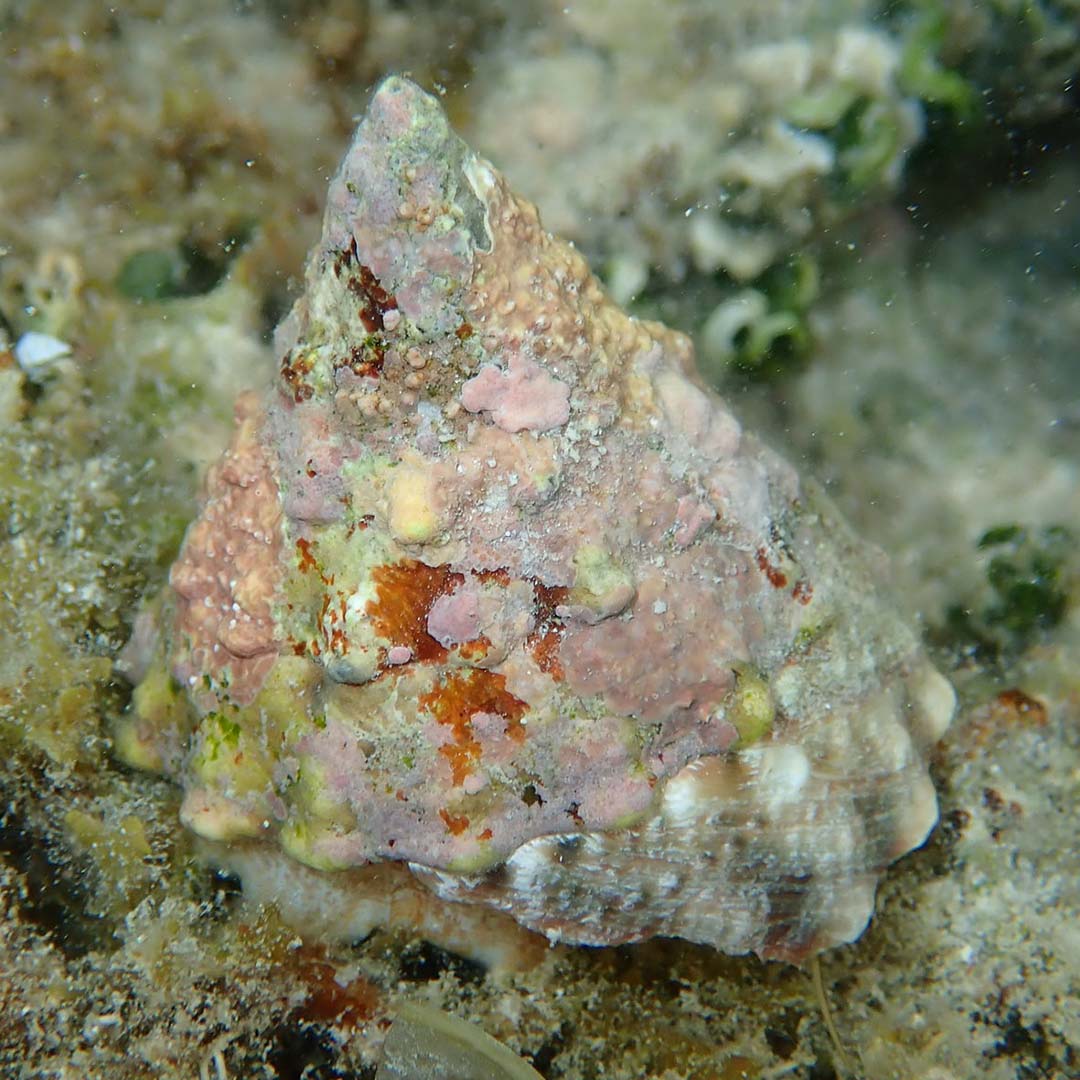
Cover photo: Thomas Mesaglio, licensed under CC BY 4.0; cropped.
The Turban Snail (Tectus fenestratus) is a herbivorous sea snail that feeds on the thin algae film on glass and rock, with a shell height of up to 7 cm (2.8 in). Its main risk in the aquarium is water quality; in the only study, 18 of 20 individuals died within 53 days in aquariums where nitrite rose and pH stayed below 8.0. Keep it in a fully cycled aquarium with pH stable at 8.1-8.4.
The Turban Snail (Tectus fenestratus) is a herbivorous sea snail with a pyramid-shaped shell that feeds by scraping the thin film of algae off glass and rock. The SeaLifeBase record (Palomares and Pauly, 2026) lists it in the Indo-West Pacific, and most GBIF records come from the Philippines, Australia and Indonesia (GBIF.org, 2026). Higo et al. (1999) stated that it is mostly found on rocky shores, and del Norte-Campos et al. (2020) that it usually lives in muddy areas. All OBIS records that carry depth information fall within 0-5 m (0-16 ft) (OBIS, 2026).
Sources differ on shell size. Poutiers (1998) stated a maximum shell height of 7 cm (2.8 in) and a common size of 5 cm (2.0 in), while the height Tryon (1889) gave for the shells he examined is 30-35 mm (1.2-1.4 in). Neither source explains the difference.
In the trade this snail is sold under all three names, turban snail, turbo snail and tectus snail, and the confusion has a scientific history. In English, “turban snails” is primarily the name of the family Turbinidae (Vermeij and Williams, 2007). Williams et al. (2008) moved the genus Tectus into Turbinidae on molecular evidence and described this as the most surprising result of their study. The MolluscaBase (2026) record in WoRMS, however, accepts the species in the family Tegulidae today. The common name SeaLifeBase gives is Fenestrate top.
The study by Watson et al. (2018) shows why the name matters. The researchers only realised after their experiment that this species had arrived in place of the snails they had ordered from a wholesaler under other names. In the same experiment every Brown Pacific Turban (Turbo bruneus), a member of Turbinidae, survived, while almost every Turban Snail died. Two snails bought under the “turban snail” label can therefore do very differently in your aquarium.
You can tell the two apart at the point of purchase by looking at the shell and the operculum, the trapdoor that seals the shell opening. The shell of Tectus fenestratus, as del Norte-Campos et al. (2020) described it, is pyramid-shaped, with an angular last whorl, a flat base and an outer surface covered in thick, rounded, oblique ribs. Tryon (1889) gave its colour as white or greyish, mottled with green, brown or olive, with a plain white base. The same work describes the operculum of Trochus, the genus the species was placed in at the time, as thin, circular, horny and made of 8-12 narrow whorls.
The operculum of Turbinidae, by contrast, is a heavily calcified, thick plate (Vermeij and Williams, 2007). If you turn the snail over and a thick, white, stone-like operculum closes the opening, you are holding a member of Turbinidae; if you see a thin, horny operculum, a pointed pyramid shell and a flat white base, you are looking at a tectus snail. A definite identification still takes an expert eye.
Water quality is the deciding factor in turban snail care. The only study that has measured how the Turban Snail copes in aquariums is by Watson et al. (2018). The researchers divided 20 individuals, together with two other snail species, among ten aquariums measuring 30 x 30 x 34 cm (11.8 x 11.8 x 13.4 in) and kept the water at around 25 °C (77 °F). After 53 days, only 2 of the 20 individuals were still alive. The average pH in the experimental aquariums stayed at 7.76, and in some aquariums nitrite reached 5 mg/l in the first measurements.
The authors showed a relationship between nitrite and mortality across the aquariums and stated that pH staying below 8.0 may also have contributed to the deaths. They attributed the nitrite spikes to the first deaths overloading a biological filter that had not yet matured. For this reason we recommend that you do not add a Turban Snail to an aquarium whose cycle has only just finished. Once the nitrogen cycle is complete, seeing nitrite stay at zero for a few weeks and pH hold steady at 8.1-8.4 tells you it is the right time to add this species.
You need to measure nitrite and pH regularly; we covered how to take these measurements in our guide to choosing test kits. For the other values you can aim for a temperature of 24-27 °C (75.2-80.6 °F), a specific gravity of 1.024-1.026 and an alkalinity of 7-11 dKH.
We recommend at least 100 l (26.4 gallons) for a single individual. What decides the volume is not the water itself but how much algae film grows naturally on the glass and rock; in a small aquarium that film runs out within a week or two. The temperature, salinity, alkalinity and volume values in this section come from established aquarium practice rather than from a study.
The Turban Snail is a herbivore and scrapes the thin film of algae from surfaces with its radula, the rasp-like toothed ribbon in its mouth. Watson et al. (2018) left individuals for 24 hours with plates coated in green algae extract and measured that the Turban Snail scraped significantly more of the plates than empty control plates did. In the same experiment they also showed that the Brown Pacific Turban grazed significantly more than this species.
The authors also pointed out a difference in behaviour. Snails with tall, pointed shells tend to avoid their competitors, and this species may have reached the food stones less often when kept with the other two snails. In a cleanup crew where several algae-eating snails live together, the Turban Snail may therefore end up on the losing side of the competition for food.
If no thin brown or green algae film is left on your glass and rocks, you can supplement the snail with dried seaweed sheets or sinking herbivore tablets. 2-3 times a week, a piece small enough for it to finish overnight is enough. This feeding advice comes from established aquarium practice rather than from a study.
The Turban Snail is peaceful and does not attack fish, shrimp or other snails. Watson et al. (2018) found the Turban Snail significantly less active than the Brown Pacific Turban in their experiment and stated that it tends to hide where it is rather than move away from a threat. Individuals spent an average of 98 percent of their time fully submerged, so this species is not much inclined to climb to the surface and out of the aquarium.
As an algae-eating snail it does not harm corals, and you can keep it in a reef aquarium. What you need to watch out for are fish and invertebrates that eat snails. Some wrasse and puffer species hunt snails, and hermit crab species may attack live snails while looking for an empty shell. The compatibility information in this section comes from established aquarium practice rather than from a study.
How many individuals you keep depends on the amount of algae in your aquarium. Adding several algae-eating snails at once increases the competition for food described above; keeping the tectus snail as the only grazer in your cleanup crew, or with a small number of other grazers, is the safer choice.
SeaLifeBase gives a general pattern for the old snail order this species belongs to: most individuals have separate sexes and release their eggs and sperm into the water, the embryos develop into larvae that drift in the plankton and settle on the bottom after a while. This information applies to the group the species belongs to, not to the species itself; no study has examined the species’ own reproduction.
Watson et al. (2018) stated that snails sold as cleanup crew are cheap and that their culture has therefore not been a priority; we also found no documented record of this species being bred in aquariums. The individuals sold in the trade are therefore wild-caught individuals.
The strongest information we have on lifespan is the short survival that Watson et al. (2018) measured. Individuals that settle well in an aquarium are said to live 3-5 years, but no study has measured the species’ lifespan in aquariums or in the wild. This lifespan value comes from established aquarium practice rather than from a study. The authors also measured that heavier individuals died sooner and could not explain why.
The three stages used in the same study are a good yardstick for spotting an unhealthy individual early. A healthy individual holds onto the surface with its foot. An individual that does not hold on, that falls to the glass or the bottom and stays there, and that only moves its foot when you touch it is struggling. At that point it is worth measuring nitrite and pH straight away.
You must remove a dead individual the same day it dies. A dead snail rots inside its shell and may not be noticeable from the outside; the decay returns to your aquarium as ammonia and nitrite, and this species is sensitive to exactly that rise. SeaLifeBase lists the species as harmless to humans; it is not venomous.
The Turban Snail is not included in version 2026-1 of the IUCN Red List (IUCN, 2026). The species is therefore in the Not Evaluated (NE) category. NE is not a risk level; it does not say the species is common or safe, only that no one has yet examined its status.
The species is outside the scope of CITES. A search for Tectus in the CITES Checklist returns no results; in the same list, the giant clams also kept in reef aquariums, the genus Tridacna, sit in Appendix II, the list of species whose trade requires a permit (CITES, n.d.). Poutiers (1998) and del Norte-Campos et al. (2020) stated that the species is also collected locally for food.
The most practical thing an aquarist can do is avoid having to buy this snail again and again. Watson et al. (2018) stated that constantly replacing species that live briefly in aquariums increases collection from the wild. Buying the species only once your aquarium is ready protects both your wallet and the wild population.
Have you kept a Turban Snail, and how many months did it live in your aquarium? Leave it in the comments below. Someone else thinking of buying this snail will see far more clearly what to expect in their own aquarium once they read what happened in yours.
References:
Was this guide helpful?
“Your answer helps us improve our guides.”
Share:
Species Info Box
Temperature
Salinity
pH
Alkalinity
Venomous
Aquarium Size
Maximum Size
Lifespan
Color Form
Reef Compatible
Diet
Temperament
Care Level
Breeding
Genus
Family
Origin
No cookies in this category.
We use cookies to personalize content, provide social media features, and analyze our traffic. We also share information about your use of our site with our analytics partners. You can change your preferences at any time. For more information, please see our Privacy Notice and Cookie Notice. Privacy Notice Cookie Notice
We sent you a confirmation link. Click it to finish subscribing.