
Cover Photo: Randi Ang, used with permission; cropped and resized.
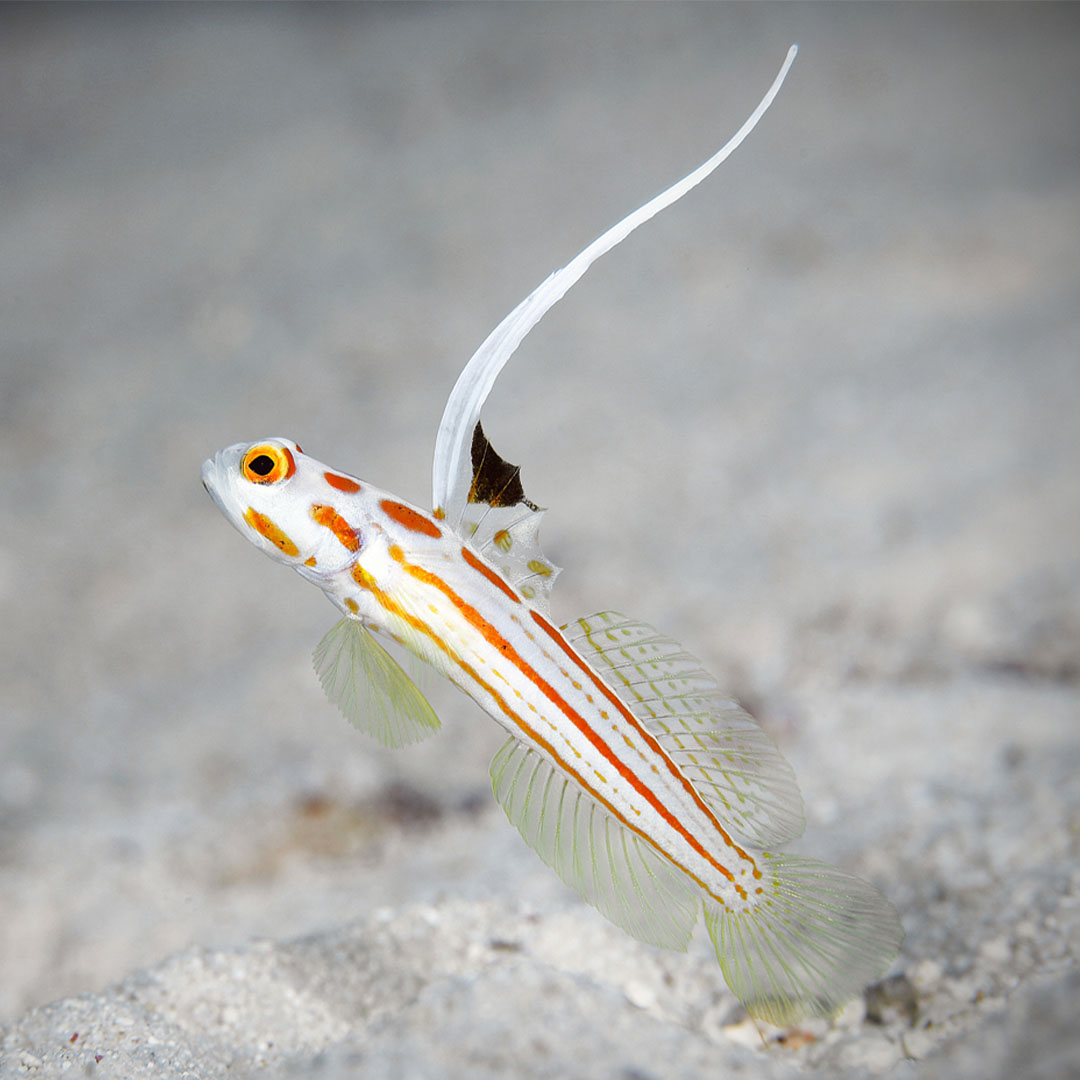
Cover Photo: Randi Ang, used with permission; cropped and resized.
The Yasha Goby is a small goby that shares its burrow with a pistol shrimp and reaches at most 4.7 cm (1.9 in) standard length in the wild. A single fish needs at least 60 l (15.9 gallons), at least 5 cm (2 in) of fine sand, water at 23-26 °C (73.4-78.8 °F) and small portions of frozen food 2-3 times a day. It lives with its own species only as an established pair, and captive-bred fish are available.
The Yasha Goby is a small reef fish that shares a burrow dug into the sand with a pistol shrimp. Yoshino and Shimada (2001) described the species from nine specimens collected in the Ryukyu Islands of Japan and identified the reddish-orange stripes on its white body as its distinguishing feature. WoRMS still lists this name as valid (Froese and Pauly, 2026b). FishBase gives the maximum size as 4.7 cm (1.9 in) standard length, the length measured without the tail fin, in a female (Froese and Pauly, 2026a).
Yasha goby care is built around this partnership. Karplus and Thompson (2011) describe the relationship between shrimp gobies and burrowing shrimps as a mutualism that benefits both partners. The shrimp digs and maintains the burrow; the goby uses it as shelter by day, a resting place at night and a breeding site. In return, the goby gives the nearly blind shrimp an alarm system that works through touch (Karplus, 2022). When the goby spots danger and dives into the burrow, the shrimp feels the movement and retreats inside as well.
The species lives in the Western Pacific. Larson et al. (2021) recorded it in the waters of Indonesia, Japan, New Caledonia and Palau. GBIF.org (2026) lists most of its records from Japan, especially Okinawa, with fewer from Indonesia and New Caledonia. FishBase lists the species on outer reef slopes at 15-40 m (49-131 ft) and says that individuals usually occur in pairs, hovering a few centimetres above the sand at the burrow entrance.
A Yasha Goby, alone or together with a pistol shrimp, can be kept in a minimum of 60 l (15.9 gallons). The fish is small and rarely strays from its burrow, but it defends its territory against members of its own species, so this figure comes from the sand area it needs rather than from its size. For an established pair, 100 l (26.4 gallons) is a more comfortable starting point. When you work out how many fish can fit in an aquarium, it helps to remember that shrimp gobies share the bottom rather than the water column. The volume, sand and water values in this section come from established aquarium practice rather than from research.
The sand bed is what this species really needs. For the pistol shrimp to dig a burrow, you need a fine-grained sand bed at least 5 cm (2 in) deep. Because the shrimp also undermines rocks, placing your rockwork directly on the aquarium bottom rather than on top of the sand greatly reduces the risk of a collapse. A Yasha Goby dives into its burrow when startled, but before its burrow is established it may jump upward; a tight-fitting lid on the aquarium prevents this loss.
The target water values are a temperature of 23-26 °C (73.4-78.8 °F), a specific gravity of 1.023-1.026, pH 8.1-8.4 and an alkalinity of 7-11 dKH. dKH is the abbreviation for degrees of carbonate hardness, the unit that measures the water’s carbonate buffer. OBIS (2026) gives surface water temperatures of 20.5-28.9 °C (68.9-84.0 °F) at the points where the species has been recorded, and the target range sits in the middle of that span. You can monitor pH and alkalinity at regular intervals with test kits.
No study has measured what the Yasha Goby eats in the wild. According to FishBase, the fish hovers just above the sand at the burrow entrance, which points to a fish that picks off small organisms carried in by the current. In the aquarium you can offer frozen mysis, copepods, brine shrimp and fine-grained pellets 2-3 times a day in small portions. It matters that the food reaches the front of the burrow, because this fish rarely leaves its burrow to feed. Feeding frequency and food choice rest on established aquarium practice.
The pistol shrimp also takes its share of the food that lands at the burrow entrance, so you need to adjust the amount for both animals. The most dangerous mistake with this species is keeping a Yasha Goby with fast-feeding fish; the food runs out before it reaches the burrow and the shy goby weakens within a few weeks. Stella et al. (n.d.) state that they weaned their juveniles onto pellet food after settlement, so a captive-bred Yasha Goby may arrive in your aquarium already used to prepared food.
The Yasha Goby is peaceful towards other species. Towards its own species, however, things are different. You should keep a single fish or an established pair in your aquarium, because two unpaired fish on the same sand bed chase each other and the weaker one stays in hiding instead of coming out to feed. If you want a pair, starting with two fish sold together makes things easier. The temperament and pairing advice come from established aquarium practice rather than from research.
The partnership with a pistol shrimp makes this a fish you see in the aquarium rather than one that hides. FishBase lists its partner as Randall’s Pistol Shrimp (Alpheus randalli). Adding the shrimp on the same day as the goby, or before it, gives the two a chance to build the burrow together. A goby without a shrimp can survive, but it spends more time hiding among the rocks. The goby does not touch corals; the shrimp, however, piles the sand it digs around the burrow and can bury small coral fragments sitting close to the bottom. We therefore recommend not placing your low-lying corals right next to the burrow.
Small, peaceful fish make suitable aquarium mates. Species that perch on rocks and corals, such as the Neon Goby (Elacatinus oceanops), do not share the sand bed and so do not disturb the Yasha Goby. If it shares the aquarium with another shrimp goby such as the Tangaroa Goby (Ctenogobiops tangaroai), each fish should have its own shrimp and its own area of the sand bed. Keeping it with large predatory fish that can eat anything small enough to fit in their mouths may cost you this fish.
In the wild, the burrow is where this species breeds. Karplus and Thompson (2011) state that shrimp gobies use the burrow dug by the shrimp as a safe place for breeding, and FishBase also lists the Yasha Goby as usually occurring in pairs. The eggs develop inside this burrow, out of sight.
Breeding in the aquarium has been documented. Stella et al. (n.d.) state that they bred the species for the first time in 2016 at the Roger Williams University marine lab. Nine wild-caught pairs began spawning after about 8 months of conditioning, and after a 5-day incubation the hatched larvae started feeding on copepods by the end of the first day. The larvae began settling on day 20-25 and took on a juvenile appearance from day 35. The researchers raised more than 1,000 juveniles from seven pairs in 4 months and measured an average survival rate of 50 percent; the fish reached a market size of 3.5-4.0 cm (1.4-1.6 in) by day 200.
Breeding at home is a demanding job. Because the larvae’s first food is live copepods, you need a copepod culture that runs continuously. If your pair spawns, raising the larvae in the main aquarium is hardly possible; you need a separate larval aquarium and feeding throughout the day.
Before moving a new fish into the main aquarium, it is worth watching it for at least 30 days in a separate quarantine aquarium. External parasites common in saltwater fish, such as white spot (Cryptocaryon irritans), can also affect this species and show up on the body as white dots the size of salt grains. The quarantine period and the lifespan value in this section come from established aquarium practice rather than from research.
A stressed goby stops eating first. If the fish does not come out of its burrow for more than a day and does not eat when you feed, first measure your water values, then watch whether other fish in the aquarium are chasing it.
It can be expected to live 3-5 years in the aquarium; no study has measured its lifespan. FishBase lists the species as harmless to humans, and the Yasha Goby has no venomous spine.
The Yasha Goby is listed as Least Concern (LC) on the IUCN Red List, meaning it is not currently in any of the categories at risk of extinction. Larson et al. (2021) assessed the species in 2020 and recorded no known threats, while noting that it is a highly sought-after fish in the aquarium trade. The assessors state that the species is seen rarely because it lives in deep water and may be more widespread than currently known. The population trend is unknown.
CITES, the convention that regulates international trade in endangered species, does not cover the Yasha Goby. Neither the genus Stonogobiops nor the family Gobiidae appears in the CITES Checklist (CITES, n.d.), so trade in this species does not require a CITES permit.
The one practical thing an aquarist can do is choose captive-bred fish. Stella et al. (n.d.) describe the aim of their breeding work as reducing the need for wild-caught Yasha Gobies. Asking whether a fish is wild-caught or captive-bred when you buy it contributes directly to that aim.
Have you kept a Yasha Goby, and did it share a burrow with a pistol shrimp? Leave it in the comments below. Someone about to bring this species into their aquarium for the first time will prepare their sand bed far better after reading what happened in yours.
References:
Was this guide helpful?
“Your answer helps us improve our guides.”
Share:
Species Info Box
Temperature
Salinity
pH
Alkalinity
Venomous
Aquarium Size
Maximum Size
Lifespan
Color Form
Reef Compatible
Diet
Temperament
Care Level
Breeding
Genus
Family
Origin
No cookies in this category.
We use cookies to personalize content, provide social media features, and analyze our traffic. We also share information about your use of our site with our analytics partners. You can change your preferences at any time. For more information, please see our Privacy Notice and Cookie Notice. Privacy Notice Cookie Notice
We sent you a confirmation link. Click it to finish subscribing.