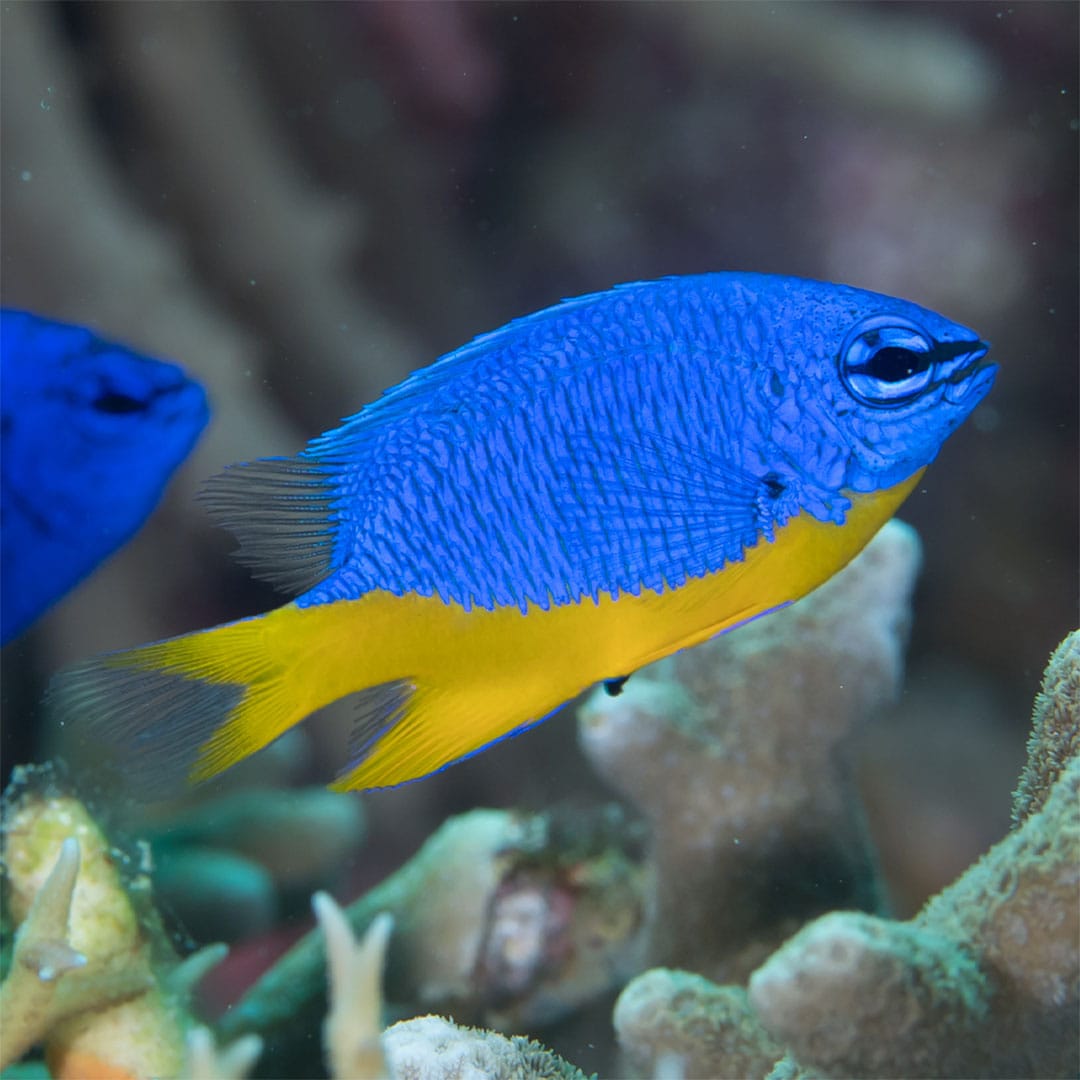
Azure Damselfish (Chrysiptera hemicyanea) is loved for its blue-yellow colors and hardiness. But beware: this small fish can turn into a dragon in your tank!
The Azure Damselfish (Chrysiptera hemicyanea), a member of the Pomacentridae family, is a small yet striking fish native to the tropical coral reefs of the Indo-Pacific. With its vibrant blue and yellow coloration, this species is a popular choice for reef tanks, offering both hardiness and visual appeal. However, experienced aquarists know not to be fooled by its small size—you might just be adding a “dragon” to your tank! (While C. parasema is sometimes called the Blue Damselfish, in the aquarium trade, C. hemicyanea is widely recognized by this name.)
For the Azure Damselfish, the ideal water temperature should range between 24-28°C (75-82°F). A minimum aquarium volume of 120 liters (approx. 30 gallons) is recommended to provide ample swimming space and rocky structures for hiding. Maintain a pH level of 8.1-8.4 and a specific gravity (salinity) of 1.020-1.025. Strong water circulation and high-quality filtration are essential for maintaining a healthy environment.
As an omnivore, the Azure Damselfish naturally feeds on plankton, small crustaceans, and algae. In an aquarium setting, they easily adapt to a variety of foods, including high-quality flakes, pellets, and frozen offerings like mysis and brine shrimp. A diverse and regular diet is key to maintaining their vivid colors and supporting a robust immune system.
This species is known for its territorial behavior. It tends to claim specific areas of the tank and can become aggressive toward intruders. In larger aquariums, this aggression is often diluted, and compatibility improves. It is best kept with other hardy species of similar size. More delicate fish, peaceful gobies, or small wrasses may unfortunately become targets of its territorial nature.
The Azure Damselfish is one of the species that can successfully spawn in captivity. Males guard the eggs deposited by females on flat surfaces. The eggs typically hatch within a few days, and the larvae become free-swimming. However, raising the fry is quite challenging, as they require specialized planktonic nutrition during their early stages.
The Azure Damselfish is remarkably hardy and resistant to most common aquarium diseases. Nevertheless, poor water quality or inadequate nutrition can cause stress, leading to parasitic infections such as Marine Ich (Cryptocaryon irritans). This species is not venomous and poses no physical risk to the hobbyist. Their average lifespan is 5–6 years, though they can live longer under optimal conditions.
Cover Photo: Rickard Zerpe
References:
Was this guide helpful?
Like, save to your profile and reach more people.
Share:
Species Info Box
Temperature
Salinity
pH
Alkalinity
Venomous
Aquarium Size
Maximum Size
Lifespan
Color Form
Reef Compatible
Diet
Temperament
Care Level
Breeding
Genus
Family
Origin
We use cookies to personalize content, provide social media features, and analyze our traffic. We also share information about your use of our site with our analytics partners. You can change your preferences at any time. For more information, please see our Privacy Notice and Cookie Notice. Privacy Notice Cookie Notice
We sent you a confirmation link. Click it to finish subscribing.
