

In this issue of AMAZONAS Magazine, new Editor-in-Chief Alex assures readers that the magazine’s content will never be written by Artificial Intelligence (AI) and will always be reviewed by real people with decades of experience. This assertive stance is one Alex emphasizes as a core editorial principle, signifying a strong commitment to quality and human expertise in the hobby. This entire issue is dedicated to the theme of Equatorial Fishes.
The magazine introduces two significant new features: a “Green Horizons” section edited by Jen Williams, focusing on beautiful aquatic art, and a “Glossary” reference section that explains uncommon terms used throughout the articles.
Remembering Lou Ekus (1955–2025)
This article is dedicated to the memory of Lou Ekus (1955–2025), written by his business partner of 28 years and wife of 26 years, Leslie Ekus. In her tribute, Leslie shares that Lou was much more than just “Mr. Tropic Marin”. Lou was a multi-faceted individual: a scientist with a Bachelor of Science from NYU who worked in Prosthetics and Orthotics, helping children; he was also a media trainer who coached chefs and TV personalities on presentation skills, and is even credited with discovering Rachel Ray.
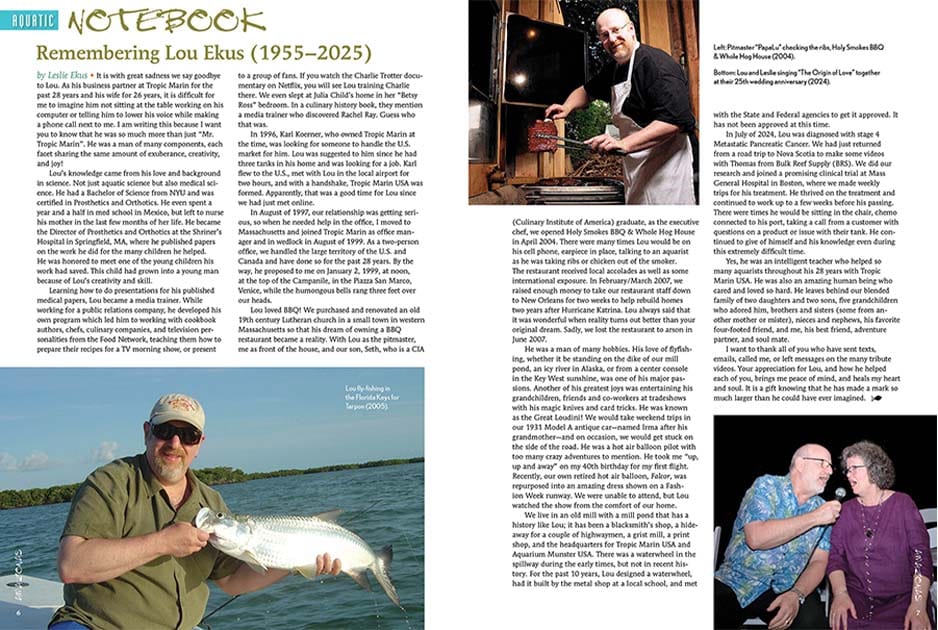
Lou founded Tropic Marin USA in 1996. Beyond his passion for the aquarium trade, he was a dedicated barbecue pitmaster (founder of the Holy Smokes BBQ restaurant) and a magician known as “The Great Loudini”. His numerous hobbies included flyfishing and hot air balloon piloting. Despite being diagnosed with pancreatic cancer in 2024, he continued working until a few weeks before his passing. Lou was described as an intelligent teacher who shared his knowledge with aquarists, and an extremely caring, loving human being who left a great legacy to his family and the hobby.
Remembering Roland Beck (1954–2025)
This tribute, penned by Stephan M. Tanner, honors the aquarist and inventor Roland Beck (1954–2025), one of the founders of Aquarium Friends Dürrwangen in Germany. A professional injection mold maker, Beck combined his passion for the aquarium hobby with his technical skills starting in the 1980s. He particularly focused on developing innovative solutions after observing the flawed structure of the so-called “Czech airlifters.”
This passion led him and his colleague Markus Harich to found Beck & Harich Aquarium Technology in 2008. The company specialized in airlifter-driven filtration systems and patented products, such as the German Breeding Rings (GBRs) with glue-free fabric bases, which are now copied worldwide. Roland Beck is remembered as a creative and passionate aquarist with the spirit of a prototypical German tinkerer, who left the world a better place through his contributions.
Quality Marine/Aquatropic Achieves American Humane Certified™ Pet Provider Distinction
The author, Marc Levenson, reviews the recognition of Quality Marine (QM) and its sister company Aquatropic, which received the American Humane Certified™ Pet Provider distinction on September 16, 2025. A key point to understand here is the difference between the certifying animal welfare organization, the 1877-founded American Humane Society, and the HSUS (now renamed Humane World for Animals), which takes a critical approach to the aquarium industry. Levenson begins the discussion precisely at this distinction.
As a market leader since 1981, QM/Aquatropic is the first aquatic company to receive this certification, thanks to its commitment to livestock care and welfare. The company adheres to MAC and OATA standards, implementing rigorous acclimation, quarantine protocols, and biosecurity measures. This move by QM/Aquatropic brings transparency to the industry and encourages other companies to adopt the same high standards. The higher these standards are raised, the greater the distinction will become between legitimate, established businesses and illicit, “under-the-table” operators in the sector.
Love on the Rocks
The article, written by Alex Rose, examines an extraordinary phenomenon observed in Brazil’s Aquidauana River: Thousands of tiny bumblebee catfish (Rhyacoglanis paranensis) climbing waterfalls. This event, recorded in November 2024, was the first recorded instance of mass migration and climbing behavior for the species. The fish anchor themselves to the rocks using their pectoral and pelvic fins and gain propulsion from tail movements; this behavior is believed to be a reproductive migration coinciding with spawning at the start of the rainy season.
The discovery is also noted for its significant conservation importance. The complex life cycles and migratory paths of small, overlooked fish species in South America are at risk due to threats like dams and habitat fragmentation. The climbing of R. paranensis carries a powerful conservation message, showing that not only commercially important large species matter, but also these small species are crucial for river biodiversity and ecological outcomes.
Hyalobagrus Flavus, The Shadow Catfish
This article by author Anja Katzschmann introduces Hyalobagrus flavus (Shadow Catfish), a small, active, and diurnal species rarely encountered in the aquarium hobby. Native to the Batang Hari and Mentaya basins in Indonesia, this member of the Bagridae family stands out for its small size (3-4.5 cm), transparent body, and adaptation to soft, acidic (pH 5.0–6.5) “black water” habitats. Although its natural habitat is threatened by deforestation, the species’ wide distribution offers hope for the overall population.
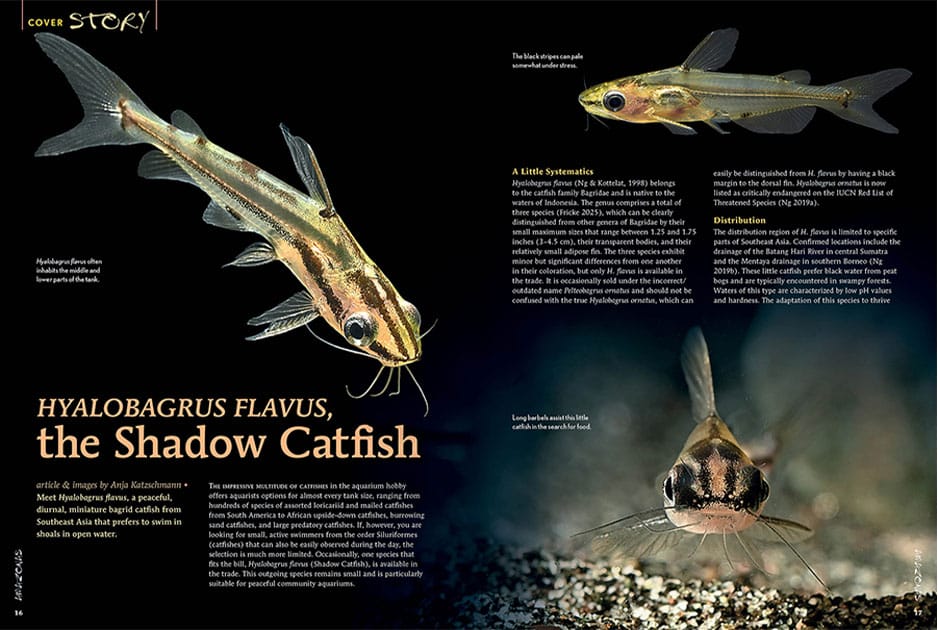
Shadow Catfish are peaceful and prefer to swim in mid-water in schools of at least five individuals in 60-80 cm aquariums. Their natural environment should be simulated using dim lighting, dense vegetation, and peat filtration. Sex differentiation is possible thanks to the longer genital papillae of males and the greenish eggs visible through the transparent bodies of mature females. Despite its presence in the hobby since the 1980s, the scarcity of breeding reports presents an exciting opportunity for aquarium enthusiasts to experience breeding in captivity for the first time. Of course, for more comprehensive information on Hyalobagrus flavus, you should purchase the Equatorial Fishes issue of AMAZONAS Magazine.
Sleeper Gobies, Fishes with Charm and Character, Recommended for the Aquarium
Author Florian Lahrmann introduces Sleeper Gobies (family Eleotridae), which he believes don’t receive the attention they deserve in the aquarium hobby. These gobies are common in tropical/subtropical waters and differ from true gobies (Gobiidae) in that their pelvic fins don’t fuse to form a suction disc. He notes that many breed in freshwater and that genera like Mogurnda and Tateurndina are ideal for aquariums because they swim in the water column, have bright colors, and provide parental care. He adds that these species can coexist harmoniously with top-dwelling fish like rainbowfish, especially in freshwater/Oceania aquariums1 (not saltwater aquariums).
As expected, the article focuses on Mogurnda adspersa (Southern Purple Spotted Gudgeon) from Australia and Tateurndina ocellicauda (Peacock Gudgeon) from New Guinea. M. adspersa is a hardy species that can reproduce even in hard water, laying its eggs on rocks, but the fry must be separated. The smaller and more peaceful T. ocellicauda stands out for its easy breeding and preference for live food; sex differentiation is quite easy thanks to the hump on the nape of the neck in males and the yellow belly in females.
A West African Beauty: Pelvicachromis drachenfelsi
In his article, author Wilfried Van der Elst discusses the West African dwarf cichlid Pelvicachromis drachenfelsi. The species was described in 2014 separately from the P. taeniatus ‘Wouri’ variant and prefers the soft, acidic waters (pH 6.0–7.0) of the Wouri River system in Cameroon. A striking member of the Equatorial Fishes group, this species is notable for its bright colors and bold parental behavior, particularly in females, which change according to their breeding cycle. The author notes that this species is far less aggressive than P. pulcher.
P. drachenfelsi is an omnivorous, bottom-feeding species suitable for mixed aquariums; fine sand is essential as they dig extensively. Breeding takes place in a small, excavated cave (coconut shells are recommended). The female initiates spawning, and the male protects the territory. Once the fry begin to swim freely, the parents keep them in a compact school, and with good nutrition (Artemia nauplii is recommended initially) and water care, they grow rapidly.
Awaous Lateristriga, The Remarkable West African Freshwater Goby
Freshwater Goby), a relatively unknown but highly adaptable species in the hobby world. Common in West African waters, this fish is tolerant of saltwater (euryhaline) and thrives in habitats ranging from slow-flowing freshwater to slightly brackish water. A significant member of the Equatorial Fishes group, the peaceful A. lateristriga is an omnivore, growing up to 22 cm and utilizing its camouflage ability by rapidly burying itself in the substrate.
The species is likely amphidromic; larvae develop in the sea, and adults return to freshwater to breed, making it a challenging breeding prospect for aquarists. A large aquarium (at least 1.5 m) and careful water management are essential for those wishing to keep this fish. Everything you need to know about the challenging-to-breed Awaous lateristriga is in the first issue of AMAZONAS magazine in 2026, Equatorial Fishes!
Aquascaping: Where Nature Meets Creativity
Frankly, as a web designer, the idea of using my profession to design an aquarium is very distant for me. However, Jen Williams, a Graphic Designer working in a similar field, addresses the art of aquascaping in her new “Green Horizons” column. Williams, who combines her professional creativity with her love of nature, views aquascaping as a living and constantly changing art form created inside a glass box using stones, wood, and plants.
Observations on the Behavioral Biology of the Blue-Eyed Pleco
Mark Regent shared his 15 years of observations and breeding attempts with the Blue-Eyed Pleco (Panaque cochliodon), stating that he has not yet achieved successful spawning from these endeavors.
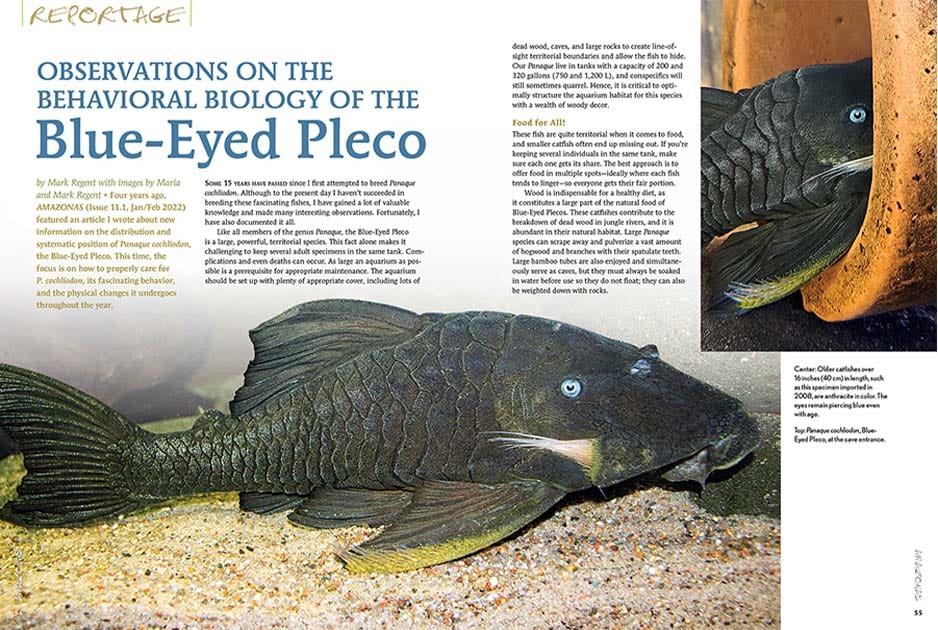
His most intriguing finding appears to be the cyclical physical changes the fish undergo throughout the year. Specifically, the defensive spines (odontodes) on their cheeks and fins become most impressive during the summer months. Additionally, during the presumed breeding season, the fish exhibit a slimy, yellowish coloration and small, white skin rashes. Regent observed that heavy water changes, which mimic low-pressure weather systems, activate the fish around their caves. He even documented a courtship-like quivering behavior, but these actions have, unfortunately, not yet resulted in successful spawning.
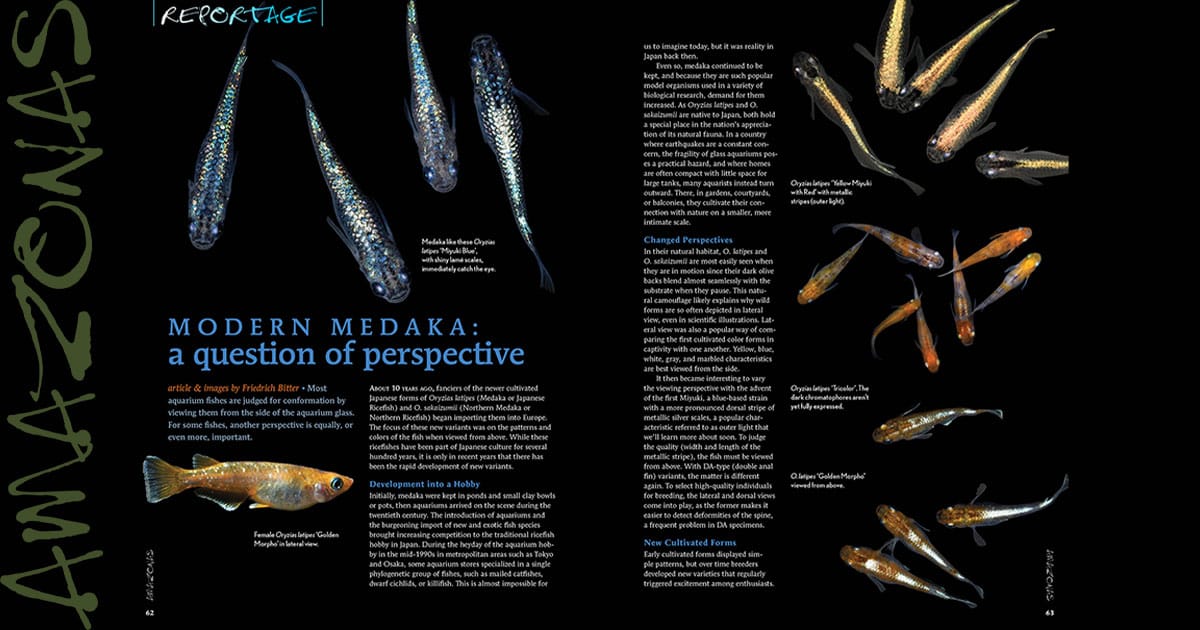
Modern Medaka: A Question of Perspective
Author Friedrich Bitter examines modern cultivated forms of Oryzias latipes and O. sakaizumii (Medaka). Traditionally viewed laterally, these fish now stand out for features developed for dorsal viewing (from above), such as metallic scales (lamé) and dorsal stripes (outer light). As part of Japan’s native fauna, Medaka are often kept in outdoor mini-ponds or pots due to earthquake risk and smaller homes.
However, the significance of Medaka extends beyond the hobby—even to the stars! Thanks to their hardiness and short generation time, they are used as model organisms in toxicity and genetic research. In 1994, they became the first vertebrates to mate and reproduce in microgravity aboard the Space Shuttle Columbia; they were also used on the International Space Station to study the effects on bone density. In short, this tiny fish is practically a space traveler, offering valuable contributions to biological research and environmental safety!
The Cellophane Swordplant, Echinodorus berteroi
According to an article by author Rudolf Suttner, the Cellophane Sword Plant (Echinodorus berteroi) is a delicate plant with translucent leaves that has been known in the aquarium hobby since the 1950s. This species, widespread from the USA to Argentina, has adapted to dynamic habitats, including the extremely hard and alkaline pools of Curaçao. Botanically, although considered one of the basal species of the Echinodorus genus by Lehtonen, it remained the sole representative of the genus after the 2018 revision by Christenhusz and Byng. You can find more information about this plant in the AMAZONAS Magazine / Equatorial Fishes issue.
The species typically grows as a short-lived wetland plant (helophyte), relying on seed propagation as its survival strategy. This allows it to survive even during long periods of drought. The author adds that it is easy to maintain in the aquarium, grows rapidly, and tolerates a wide temperature range (5–38°C). Its seeds germinate gradually; successful cultivation requires a nutrient-rich, loamy substrate and long lighting periods.
Reunion with Uruguay: Cichlids and Their Habitats
In his article, author Wolfgang Staeck examines Uruguay’s rich cichlid fauna and habitats. While the country doesn’t stand out in fish exports, the article shows it has a surprisingly rich cichlid diversity with 29 valid taxa. Habitats such as stream banks (arroyos) and Pampa ponds used for cattle watering, where the author collected specimens, host members of the genera Gymnogeophagus (Earth Eaters) and Australoheros.
The genus Gymnogeophagus exhibits two distinct reproductive strategies: mouthbrooders (G. gymnogenys complex) and substrate-laying cichlids (G. rhabdotus complex). The author notes that G. rhabdotus, featured in the AMAZONAS magazine’s Equatorial Fishes issue, is the most frequently encountered colorful cichlid. Large predators such as pike cichlids (Crenicichla and Saxatilia) are also common species in this region, and the author concludes that, despite habitat threats, it remains critically important for studying Uruguay’s subtropical aquatic life.
- Oceania is a geographical region encompassing Australia, New Guinea, New Zealand, and thousands of Pacific islands. In the aquarium hobby, when “Oceania Aquarium” or “Oceania Biotope” is mentioned, it generally refers to freshwater or brackish (slightly saltwater) species from this region; therefore, it is important not to confuse it with saltwater aquariums. ↩︎
AMAZONAS Magazine is one of the world’s leading print publications for the freshwater aquarium industry. If you’d like to subscribe and read all the content, you can start your Subscription Here. You can find the previous issue, Livebearers: Wild & Domestic / AMAZONAS Magazine Review September-October 2025, Here! We’re eagerly awaiting the next issue!
Join the Discussion! Do you have a question or a tip to share about “Equatorial Fishes / AMAZONAS Magazine Review” Whether you’re a beginner or a professional, we value your experience—leave a comment below to help our community grow!
Cover Photo Credit: Reef Network
References:
- AMAZONAS Magazine: Equatorial Fishes / Last Access Date: 12.12.2025